Building Secure and Reliable Systems: the seven chapters FDEs need
The book is free to read online, and seven of its 21 chapters map closely onto the work an FDE does on a client site.
In brief
- The book has 21 chapters in five parts. The authors wrote for several audiences, so individual chapters stand on their own.
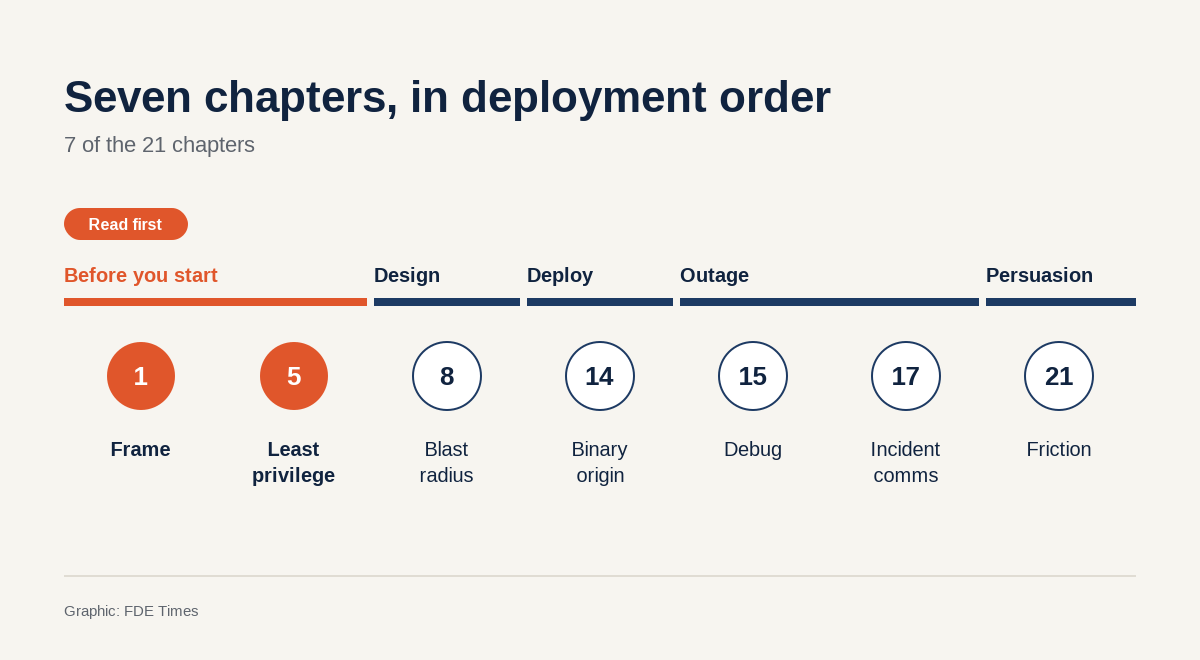
- The seven to read first are 1, 5, 8, 14, 15, 17 and 21, following the deployment from design and rollout to incident investigation and persuading the client.
- Three ideas to keep: security cannot be bolted on later, ask only for the access you need, and running degraded beats going down entirely.
“Can a system be considered truly reliable if it isn’t fundamentally secure?” That question opens Building Secure and Reliable Systems, written by Heather Adkins, Betsy Beyer, Paul Blankinship, Ana Oprea, Piotr Lewandowski and Adam Stubblefield and published by O’Reilly Media in 2020.
For an FDE, the question comes up almost every week. You ship code into an environment that is not yours and ask for access to data that is not yours. Then you take the midnight call when something you do not own breaks.
The client’s SRE and security teams will both scrutinize your work. This book helps you speak the language of each.
The good news is that you do not have to read all of it. The official table of contents lists 21 chapters plus a Conclusion, grouped into five parts: Introduction, Design, Implementation, Operations, and Organization and Culture.
The authors say they wrote for several audiences, not only security engineers, so reading chapters on their own is a sensible way to use the book. Its page on sre.google also links to a free “Read online” edition.
Seven chapters, in the order of a deployment
The diagram at the top arranges the seven chapters by the sequence of work on a client site rather than by chapter number: 1 and 5 before you start, 8 during design, 14 at deployment, 15 and 17 when an incident hits, and 21 when you need to persuade.
Chapter 1 sets the frame for the whole book. In the authors’ account, the main difference between reliability and security is the presence or absence of a deliberate adversary.
Put simply, a failed disk is a matter of probability, while an attacker actively hunts for the weakest point. Once that boundary is clear, you will know which questions to take to the SRE team and which to take to security.
Idea one: it cannot be bolted on after delivery
Chapter 1 treats reliability and security as emergent properties of a system’s design, unlike many other characteristics.
On a client site the consequence is concrete. If the demo runs on an all-powerful service account and an API call path with no fallback, you cannot patch security in the week before go-live.
At that point you have to redesign.
That is why decisions made in the first week carry more weight than any end-of-project checklist.
Idea two: ask for the right access, with the right scope
Chapter 5 defines the principle of least privilege: users should have the minimum amount of access needed to accomplish a task. The principle applies to people and systems alike.
To see how it works, take a hypothetical example that runs through the rest of this piece: you are asked to build an agent that reads order data from a client’s CRM to summarize complaints. The lazy approach is to request CRM admin rights “to move fast”.
The right approach is to request read-only access to exactly two tables, orders and complaints, granted to a dedicated service account for the agent and kept separate from your personal account.
The chapter also explains zero trust networking: sitting inside a company’s internal network does not automatically confer any special privileges. Many enterprise clients follow this model, so if you still assume “on the VPN means access to everything”, you may well be blocked just when you need to give a demo.
The career advice here is specific. On a CV, a line such as “designed scoped read-only access for a customer data integration, approved by the security team’s review” carries more weight than “experienced in security”.
If the FDE posting you are targeting mentions least privilege or zero trust, prepare a story like this for the interview. The interviewer will want to hear which permissions you requested and why, and has no need for you to recite the definition.
Idea three: running degraded beats going down
Chapter 8 covers failure domains, blast radius, defense in depth and controlled degradation. The line worth copying down: a severely degraded service is still better than an unusable one.
For the CRM agent, if the language model’s API goes down, the agent should display the raw, unsummarized list of complaints. It should not return an error page that leaves the whole customer service team waiting.
When the code ships, Chapter 14 calls for every build to produce binary provenance, an exact description of how that artifact was built. When the security team asks “where did this file come from?”, you can answer with a verifiable record instead of a promise.
The three most common first-week mistakes
Pulling the CRM agent example together, the three most common mistakes are all shortcuts that look harmless during a demo but each violate one of the book’s principles.
The common shortcut
- Request CRM admin rights to move fast
- Assume the VPN grants access to everything
- No fallback, so a dead API means an error page
What the book recommends
- Read-only on exactly two tables, via a dedicated service account (Chapter 5)
- Every access still needs its own authorization, per zero trust (Chapter 5)
- Show the raw complaint list when the model fails (Chapter 8)
All three are easy to fix in the first week and very expensive if left until go-live, just as Chapter 1 warns.
When an incident hits, the hard part is not the code
Chapter 15 teaches systematic debugging: gather data, form hypotheses about the cause, then test them. That discipline matters even more when you are investigating inside someone else’s system, where guessing and restarting things at random is not an option.
Chapter 17 addresses something every FDE will face: of all the technical challenges in incident response, communication remains the hardest. An FDE sits between their own company’s engineers and the client, so this chapter deserves a closer read than even the one on deployment.
Chapter 21 closes with an argument you will use repeatedly: the belief that improving security and reliability must create friction is a misconception. The next time the client’s team objects to a dedicated service account as “too much overhead”, you will have your answer ready.
Read Chapters 1 and 5 before your next deployment. Save the other 14, including the Chapter 11 case study on a publicly trusted CA, for the day a client asks a question you cannot yet answer.
Was this article useful?
Thanks for the feedback!
10 sources
- Building Secure and Reliable Systems - Google Books · 2020
- Building Secure & Reliable Systems (sre.google/books)
- Building Secure and Reliable Systems - Table of Contents
- Chapter 1: The Intersection of Security and Reliability
- Chapter 5: Design for Least Privilege
- Chapter 8: Design for Resilience
- Chapter 14: Deploying Code
- Chapter 15: Investigating Systems
- Chapter 17: Crisis Management
- Chapter 21: Building a Culture of Security and Reliability