The 11% of AWS's GenAI exam that matters most for FDEs
Studying by domain weight will get you a pass, but the eval experience AWS lists first in its own FDE job ad sits in the exam's lightest domain.

In brief
- Domains 1 and 2 account for 57% of scored content, so study them first to build a solid base.
- Safety content shows up in all four other domains, so in practice Domain 3 weighs more than its 20%.
- Domain 5 is only 11%, but it covers agent evaluation, close to the eval experience AWS's Sr FDE job ad lists first.
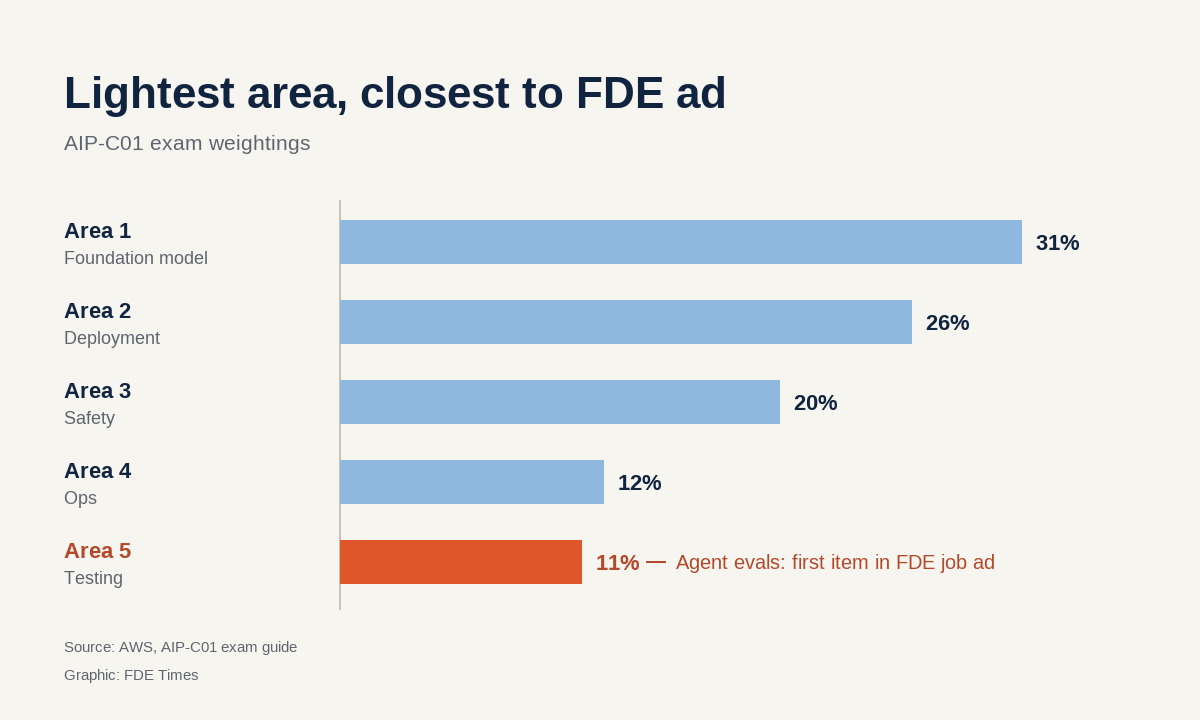
The AWS Certified Generative AI Developer - Professional exam puts 57% of its scored content into its first two domains. Agent evaluation sits in Domain 5, the lightest at 11%. It is also the part closest to eval experience, which AWS’s own Senior FDE job ad lists first among its AI tools.
The certification, exam code AIP-C01, is issued by AWS for GenAI developers. According to a timeline compiled by Hidekazu Konishi, beta registration opened on November 18, 2025, and the full version launched in 2026.
For anyone working as an FDE or hoping to become one, passing is only half the story. Study order decides what you walk away with after a few weeks of work: a certificate alone, or a certificate plus the skills an interview will probe.
An exam for people who have shipped
AWS describes the target candidate as someone with at least 2 years of building production applications on AWS or with open-source technologies, experience in AI/ML or data engineering, and 1 year of hands-on experience implementing GenAI solutions. The exam does not cover model development and training, advanced ML techniques, data engineering or feature engineering.
The questions therefore lean heavily toward plugging foundation models into existing systems, wiring tools to agents and proving that everything runs safely. If your FDE work is mostly about bringing off-the-shelf models into a client’s systems, much of the exam will match what you do every day.
The exam has 75 questions in 180 minutes, each with one or more correct answers. You can sit it at a Pearson VUE center or online with a proctor. According to the exam guide, only 65 questions are scored, on a scale of 100 to 1,000, with 750 needed to pass.
Compensatory scoring changes how you study
AIP-C01 uses a compensatory scoring model: there is no minimum score per domain, only an overall passing score. Multiplying the 65 scored questions by each domain’s weight gives a rough estimate (AWS does not publish these numbers): about 20 questions for Domain 1, 17 for Domain 2, 13 for Domain 3, 8 for Domain 4 and 7 for Domain 5.
On that arithmetic, a firm grasp of Domain 1 (foundation model integration, data management and compliance, 31%) and Domain 2 (implementation and integration, 26%) covers more than half the exam. Erick Mancz, writing about the exam on AWS Builder Center, observes that safety scenarios creep into all four other domains.
That makes Domain 3 (AI safety, security and governance) heavier in practice than the 20% on paper. The first three domains already add up to 77% by official weight, and if Mancz is right, the real share is higher still.
A study order for an FDE
Start with Domain 1, then move to Domain 2. Domain 2 contains the agentic AI and tool integration skills. Skill 2.1.7 spells out two options: Lambda to run stateless MCP servers for lightweight tools, and Amazon ECS for MCP servers that provide complex tools.
Say a client wants an agent that both looks up order status and runs a multi-step reconciliation workflow. The lookup needs only one short call, so it suits Lambda. The reconciliation workflow needs a long-running process that holds connections, so it leans toward ECS.
In the exam room, this scenario will most likely appear as a description of the client’s requirements with four architecture options, and you must pick the one that puts each tool in the right runtime. In real work, you will have to draw the same distinction when sketching the first architecture with the client.
Do not set aside a separate week for Domain 3. While studying each service in Domains 1 and 2, ask the questions as you go: where does sensitive data flow, who may call which tool, where do the guardrails sit. Then move on to Domain 5, and leave Domain 4 (operational efficiency and optimization, 12%) for last.
The 11% domain closest to the job ad
Domain 5 (testing, validation and troubleshooting) is only 11%, but it includes skill 5.1.7: building an agent performance evaluation framework. The skill covers measuring task completion rate and tool-use efficiency, using Amazon Bedrock Agent evaluations and scoring reasoning quality in multi-step workflows.
AWS’s Sr Forward Deployed Engineer job ad (Job ID 10517491) asks for experience with eval frameworks, agent tooling, RAG pipelines and prompt engineering. Eval tops that list. If passing is all you need, Domain 5’s roughly 7 questions will not decide much, but if you are aiming for an FDE role, this part deserves far more study than its weight suggests.
A good exercise is to take the order-lookup agent above, write a set of test questions with expected answers, and measure two numbers in the spirit of skill 5.1.7.
The first is the share of tasks the agent completes correctly; the second is the number of tool calls it makes per task. Change the prompt or the tool descriptions, run it again and compare.
Two mistakes that cost candidates needless points
The first mistake is skipping Domain 3 on the assumption that its 20% can be made up elsewhere. Compensatory scoring allows that in theory, but if Mancz is right that safety scenarios are scattered through the questions of the other four domains, skipping Domain 3 means losing points in many places.
The second mistake is cramming Domain 5 into the last few days by reading documentation. Mancz writes that no course can save someone who studies for AIP-C01 without running the services by hand. Agent evaluation is the hardest part to understand if you have never watched an agent go wrong and had to find the step where it failed.
The lab work is what you take to the interview
For an FDE, the advice to run labs carries an extra benefit: the lab output itself is what you bring to the interview. On your CV, do not list only the certification name.
Add a line describing a project, for instance an agent on Bedrock calling an MCP server running on Lambda, with an eval suite that measures task completion rate before and after your prompt changes. Reading that line, a hiring manager sees eval, agent tooling and prompt engineering, three of the four things AWS’s job ad names.
The certificate shows you understand AWS. An eval suite with concrete numbers shows you can get an agent running for real at a client’s site.
Was this article useful?
Thanks for the feedback!
7 sources
- AWS Certified Generative AI Developer - Professional (AIP-C01)
- AWS Certified Generative AI Developer - Professional
- Content Domain 2: Implementation and Integration
- Content Domain 5: Testing, Validation, and Troubleshooting
- Sr Forward Deployed Engineer, AWS Forward Deployed Engineering
- The AWS Generative AI Professional exam: what the blueprint doesn't reveal · 2026-05-07
- AWS Certification History and Timeline - Exams, Updates, Retirements, and Introduction · 2026-07-05