Anthropic steers FDEs to the Developer exam, not Architect
Two secondary sources agree, though the official track page could not be checked, and the Architect exam rewards engineers who have watched agent systems break.
In brief
- According to FourWeekMBA and nowucca, the FDE learning path on Partner Academy leads to Developer – Foundations rather than Architect.
- Developer describes someone who builds, integrates and ships agentic applications; Architect describes someone who designs agent systems.
- Both the learning path and the exams are open only to Claude Partner Network companies; Developer – Foundations gets a new exam from 7 December 2026.
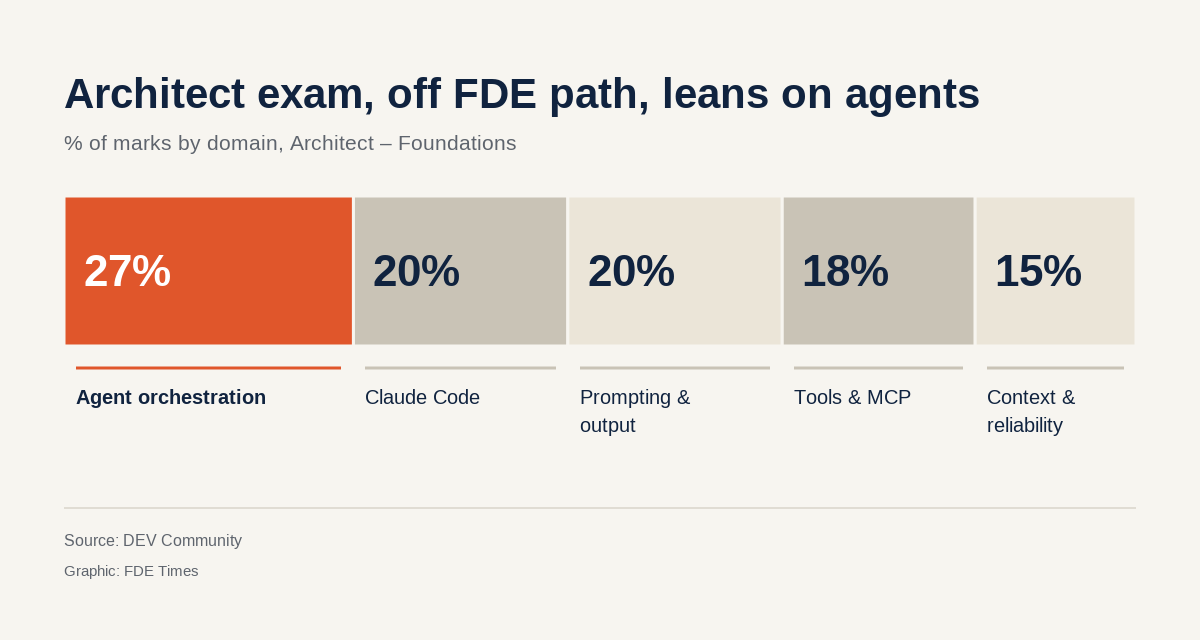
According to FourWeekMBA, the Forward Deployed Engineer learning path on Anthropic’s Partner Academy recommends the Claude Certified Developer – Foundations exam as the next step. That is a curious choice, given that the first technical certification Anthropic launched, in March 2026, was the Architect exam.
An independent analysis published on nowucca.com on 22 November 2026 also says the path prepares candidates for the Developer exam, and makes no mention of Architect. Both are secondary sources: the official learning path page returns a 403 error when loaded directly, so the claim could not be checked against Anthropic’s own material.
Even so, if you are an FDE or want to become one, two independent sources pointing the same way is a clear enough signal about which exam to take first. What remains is to understand what each Foundations exam tests, and which one matches the work you do on a client site.
Two exams that grade two different jobs
Anthropic introduced Claude Certified Architect, Foundations on 12 March 2026, alongside the announcement of the Claude Partner Network, and at the time the exam was open only to partners. Its Credly badge describes successful candidates as able to design and build production-ready applications with Claude.
On 23 July 2026, when it announced four role-based certifications, Anthropic positioned Architect – Foundations for solution architects who design and build agent systems. Developer – Foundations is for engineers who build applications with Claude. Credly describes those who pass Developer as able to build, integrate and ship agentic applications to production.
Look at the verbs. Architect opens with “design”. Developer stresses “integrate” and “ship”: wiring Claude into existing systems and getting it running for real, which is exactly the kind of work an FDE does on the client side.
The path does not start from zero, either. FourWeekMBA reports that the learning path page expects learners to have built software before and to have worked directly with client-facing teams. In other words, it is for people who already know the trade and need the Claude layer on top.
The Architect exam suits those who have handled real incidents
One candidate who passed the Architect exam, writing on the Udacity blog, observed that the exam favors people who have seen first-hand how these systems break, fail or become unreliable. The author of the Test Engineering Notes blog, who passed both Foundations exams, likewise argues that Architect is worth more to people who regularly make system-level design decisions.
A hypothetical example to practice that kind of thinking: a customer service agent looks up orders, processes refunds and answers policy questions. The longer the conversation runs, the more often the agent forgets the refund constraints and calls the order lookup tool by mistake. What do you fix first?
The easiest reflex is to stuff more instructions into the system prompt, but that does not reach the cause. Separate the two symptoms. Calling the wrong tool usually points to overlapping tool descriptions, while forgetting constraints as the conversation grows is a context management problem.
Only when the two groups of tasks are genuinely distinct, for instance when refunds need their own permissions and rules, is it worth considering splitting them into several agents, because the system becomes markedly more complex. That kind of judgment is hard to learn from a few hours of video. It comes from the times you have debugged a broken agent yourself.
The Developer exam is about to change, so plan ahead
Pearson VUE has announced that exams will be updated from 7 December 2026, naming Associate – Foundations, Developer – Foundations and Architect – Professional. Anyone sitting an exam from that date should study against the new exam guide. Architect – Foundations is not on the list.
For FDEs the consequence is concrete: the exam the FDE path leads to is the very one being revised. Study notes and practice questions shared online before December may no longer match the new exam, so treat the official exam guide as the reference.
Is the exam worth the effort? The author of Test Engineering Notes thinks Developer Foundations is worth taking for engineers already working with Claude. That is a personal view, but it fits how Credly describes the exam.
The biggest barrier is not the exam itself
According to AI Codex, only people at companies in the Claude Partner Network can enroll in the FDE learning path. The Pearson VUE page also states that the certification program is open to organizations in the network, and that certifications count toward the company’s partner tier.
That last detail matters to job seekers. A partner company has a reason to send its staff to sit the exams, because certifications help it move up a tier. In interviews, ask directly whether the company is in the Claude Partner Network, and whether employees can enroll in the courses and exams.
If your current employer is not a partner, the skills can still be learned through real work, just without the certificate to go with them.
The order to follow
According to a roundup by WenHao Yu, the program has five exams: Associate – Foundations, two Developer exams and two Architect exams, with Foundations and Professional levels for each role. Based on how the sources describe each exam, a sensible order for an FDE is to take the FDE learning path, pass Developer – Foundations, complete a few real deployments, and only then sit Architect – Foundations.
The reason has nothing to do with difficulty. Developer tests the building and shipping that FDEs do every day, while Architect grades judgment, and judgment comes from the systems you have seen fail.
On your CV, put the certificate next to evidence: a repo that integrates Claude into a real system, or a line describing an agent you took to production for a client. A badge says you passed an exam; recruiters want to know what you have shipped.
Was this article useful?
Thanks for the feedback!
11 sources
- $100 million for the Claude Partner Network · 2026-03-12
- Four role-based certifications for the people who put Claude to work for customers · 2026-07-23
- Claude Certified Developer - Foundations - Credly
- Claude Certified Architect – Foundations - Credly
- Anthropic's Forward Deployed Engineer path: 9.5 hours, and the 100 minutes that make it FDE · 2026-11-22
- Anthropic Lays Out Its FDE Training: 11 Courses in 9.5 Hours - FourWeekMBA · 2026-11-24
- Anthropic's Forward Deployed Engineer learning path: what's in it and who can take it — AI Codex · 2026-11-24
- Claude Certification Program by Anthropic - Pearson VUE
- Claude Certified Architect & Anthropic's 5 Certifications: Cost, Format, and How to Register (2026) · 2026-07-20
- Claude Certifications 2026: Exams, Preparation & My Experience — Test Engineering Notes · 2026-09-16
- The Claude Certified Architect Exam Explained by Someone Who Passed It · 2026-07-02