The architecture book FDEs should read before meeting executives
Gregor Hohpe wrote for software architects, but his elevator metaphor teaches the skill FDE job ads now ask for: moving between the boardroom and the engine room.
In brief
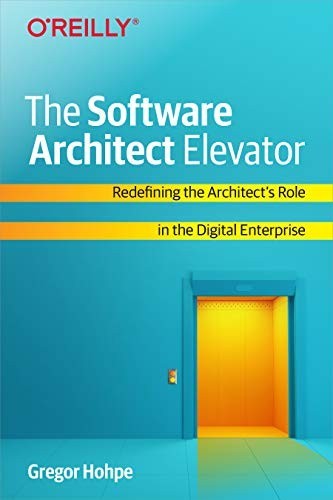
- Gregor Hohpe's The Software Architect Elevator (O'Reilly, 2020, 366 pages) has 41 short chapters about moving between the executive floor and the engine room.
- Buildkite's FDE job ad asks for exactly that skill: being in the room with both the client's engineers and its executives, and staying calm when an executive is frustrated.
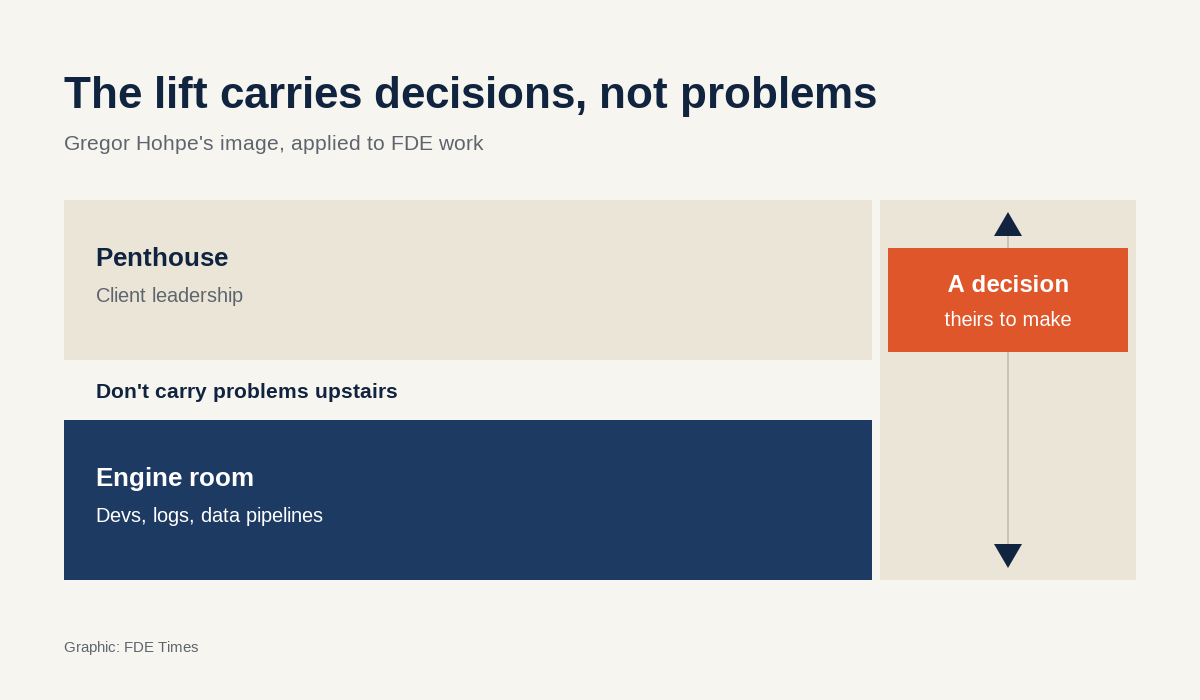
- Hohpe warns against using the elevator to move problems from one floor to another. For an FDE, that means bringing a specific decision upstairs.
Buildkite’s job ad for a Forward Deployed Engineer contains a phrase worth reading slowly. According to the ad, the person hired will be in the room with both the client’s engineers and its executives, and must stay calm when an executive on the client side is frustrated.
That sentence mentions no framework, language or cloud. It describes a different ability: holding a conversation on two floors of the same organization that sit very far apart. Gergely Orosz’s piece on FDEs in The Pragmatic Engineer goes further, quoting a role description that likens an FDE’s responsibilities to those of a startup CTO.
If you are an engineer with two to eight years of experience who wants to move into this work, you practice code every day. You rarely get to practice sitting between those two floors. The book most worth reading to build that skill was written for another profession altogether: software architecture.
A book for people who ride the elevator
The Software Architect Elevator by Gregor Hohpe, published by O’Reilly Media in 2020, runs to 366 pages. It expands on his earlier 37 Things One Architect Knows and is made up of 41 short chapters written for IT leaders, enterprise architects and software architects.
Three years before the book appeared, in an article on Martin Fowler’s site, Hohpe wrote that an architect’s main job is to ride the elevator between the penthouse, where executives sit, and the engine room, where systems run. He also observed that many people in the penthouse feel cut off from what is really happening inside their own organization.
Read that passage, then go back to the Buildkite ad, and the two describe the same job under different titles. That is why the book belongs on an FDE’s desk, and three of its ideas are worth taking to the client.
Covering many floors matters more than reaching the top
In a 2015 blog post, Hohpe wrote that an architect’s value should not be measured by how “high” they rise; what counts is how many floors they can span.
For an FDE this is a practical warning. Being invited into a meeting with a vice president can easily feel like success. But if you can no longer go downstairs and read logs with the client’s engineers, you lose the very thing that makes executives want to listen to you.
Hohpe puts it more bluntly: sipping champagne in the penthouse while the basement floods is no way to transform enterprise IT. At a client, the flooded basement is a broken data pipeline, stalled access requests, a test environment nobody owns.
Carry decisions in the elevator, not problems
The sharpest idea comes from a 2020 Thoughtworks technology podcast, in which Hohpe warns against using the elevator to move problems from one floor to another. He stops at the warning; what follows is how it applies to FDE work.
Take a hypothetical example. Your agent pilot is two weeks late because the security team hasn’t approved read access to the data warehouse, and the client’s product director is annoyed. Carrying the problem upstairs means saying, “We’re blocked on access.”
Carrying a decision upstairs means saying: “The pilot is two weeks behind because of read access to the warehouse. If you approve a sandbox with anonymized data, my team can carry on this week.”
The first sentence leaves the executive to find the answer. The second gives them a choice they have the authority to make. It is also how you stay calm in front of a frustrated executive, as the Buildkite ad demands: you bring something to decide, rather than one more worry.
Top-down governance damages what it means to protect
Kartick Vaddadi’s summary of the book highlights one of its points: imposing arbitrary “governance” from the top down does more harm than good. FDEs often land in the middle of exactly this kind of conflict, when leadership wants to issue an AI policy and the engineering team wants room to experiment.
Back at the same client, leadership plans to require that every prompt change go through a weekly review board, while the engineering team edits prompts almost daily. Objecting outright will only mark you as one of the engine-room crowd.
A better move is to bring a proposal upstairs: the board reviews only changes that touch customer data, and everything else goes through an automated eval suite whose results the security team can read.
Then you take the elevator down. You explain to the engineers that the board exists because leadership is worried about data leaks, so the eval reports must be clear enough for people who don’t write code to trust them.
The rules then follow how the system actually runs, and the engineers understand why the guardrails exist. You haven’t taken either floor’s side; you’ve given both floors the same version of the truth.
What to read, in what order
Start with “The Architect Elevator — Visiting the upper floors” on martinfowler.com, then read the 2015 post on Enterprise Integration Patterns. Both are short and give you enough of the picture to judge whether the book suits you. The Thoughtworks podcast episode works well for a commute.
Because the book is split into 41 short chapters, there is no need to read it cover to cover. A better approach is to pick the chapter closest to your current engagement and apply it that same week.
For your career, when you read job ads, look for words such as “executives” or “stakeholders” sitting next to “engineers”: that signals a role that needs elevator skills. On your CV, one line about a time you turned a technical blocker into an executive decision, with the outcome, is more persuasive than any self-description along the lines of “strong communicator.”
Hohpe wrote for architects, but today’s FDE job ads are looking for the person he describes: at ease in both the penthouse and the engine room, and aware of when to press the button for down.
Was this article useful?
Thanks for the feedback!
8 sources
- Open Library Books API: ISBN 9781492077541
- My Books: Architecture, Cloud, and More - The Architect Elevator
- The Architect Elevator — Visiting the upper floors · 2017-05-24
- The Architect Elevator (Gregor's Ramblings, Enterprise Integration Patterns) · 2015-01-15
- Architect elevator (Thoughtworks Technology Podcast) · 2020-12-24
- Summary of The Software Architect Elevator · 2022-10-28
- Job Application for Forward Deployed Engineer at Buildkite
- What are Forward Deployed Engineers, and why are they so in demand? · 2025-08-12