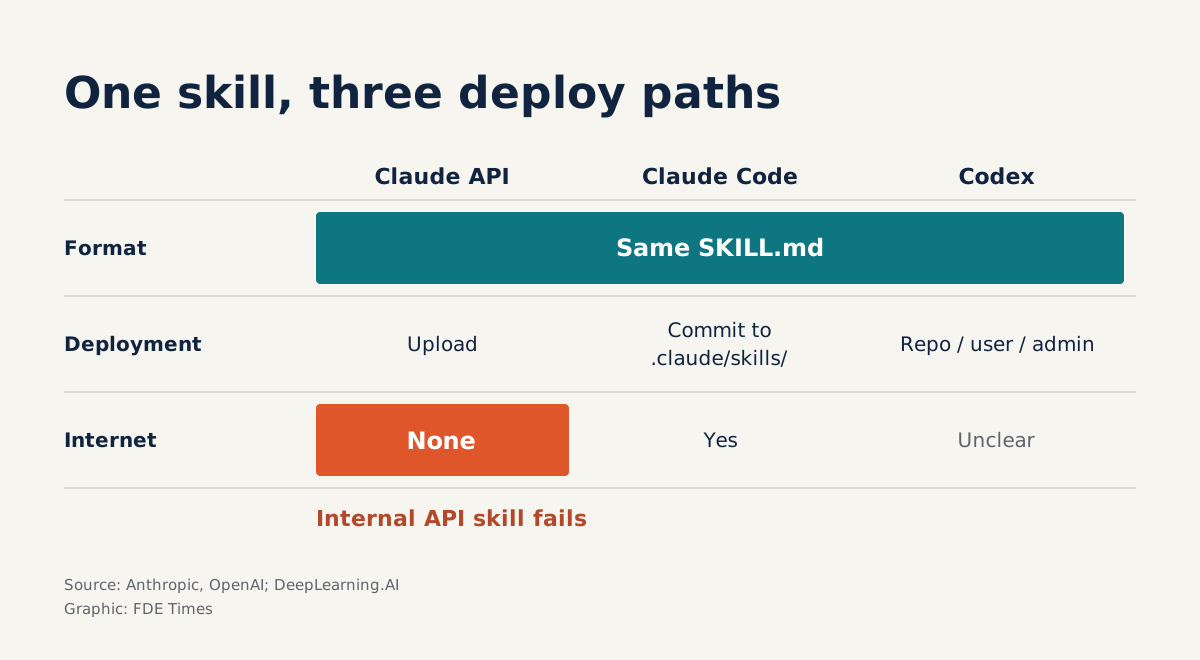
The skill format travels between platforms. Deployment does not
The two-hour DeepLearning.AI and Anthropic course is worth taking, as long as you also read each platform's own documentation.
In brief
- A Beginner-level course, 2 hours 19 minutes long, taught by Elie Schoppik of Anthropic, with three lessons dedicated to the Claude API, Claude Code and the Claude Agent SDK
- The SKILL.md format also carries over to OpenAI Codex, because Codex is built on the same open standard
- Each platform needs its own deployment: custom skills do not sync automatically, and network access and sharing scope differ
The landing page for the course Agent Skills with Anthropic makes a promise: skills follow an open standard format, so you write one once and deploy it on any agent that supports skills. The Claude API documentation carries a drier line: custom skills do not sync across surfaces, and uploading one in one place does not make it available anywhere else.
The two statements do not contradict each other. What travels is the format. Deployment, meaning upload, sharing scope and runtime environment, has to be redone on each platform, and for an FDE that is where customer projects tend to break.
The course is therefore still worth more than two hours of your time, provided you take it as an engineer about to be accountable for a system in production, not as someone watching a demo.
A short course, taught by Anthropic
DeepLearning.AI built the course with Anthropic and announced it on its community forum on 28 January 2026. The instructor is Elie Schoppik, Head of Technical Education at Anthropic. The course is rated Beginner, runs 2 hours 19 minutes, and the course page lists its most recent update as 17 July 2026.
The page says “10 Lessons” but the outline lists 12 items, so do not be surprised if your own count differs. The three most notable lessons are each dedicated to a platform: the Claude API (17 minutes), Claude Code (24 minutes) and the Claude Agent SDK (20 minutes). The page describes these lessons only briefly, so you cannot tell in advance how deeply they go into deployment.
DeepLearning.AI’s announcement describes skills as folders of instructions that extend an agent’s capabilities with specialised knowledge. For an FDE, that specialised knowledge is usually the customer’s business processes, gathered through customer discovery and something you want the agent to reuse every time.
First idea: a skill is just a folder
Anthropic’s engineering post of 16 October 2025 defines a skill as a folder containing a SKILL.md file. That simple definition has immediate practical consequences. In Claude Code, personal skills live in ~/.claude/skills/, while project skills live in .claude/skills/.
Because they sit inside the repo, project skills get committed, reviewed in pull requests and handed over with the source code. Knowledge about the customer no longer lives in one person’s head.
Second idea: the format travels to other vendors too
“Write once” is the course’s marketing line, but there is independent evidence for it. Anthropic says skills run across four of its products and has published the format as an open standard, and the agentskills.io site confirms that origin. More convincing still, OpenAI Codex builds its skills on the same standard, with SKILL.md requiring name and description.
If a customer uses both Claude and Codex, you do not have to rewrite the instructions. Because Codex requires the name and description fields, write them carefully from the start if you want the skill to move to Codex without edits.
Third idea: deployment must be redone on each platform
Picture a customer whose backend calls the Claude API, whose engineering team uses Claude Code, and where another group uses Codex. You have one skill folder, but three deployment paths.
On the API, you upload the skill and it is shared across the whole workspace. With Claude Code, you commit it to .claude/skills/. In Codex, you choose whether to place the skill at the repo, user, admin or system level, or distribute it through a plugin if you want it used beyond a single repo.
The Claude API documentation spells out how the two environments FDEs meet most often differ.
| Claude API | Claude Code | |
|---|---|---|
| Network and external APIs | None | Yes, like any other program on the machine |
| Installing packages at runtime | Not allowed | Documentation states no such limit |
| Sharing scope | Whole workspace | Personal folder or per project |
| Sync with other surfaces | No automatic sync, upload separately | No automatic sync |
Try putting a concrete skill into that table. Suppose the skill calls an internal API to fetch the customer’s product catalogue. It works in Claude Code because there is network access, but once uploaded to the API it breaks, because there the skill cannot make outbound calls. The format is unchanged; only the environment differs.
The Claude documentation also advises treating skills like software installed on a system, and links to a separate page on governance, vetting and deployment at organisational scale. The very existence of that page shows deployment is a distinct discipline, outside the promise about the format.
What order to study in, and what to put on your CV
Read Anthropic’s engineering post “Equipping agents for the real world with Agent Skills” first, then watch the course. After the three platform lessons, open the Agent Skills overview page in the Claude API documentation straight away to fill in what the course page does not cover. If the customer uses Codex, also read OpenAI’s Build skills page.
The most worthwhile exercise is to deploy one skill on two platforms and record everything you had to change. On your CV, do not just list the course name. Write one specific line, such as “deployed the same skill to Claude Code and the Claude API, working around the no-network limit”.
A certificate shows you watched the whole course. A README that states clearly where the skill does not run shows you have actually deployed it.
Was this article useful?
Thanks for the feedback!