The guardrails course that stops just short of production
DeepLearning.AI's 1 hour 42 minute course with GuardrailsAI is worth taking for its notebook lessons; running guards as a service for a client is left to further reading.
In brief
- A short beginner course from DeepLearning.AI and GuardrailsAI, taught by Shreya Rajpal, that needs only basic Python
- Its biggest value is the NLI-based hallucination check and the habit of building guards around each client's specific risks
- The course stops at the notebook, so read up on Guardrails Server before deploying for a client
A customer service chatbot answers fluently, quotes the internal documents correctly, and then, out of nowhere, praises a competitor’s product. For an enterprise client, one answer like that is enough to halt a whole project. DeepLearning.AI’s course Safe and reliable AI via guardrails was made to deal with exactly this kind of failure.
The course was built with GuardrailsAI and is taught by Shreya Rajpal, the company’s founder and CEO. The course page lists its most recent update as 17 July 2026. It runs 1 hour 42 minutes, with 10 videos, 7 code examples and one graded quiz, is pitched at beginners, and asks only for basic Python.
What makes it worthwhile for an FDE is that it does not stop at getting a RAG chatbot to work; it teaches how to make one safe enough to switch on for real users. Most of the course is worth your time. The one thing it does not teach is taking guards into production, and that part you will have to read up on yourself.
The root problem is probability, not the prompt
The course frames the problem in one short sentence: LLM output is probabilistic by nature. From there it defines guardrails as safety mechanisms and validation tools built into an AI application. That framing is worth keeping, because it decides what you should promise a client.
Picture a bank running a chatbot that answers 1,000 questions a day. Suppose the prompt is so good that only 2% of answers are fabricated: 20 customers still get wrong information every day.
More prompt work can push that number down, but it cannot get it to zero. What you can sell the client is a layer of checks that catches those 20 answers before their customers read them.
Three ideas worth taking to a client
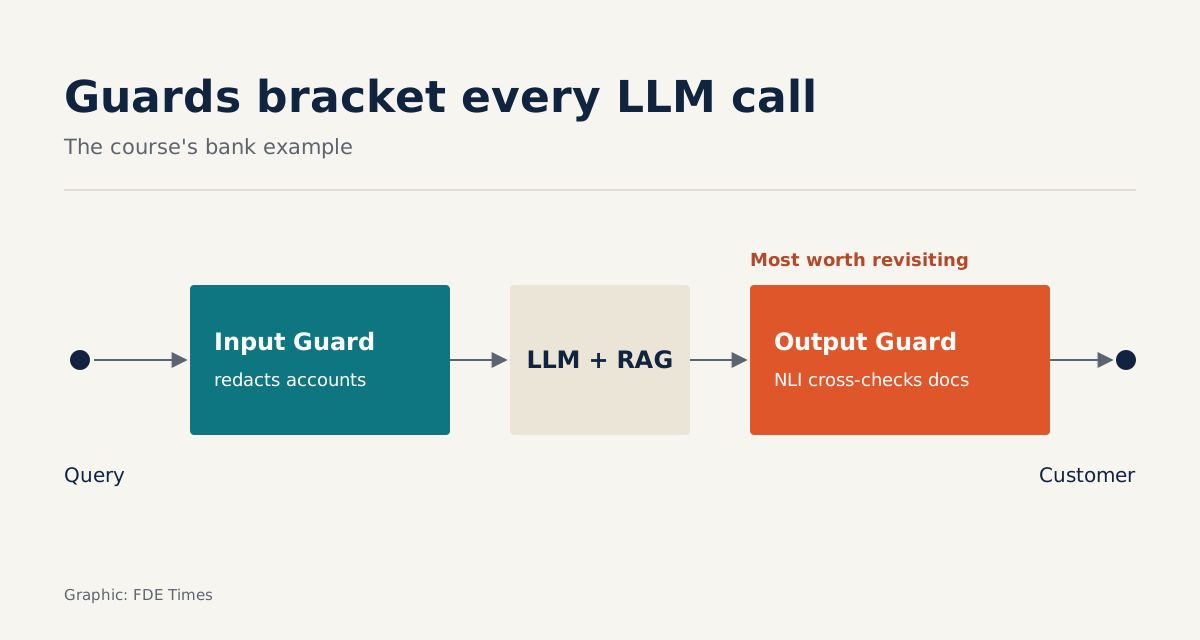
The first idea is to put guards at both ends. The open-source Guardrails AI framework is built around an Input Guard and an Output Guard, used to detect, quantify and mitigate risk.
Guardrails Hub offers prebuilt validators, and several validators can be combined into one guard. In the bank example, the Input Guard would filter out account numbers a customer pastes into the chat box by mistake, while the Output Guard checks each answer before it goes out.
The second idea, and the lesson most worth rewatching, is checking for hallucinations with Natural Language Inference. With RAG, what needs checking is whether each claim in the answer is supported by the documents just retrieved, not merely whether the model produced an answer.
Knowing how to automate that comparison is a skill you can carry into any RAG project, even one that does not use Guardrails AI.
The third idea is to build guards around each client’s specific risks. The course has separate lessons on keeping a chatbot on topic, preventing PII leaks and blocking mentions of competitors.
The Hub lists 65 validators, including Detect PII, Toxic Language and Competitor Check, which match the lessons. In customer discovery, ask the client which answer would get them summoned by the legal department: the list of validators you need is in their reply.
What you can skim
If you have built RAG before, the opening lessons on RAG failure modes will feel familiar, and you can watch them at speed. Don’t skip the lesson where you build your first guard, though: that is where you learn how the library organises validators. The final quiz is a useful self-check, but not something to put on a CV.
The real gap lies elsewhere. The hands-on project is a RAG customer service chatbot that runs entirely in a notebook. At a client, a guard has to run alongside an existing system used by several teams.
At that point the question is no longer whether the guard catches errors. You have to agree how much response time each validator may add, which team is accountable when a guard blocks something it should not, and whether, when the guard itself fails, the system blocks every answer or lets them all through.
What to read once you finish
In a sensible order: watch the course first, then read the README of the guardrails-ai repo on GitHub to see where the Input Guard and Output Guard sit in the code. Next, browse the Hub to know which validators already exist before writing your own. Finally, read the announcement of Guardrails Server in version 0.5.0, released in July 2024.
Guardrails Server lets you run guards as a service and provides an endpoint compatible with the OpenAI SDK. For an FDE, this is the most valuable detail. A client application that already calls an OpenAI-style API can be routed through the guard with almost no change to the calling code.
One more thing to do before proposing it: measure the latency each validator adds on the client’s real data, because an NLI step run on every answer is not free.
There is also a small legal detail that can save weeks: the library is licensed under Apache-2.0. When the client’s procurement team asks about open-source licences, you can answer on the spot.
Turning the course into a line on your CV
A certificate for a course under two hours long persuades nobody. What persuades a hiring manager is a small repo: a RAG chatbot over a public document set, with an Input Guard that blocks PII and an Output Guard that checks for hallucinations with NLI, plus a table showing how many answers were blocked and why.
When reading FDE job ads, look for phrases such as guardrails, AI safety, PII or production LLM. If an ad contains them, a repo like this is direct evidence that you have done exactly the work they need.
On your CV, write in terms of results, for example “built a guard layer for a RAG chatbot that blocks PII leaks and unsupported answers”; that carries more weight than the course title.
By the end, you will know how to catch errors in a notebook. Putting the same guard layer into a client’s system, running on real data without slowing the product down, is the part no course will do for you.
Was this article useful?
Thanks for the feedback!