Postman's Student Expert badge is gone, and FDE CVs need proof instead
The course's API fundamentals are still worth learning, but the evidence on your CV should be something you built yourself and a recruiter can open.
In brief
- Postman has shut down its Student Program, removed the Student Expert course from Postman Academy and no longer supports the badge-claiming step.
- Even when it was running, the badge only showed that you had finished a self-paced course on API fundamentals; it said nothing about working with customers.
- On an FDE CV, replace the certificate line with a project that calls a real API, with a number, a README and a link.
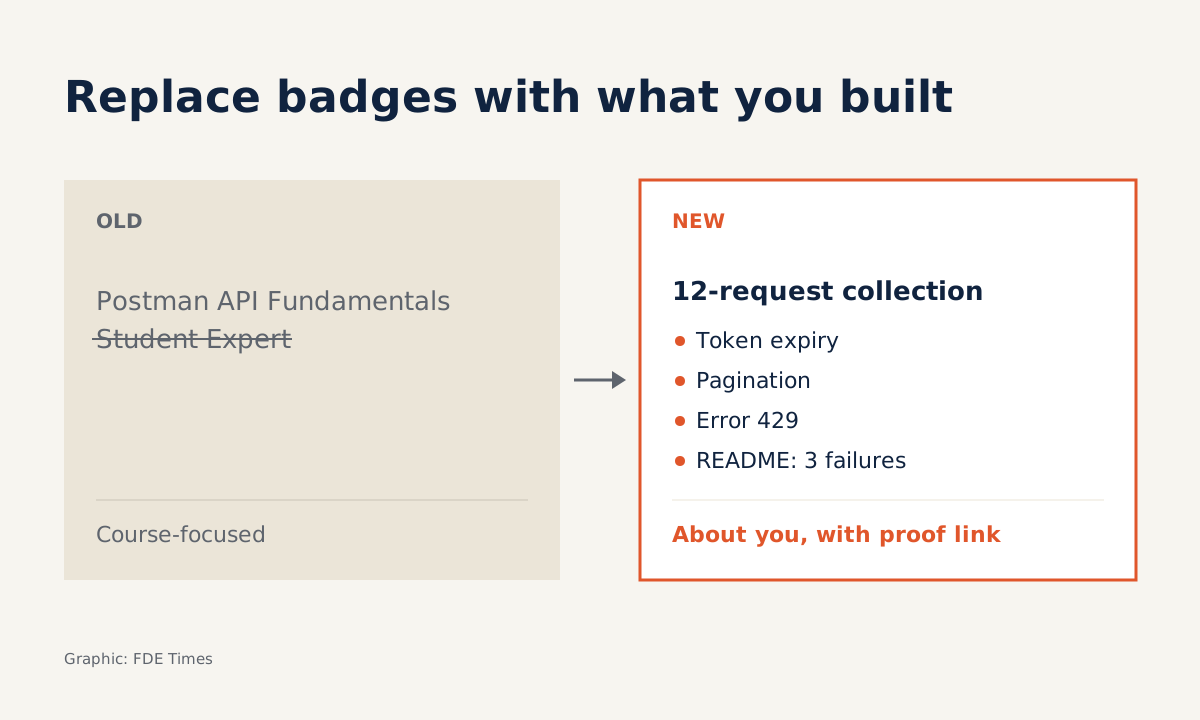
Many technology students once added the same certificate to their LinkedIn profiles: Postman API Fundamentals Student Expert. On 23 March 2026, a notice on Postman’s community Help Hub ended it in one short sentence: the Student Program had been officially discontinued.
The Student Expert course was removed from Postman Academy at midnight that day. Postman’s explanation was that, after an interface change, the final step (sharing a collection to claim the badge) was no longer supported. Anyone who finished by 2 March can still find the badge in their Parchment backpack.
The warning signs came earlier. A community thread in early March showed that badge claiming had already broken for Free plan accounts before the deadline, while a user on a paid plan could still claim it.
If you were planning to take the course to add an “API skills” line to an FDE job application, drop the plan. The more useful question is how much that certificate line ever proved, and what should replace it.
One CV line, written two ways
Picture two lines on the same CV. The first: “Postman API Fundamentals Student Expert”.
The second, an illustrative example: “Built a 12-request collection against a public payments API, handling expired tokens, pagination and 429 errors; README documents how to run it and 3 failure cases encountered.” This line has a link to open and check, gives an interviewer something to ask about, and stays standing whichever course shuts down.
The FDE CV guide from Aced (formerly Exponent) sets a rule that every bullet should end with a number. Scaler likewise sets a weak line, “Built a data pipeline for customer reporting”, beside a strong one that spells out the scope: a Python pipeline pulling data from three of the customer’s sources. The first line above fails both tests.
It is weak because it describes the course, not you. In 2022 Postman renamed the badge to its official title, API Fundamentals Student Expert Certification, because “Student Expert” left no room for higher-level certifications. To earn the badge, issued through Badgr, learners had to complete two courses: Intro to APIs and Postman, and the certification course.
Postman described the programme as a self-paced, hands-on curriculum to raise “API literacy”, open to students of any discipline. Postman itself promoted the badge as something to put on LinkedIn or a CV. It is evidence of a foundational skill that suits a second-year student, but it says nothing about how you work with customers and deploy for them.
That is exactly what FDE recruiters want to know. When a customer’s API returns something that does not match its documentation, how do you cope? An introductory badge cannot answer that.
Without an FDE title, where does the evidence go?
Aced notes that a Projects section is especially valuable for candidates who have never held an FDE title. Scaler adds that a portfolio, such as a repo with a proper README, should show what a two-page CV cannot hold.
So the sensible order is: learn API fundamentals properly, build a project that calls a real API, write a CV line with a number, and finish with a README so a recruiter can check it themselves.
If the project has real users, say a club or a shop run by someone you know, state that you talked to them. Aced advises being explicit about working with users or stakeholders, because that is the other half of the FDE job.
What should a collection README look like?
Below is an illustrative template for the public payments API in the example above.
# Collection: Payments API (trial version)

How to run
- Import the collection and the environment file
- Set the API_TOKEN variable in the environment; do not put the token in requests

Authentication
- Token sent via the header Authorization: Bearer {{API_TOKEN}}
- Case encountered: token expiring mid-run returns 401; the script stops and reports it clearly

Pagination
- The API returns a cursor in the response; the next request reads that cursor
- Check: the last page has no cursor and the loop stops correctly

429 errors (rate limit exceeded)
- Read the Retry-After header, wait the full time, then retry
- Log the number of retries in each run

Not done yet
- Not tested with more than a few pages of data
The last section matters as much as the three above it. When you write down your own limits, the interview has its next question ready, and you are the one steering the conversation. Prepare one more concrete case as well: a time the API returned wrong results and how you traced the cause.
Three ideas worth keeping from the closed course
First, API fundamentals still come first. The “API literacy” goal Postman set remains right: reading requests and responses, understanding status codes, headers and authentication. If this is a weak spot, learn it before agents or RAG.
Second, learn by doing. The course was built around hands-on exercises, and that is the way of learning that suits FDE work. Reading documentation will not help you remember how a system behaves when a token expires mid-run; calling it yourself will.
Third, learning and proving are separate jobs. Use a course to learn, then use your own work to prove it. When an FDE job ad includes a phrase such as “integrate with customer systems”, put a link to your collection right next to the skills line.
Nobody issues the Student Expert badge any more. The habit of calling an API, writing down what happened and making it reproducible for others is still something you carry into every interview.
Was this article useful?
Thanks for the feedback!
6 sources
- Important: Update regarding your Postman Student Expert course - Help Hub - Postman Community · 2026-03-23
- Will I receive the Badge - Help Hub - Postman Community · 2026-03-10
- Postman Student Programs update: new certification and more | Postman Blog · 2022-10-14
- Start the school year strong with the Postman Student Expert Program | Postman Blog · 2022-10-19
- Forward Deployed Engineer Resume: Examples & Skills (2026) - Aced (formerly Exponent)
- The Forward Deployed Engineer Resume and Portfolio That Actually Wins Interviews · 2026-10-05