Snorkel AI hires FDEs for Data-as-a-Service: the core job is building evaluators, base $180,000–$320,000
At a company that sells data to AI labs, forward deployed engineers still integrate systems. Their main job, though, is to decide what counts as good data and prove it with measurements.

In brief
- Snorkel describes the DaaS team's FDE position as an engineering delivery role: take a customer's vague need and return production-grade data, with evaluators and quality measurement systems at the core of the work.
- The $180,000–$320,000 range spans both Senior and Staff levels and is base salary only, before variable bonus and equity.
- A research Director role in the same team pays a base of $228,800–$403,200 and also centres on specification and evaluation standards, so in this team eval is a paid skill at every level.
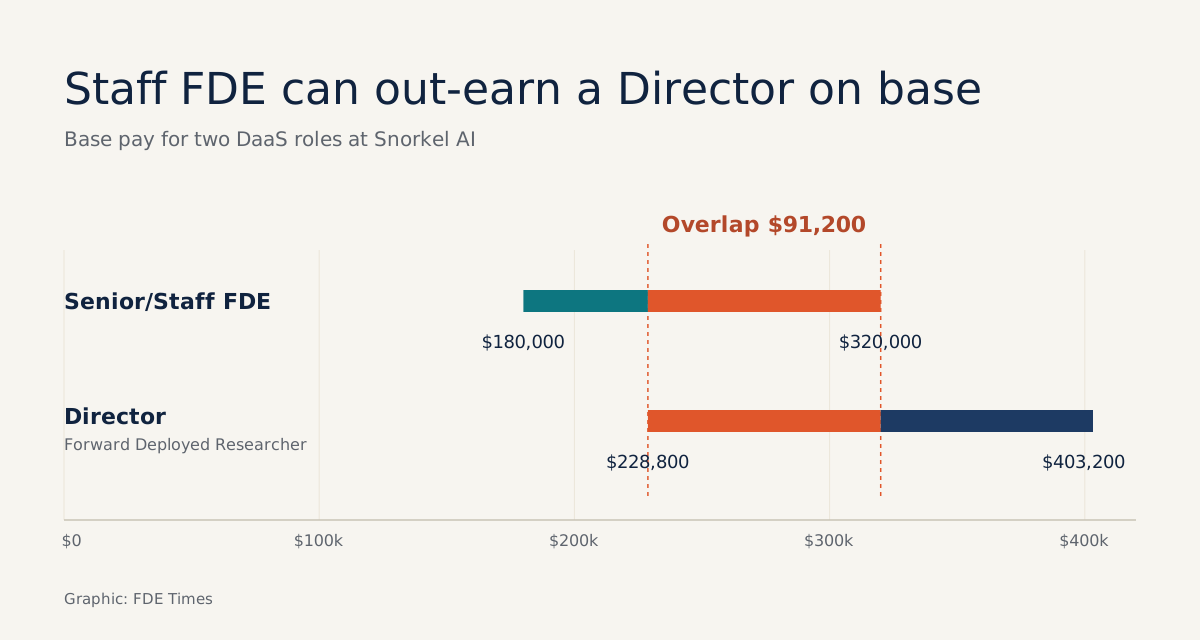
Snorkel AI updated its job posting for a Senior/Staff Forward Deployed Engineer on its Data-as-a-Service team on 29 October 2026, with a base salary of $180,000 to $320,000.
The top of the range is nearly 1.8 times the bottom. But the job description deserves a closer read than the numbers. The posting still asks for experience integrating systems through APIs, yet the work it puts first is building evaluators and measuring data quality.
Snorkel calls itself a “frontier AI data lab”. It was spun out of the Stanford AI Lab in 2019. Its homepage says it sells training data and specialised environments to frontier AI labs and AI teams, including Data Series, custom data development and specialised agents.
When what the customer receives is a dataset rather than a software system, “deployment” means something quite different. That makes the posting worth reading even for engineers with no plans to apply to Snorkel: it shows a kind of FDE role in which eval sits at the centre of customer work.
When the product is data, what does an FDE deliver?
Snorkel describes the position as an “engineering delivery” role: taking customers’ still-vague needs and turning them into production-grade data. The FDE belongs to a team coded “310 - DaaS FDE”, works closely with the DaaS Delivery Operations team and also provides technical support to Delivery Managers.
A company press release dated 22 September 2026 explains why this takes a real engineer. Snorkel says its products are expert-level agentic tasks, environments and rubrics, which take even the best people hours, sometimes days, to build.
A product that hard to make cannot be shipped on a “finish it and send it” basis. Someone has to stand between the customer and the data production line, understand what the customer wants and verify that the right thing was delivered.
How a vague request passes through an FDE’s hands
Imagine an AI lab telling Snorkel it needs “data to help an agent get better at invoice reconciliation”. That sentence is not enough to produce anything. The FDE’s first job is to write a specification: which steps a task involves, what the input looks like and what counts as “done”.
The next step is the rubric, and this is where mistakes come most easily. Suppose each solution has three steps: read the correct invoice line, match it to the purchase order, then compute the discrepancy.
If the rubric checks only the final number, a solution that reads the wrong line and matches the wrong order but happens to reach the right total still passes, and the customer will train its model on exactly those flawed solutions.
The evaluator turns the rubric into code that runs across a whole batch. A minimal version might look like this:
def grade(sample, gold):
    checks = {
        "read_lines": sample["lines"] == gold["lines"],
        "match_po": sample["po_match"] == gold["po_match"],
        "final_diff": abs(sample["diff"] - gold["diff"]) < 0.01,
    }
    return all(checks.values()), checks
Run this function on 50 samples and you get two numbers to compare: the pass rate when only final_diff is checked, and the pass rate when all three steps are checked.
The gap between them is the amount of flawed data that final-answer grading lets through. The FDE then uses synthetic data to fill in the missing kinds of cases, and only then delivers the dataset.
Snorkel’s posting lists exactly that chain of work: building and deploying evaluators, designing quality measurement systems, generating synthetic data, delivering datasets and writing production specifications.
Eval is the backbone, at every level
In the same Data-as-a-Service team, Snorkel is also hiring a Director, Forward Deployed Researcher, with a base of $228,800–$403,200. The role’s stated remit is to set and uphold technical standards for specifications, evaluation frameworks and customer deliverables.
Reading the two postings side by side reveals something neither says on its own: the engineering and research tracks differ in scope of influence, not in subject. The FDE writes specifications and evaluators for each project; the Director holds the common standard for every specification and evaluation framework.
The two salary ranges also overlap between $228,800 and $320,000, a band $91,200 wide. A Staff FDE at the top of the range could therefore earn a higher base than a Director at the bottom of theirs. In this team, earning more does not necessarily mean moving into management, provided your eval skills run deep enough.
$180,000–$320,000 is not your number yet
The posting combines the Senior and Staff levels, so the range spans two career grades. Treating the midpoint of $250,000 as your expectation is the wrong reading: the level you are placed at decides which half you land in.
It is also base salary only. The posting mentions a variable bonus and says most offers include equity and benefits, so two offers with the same base can still differ considerably once everything is added up. The real negotiation is over levelling, not the top figure.
Who fits the role, and how to prepare
Snorkel asks for at least five years of experience in data science, data engineering, ML engineering or solutions engineering, along with strong Python and SQL and experience integrating systems through APIs.
That list leaves the door open to several starting points: a data engineer who has built data-quality pipelines has as good a chance as an ML engineer. What sets candidates apart is whether they can show they know how to measure quality.
The quickest way is to build a small end-to-end project like the invoice example above, with a short report showing that the evaluator catches errors that final-answer grading misses. A project like that maps directly onto the responsibilities in the posting, giving you something concrete to talk about in interviews.
On your CV, write in terms of measured results rather than listing tools, along the lines of: “Designed a rubric and evaluator for N agent data samples, finding that X% of solutions had wrong intermediate steps despite a correct final answer”, using figures from your own project.
In Snorkel’s DaaS team, the question “is this data good enough yet?” is paid for from Senior all the way to Director. If you want to target roles like these, start with an evaluator that runs on 50 samples, not with a certificate.
Was this article useful?
Thanks for the feedback!
4 sources
- Senior/Staff Forward Deployed Engineer - Data as a Service (Snorkel AI, Greenhouse) · 2025-10-24
- Director, Forward Deployed Researcher - Data as a Service (Snorkel AI, Greenhouse)
- We build the data that pushes the frontier (Snorkel AI)
- Snorkel AI Raises $350M to Scale the Data Factory for Frontier AI · 2026-09-22