FDEs at Owkin: juniors and seniors share a stack but carry different responsibility
Two job ads from the same pharma AI company show that moving from junior to senior needs no new framework. It means owning what you build for the customer.
In brief
- Junior and senior FDEs at Owkin both need strong Python, use of coding co-pilots and experience with LLMs and agentic AI frameworks.
- Juniors need 2+ years of backend work and support engagements alongside more experienced colleagues. Seniors need 5+ years, embed with customers and turn proven patterns into components, tools and playbooks.
- Seniors also mentor juniors and join the team's shared on-call rota, meaning they own the systems they build once those systems run in production.
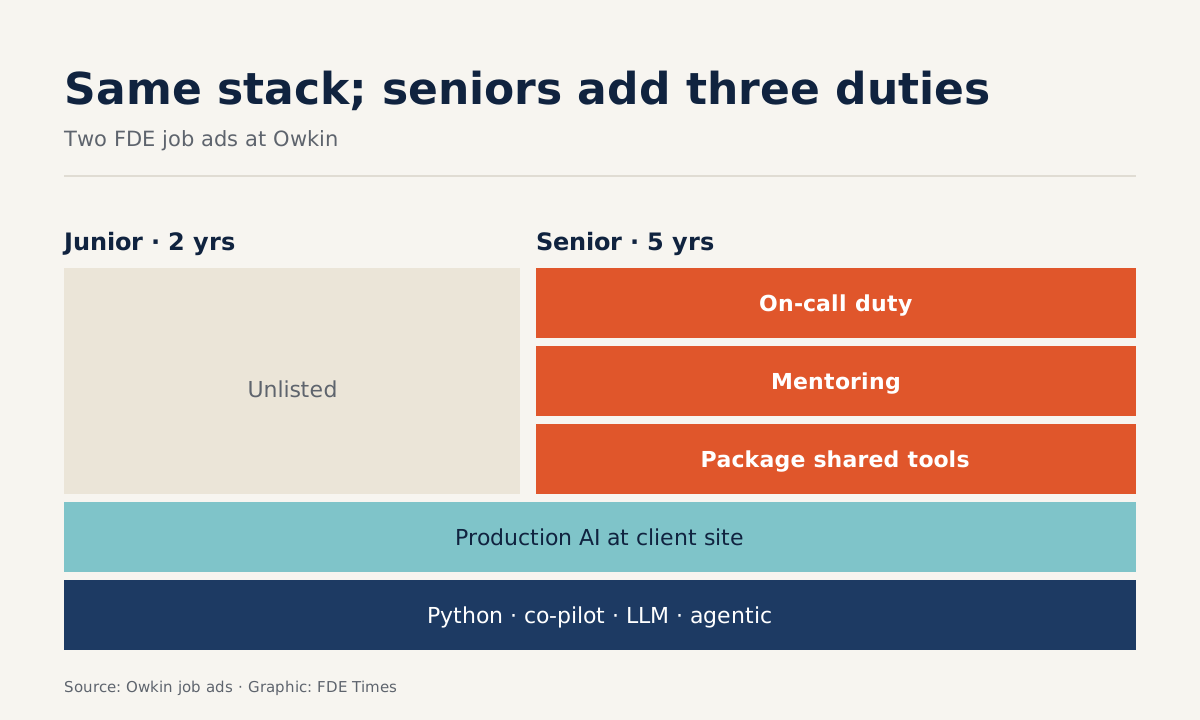
Owkin is hiring for two roles with the same title, Forward Deployed Engineer: one junior, one senior. Set the two ads side by side and the technical requirements almost match. Both ask for fluency in Python, comfort with coding co-pilots and experience with LLMs and agentic AI frameworks.
The difference lies in the remaining lines. The senior ad asks for more years of experience, describes customer work with stronger verbs and adds three duties the junior ad does not mention: turning solutions into reusable assets, mentoring juniors and being on call.
For engineers with two to five years of experience who want to become FDEs, this is worth noting. Moving up does not require learning another framework. It requires showing that you own what you build, both once it runs at the customer’s site and when others need to reuse it.
What does Owkin sell, and what do FDEs build on?
Owkin was founded in Paris in 2016 and became known early for federated learning, a technique that lets several parties collaborate without moving or sharing their data. The data stays with its owner.
In May 2025 the company launched K Navigator, an agentic research environment that Owkin describes as a “playground” where researchers can explore, refine and validate hypotheses.
On 16 October 2025 the next product, K Pro, arrived: a co-pilot for biopharma where enterprise and academic customers can securely upload their proprietary data.
FDEs work on this foundation. According to the junior ad, the job is to design, build and deploy production AI systems on Owkin K. The senior ad states that a significant share of the work takes place on customer premises.
The ads do not explain why the work must happen on site, and since K Pro lets customers upload data, the reason is unlikely to be that “the data cannot leave”. A more plausible reading: connecting agents to sensitive data scattered across a customer’s systems is easier when sitting next to the people who control that data.
Whatever the reason, FDEs here do more than write prompts. They connect an agentic system to a customer’s sensitive data, and they are the ones present when that connection breaks.
Same stack, different roles
Lay the two ads out row by row and the overlaps and gaps become obvious.
| Criterion | FDE (junior) | Senior FDE |
|---|---|---|
| Minimum experience | 2+ years, backend-leaning | 5+ years, backend-leaning |
| Tools and techniques | Python, coding co-pilots, LLMs, agentic frameworks | Same as junior |
| Relationship with customers | Supports engagements alongside more experienced colleagues | Embeds with customers to solve high-impact problems |
| Main deliverable | Production AI systems on Owkin K | Reusable components, tools and playbooks |
| Additional responsibilities | None listed | Mentoring junior FDEs, shared team on-call |
| Place of work | Significant share on customer premises | Significant share on customer premises |
The tools row matters most precisely because it does not differ between the columns. Owkin does not split levels so that juniors use simple tools and seniors advanced ones. Everyone must be able to use LLMs, agents and co-pilots from day one.
The next three rows are what separate the levels. A junior is responsible for the code they write. A senior is responsible for the outcome at the customer, for whether the next engagement can go faster and for the people working beside them.
How do “supporting” and “embedding” differ in an engagement?
Consider a hypothetical case. A biotech company wants to bring its internal research data into K Pro so its scientists can put questions to an agent. The data sits across several systems, each in a different format, and its IT team wants to know exactly how the data is processed at every step.
In this scenario, the junior FDE would most sensibly take on well-defined work: writing a pipeline to read and normalise the data, building an API for the agent to query, writing tests, then deploying. That is why the ad asks for a backend foundation, not just someone used to calling LLM APIs.
The senior FDE works one layer earlier. They sit with the scientists to work out which questions are truly worth answering, decide what to tackle first and take responsibility when the agent’s results do not match what the scientists know.
A “high-impact problem” is one that, once solved, changes how the customer works, rather than merely adding a feature.
When a third customer arrives with a similar request, the gap between the levels widens. Someone who only supports will write the connector for the third time. Someone working at senior level will recognise a pattern and package it into something any team can use.
Reusable assets are the real test
The senior ad asks for proven patterns to be turned into reusable, scalable components, tools and playbooks. This is a hard requirement, because work at the customer’s site constantly pulls towards bespoke solutions.
Bespoke work is fast and pleases the customer immediately. But if every job is bespoke, each new engagement costs as much effort as the first, and the platform learns nothing from the field. A senior FDE must be flexible enough to solve the customer’s problem and disciplined enough to extract the shared part.
A good playbook lets the next person redo the work faster without asking its author. In the example above, it might be a page listing the questions to ask the customer’s IT team before touching any data, along with the formatting errors most often encountered.
Mentoring juniors and being on call, the last two duties in the senior ad, point the same way. On-call means the system you deployed at the customer remains your job at midnight. Mentoring means knowledge from the field has to be passed on.
When customers place proprietary data on a platform and engineers work inside their organisations, a production incident touches trust, not just technology. The person put on call is the one the company trusts to protect it.
At the two-year mark, what should you practise?
The junior ad sets the bar at two years of backend work, a signal that engineering fundamentals must already be in place. You need to design APIs, handle messy data and deploy things that run reliably. The LLM and agent layer sits on top of that foundation; it cannot replace it.
If you are aiming for the junior level, build a small agent system that genuinely runs: one that reads data from several sources in different formats, has tests and can be deployed repeatably. A polished notebook demo does not prove what the ad asks for, which is production-grade AI systems.
If you have three to five years and are aiming for senior, the interview question most worth preparing for is not technical: have you ever turned a bespoke solution into something the whole team uses? If not, start with the smallest case: take a script you have written three times for three different people and package it.
On your CV, do not just write “built a RAG pipeline for customer X”. Tell it in three steps: the problem found in the field, the bespoke solution, then the reusable asset it became and who used it. That third step is exactly what Owkin’s senior ad is looking for.
When reading any FDE job ad, watch the verbs. “Support alongside” signals a junior role, where you learn next to more experienced colleagues. “Embed”, “on-call”, “mentor” and “playbook” signal that the company needs someone who owns outcomes.
Owkin is bringing agentic AI to the proprietary data of pharma and biotech customers, and its two ads already sketch the career path: start by being able to deploy a system, then grow into someone willing to take the on-call page for it.
Was this article useful?
Thanks for the feedback!
5 sources
- Forward Deployed Engineer – Owkin (Built In NYC)
- Senior Forward Deployed Engineer – Owkin (Built In NYC)
- Owkin Launches K Pro: The First Agentic AI Co-Pilot for Biopharma Powered by Biological Reasoning Models · 2025-10-16
- Owkin Launches K Navigator, a Ground-breaking Agentic Co-pilot to Speed up Breakthroughs in Biomedical Research by 20x · 2025-05-06
- Owkin – Wikipedia