US pay transparency laws push more FDE job ads to post salary ranges, but the number is not a promise
More US states now require job ads to state pay, yet one recruiter still counts 43% of FDE postings without a salary. Candidates who know how the law defines that range know where to start negotiating.

In brief
- California, Colorado, Virginia and Maine all require salary ranges in job ads; California and Colorado apply this to remote roles too.
- A salary range is a good-faith estimate; in Colorado the final offer can be above or below it.
- Only 55% of startup FDE postings mention equity, and fewer than 1 in 25 state a percentage.
In 2023 the state of Washington saw just 54 employment class actions. By 2025 the figure had reached 773, and the first half of 2026 alone added 658 more. The law firm Davis Wright Tremaine ranks pay transparency among the fastest-growing areas of litigation in the state.
Despite that legal pressure, 43% of Forward Deployed Engineer job postings still carry no salary, according to Recruiting From Scratch, a recruiting firm. The count comes from a recruiter itself, so it is best treated as a signal. Even so, it is a reminder that nearly half of FDE postings may give you no number to anchor on.
The practical question therefore has two parts: when must an FDE posting include a salary range, and once there is a number, how should you read it?
A salary range is a legal concept with a specific definition, and each state defines it differently. Misread the definition and you risk naming an expectation that is too low, or expecting a figure the company never meant to pay.
How far has the law pushed salary ranges into the open?
In California, Labor Code 432.3 defines “pay scale” as the salary range the employer reasonably expects to pay for the position. The state’s labour agency reads it more broadly still: the requirement covers any job a California resident could fill, including remote work.
That second point matters if you are targeting remote FDE roles. A company based anywhere falls within the law as soon as it opens a position to people in California.
Colorado follows the same logic: a posting for a remote role must comply if the work could be done in Colorado as well as anywhere else.
Virginia has a new law requiring a good-faith salary range in every job posting. Maine applies its rule to employers with 10 or more staff, which takes in even very small FDE startups in the state.
The company-size thresholds vary by state, so there is no single rule for the whole US. The direction, though, is clear: more states are passing laws, their scope is extending to remote work, and in Washington pay transparency is among the fastest-growing areas of litigation.
A salary range is an estimate, not a promise
This is where many candidates go wrong. The table below sets the rules side by side to show what a salary range actually says in each place.
| State | What the range means | Notable scope | How candidates should read it |
|---|---|---|---|
| California | What the employer reasonably expects to pay | Includes remote work a California resident could do; third-party recruiters must also be given the range | The number is tied to expected pay for the role; asking a recruiter for the range is a legitimate question |
| Colorado | From the lowest to the highest the employer in good faith believes it might pay | Includes remote work; the final offer can be above or below the range | The range can be very wide, and it is not a commitment |
| Virginia | A good-faith salary range in every posting | New law | One more source of postings with numbers to compare |
| Maine | A salary range in the job posting | Employers with 10 or more staff | Small startups may also have to state pay |
| Washington | Pay transparency is among the fastest-growing areas of litigation | Total employment class actions (all types, not only pay transparency) rose from 54 (2023) to 773 (2025) | Companies have a strong incentive to post complete ranges |
Look at the second column and you will see two definitions that permit two different kinds of range. California’s ties the range to what the employer reasonably expects to pay for the role. Colorado’s lets the range run from the lowest to the highest possible figure, so in principle a single posting can fold several levels into one band.
Colorado’s EPT Rule 4.1.2 also states plainly that final pay may differ from the posted range. A range is therefore only a good-faith estimate. It is not a contract, and you should not assume you will be paid at the midpoint.
How to read an FDE posting with a $175K–$225K range
Recruiting From Scratch calculates that the median base salary range in FDE postings at US startups from seed to Series B is $175K–$225K. That is the best benchmark among the figures here. Put it to work through a hypothetical example.
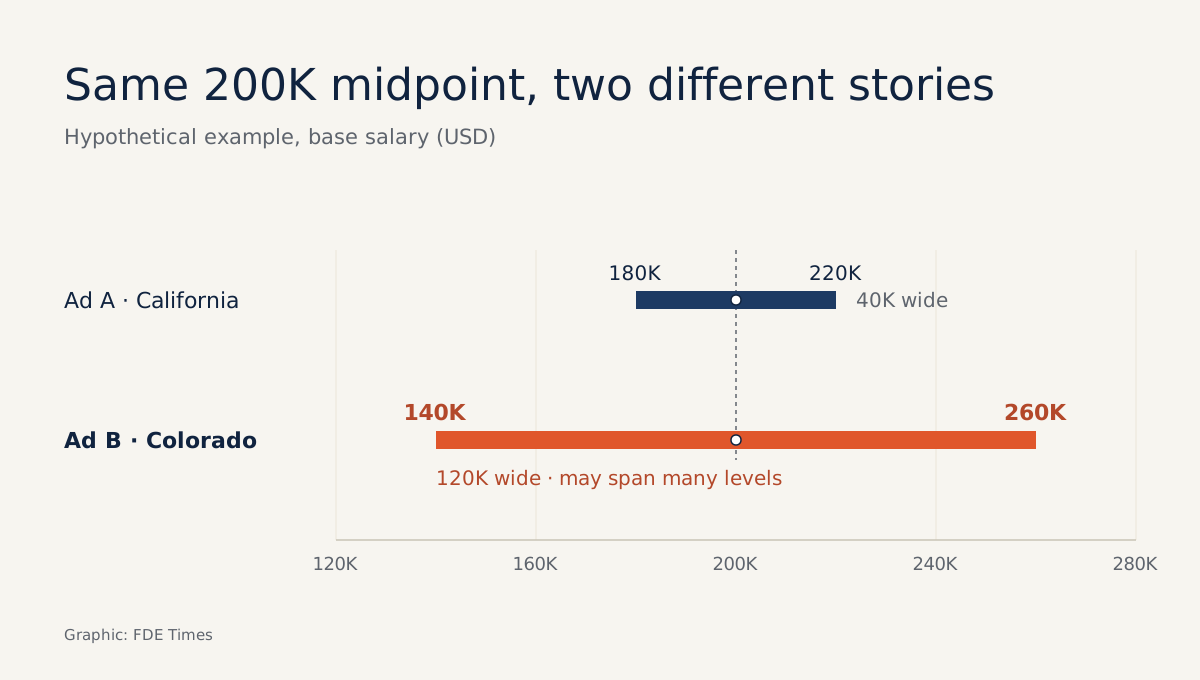
Suppose you are weighing two postings. Posting A, covered by California law, lists $180K–$220K: a range $40K wide with a midpoint of $200K. Posting B, a remote role under Colorado’s rules, lists $140K–$260K: a range $120K wide, also with a midpoint of $200K.
The midpoints match, but the postings say different things. Posting A’s narrow range may suggest the company already has a fairly specific budget, so the negotiation is mostly about whether you sit in the upper or lower half.
Posting B’s floor is $35K below the median floor and its ceiling $35K above the median ceiling, so the range has quite possibly merged several levels into one.
With Posting B, the key question is not “how much” but “which level”. If you are slotted at a lower level, the $260K ceiling is almost irrelevant to you. So ask before you name your number: what level does this role map to, and where in the range do people with your experience usually land?
In California, that question has extra backing. If the company uses a third-party recruiter, it must give that recruiter the salary range. A recruiter who says they do not know the range is passing over information they should have.
What the salary range does not tell you
The posted range is only one part of an offer. Again according to Recruiting From Scratch, equity appears in 55% of startup FDE postings, but fewer than 1 in 25 state a percentage.
A line saying “equity included” without a number is not enough to compare two offers. Ask for the number of shares, the total shares outstanding and the vesting schedule, so you can work out the percentage yourself.
And the 43% of postings with no salary? Treat that as a sign you need to ask earlier. Ask for the range on the first call, before giving your own expectation. Whether they answer directly or dodge, you learn a good deal about how the company operates.
If you live outside the US, keep one more point in mind. These rules target jobs that people in California or Colorado could do, so there is no guarantee the posted range applies to candidates elsewhere. Ask the company directly whether it pays the same range to candidates in your country.
Turn reading salary ranges into an interview advantage
Reading a salary range is really what FDEs do every day: take a number someone hands you, ask how it is defined, then check it against other data before deciding. Candidates who can do this with their own offer are demonstrating exactly that skill in front of the hiring manager.
When reading an FDE job description, look for three things: whether a salary range is given, whether the level is stated, and whether equity comes with a number. If any one is missing, that is your first question. When negotiating, cite the posting’s own range and the $175K–$225K benchmark rather than a figure you came up with yourself.
More states will pass laws, and more FDE postings will carry numbers. That will not make negotiation easier. It simply shifts the question from “how much will you pay” to “how is this number defined”, and whoever asks it first has the advantage.
Was this article useful?
Thanks for the feedback!
6 sources
- California Labor Agency Posts FAQs Relating to New Pay Scale Posting Requirements (Ogletree Deakins) · 2023-01-12
- Colorado Issues Final Rules for Equal Pay for Equal Work Act (Littler) · 2020-11-13
- Colorado Pay Transparency: More Guidance on Job, Promotional Posting Requirements Issued (Jackson Lewis) · 2020-12-21
- Washington Employment Class Actions on the Rise (Davis Wright Tremaine) · 2026-08-21
- Pay transparency laws by state (SixFifty) · 2026-09
- Forward Deployed Engineer Salary at Startups (2026): What Startups Pay vs. What Candidates Ask · 2026-10-09