Multi-agent AI works when only one agent is allowed to write
Anthropic and Cognition reached opposite verdicts a day apart, but read side by side they point to one rule: parallelize the reading, keep the writing in one thread.
In brief
- Multi-agent systems win clearly at research, where most of the work is reading and can be split in parallel; for code the advantage is much weaker.
- The price is roughly 15 times the tokens of chat, plus non-deterministic behavior that makes debugging hard; Anthropic relies on full production tracing to diagnose failures.
- The safe pattern today: many agents read in parallel, a single thread writes, and a reviewer with a clean context checks the result.
On June 12th 2025, Walden Yan of Cognition published a post with a blunt title: “Don’t Build Multi-Agents”. The next day, Anthropic unveiled its Research system, in which a lead agent running Claude Opus 4 orchestrates Sonnet 4 subagents. On Anthropic’s own internal research eval, the system beat a single-agent Opus 4 by 90.2%.
Two companies building agents, two opposite conclusions, 24 hours apart. Forward deployed engineers will hear the question from clients soon enough: “Should we be using multi-agent?”
Getting the answer wrong is expensive in either direction. Say no when the problem genuinely needs it, and the client misses out on a substantial gain in quality. Say yes when it does not, and you leave behind a system that costs several times as much, fails in hard-to-predict ways, and may well be yours to debug at 2am.
The two camps are not really arguing
Read closely, Anthropic never claimed multi-agent is good for everything. Its post says the architecture excels at valuable tasks that involve heavy parallelization. In the same post, it concedes that most coding tasks involve fewer truly parallelizable pieces than research does.
Cognition, which builds a coding agent, looks at the problem from the other side. Walden Yan’s argument is that when many agents collaborate, context and decisions get scattered, and the result is a fragile system.
His second principle explains why: every action carries implicit decisions, and conflicting implicit decisions produce bad results.
A LangChain post, published three days after Anthropic’s, reconciles the two positions. Its observation: reading is inherently easier to parallelize than writing. Seen through that split, the other two posts fall into place. Research is reading; writing code is writing.
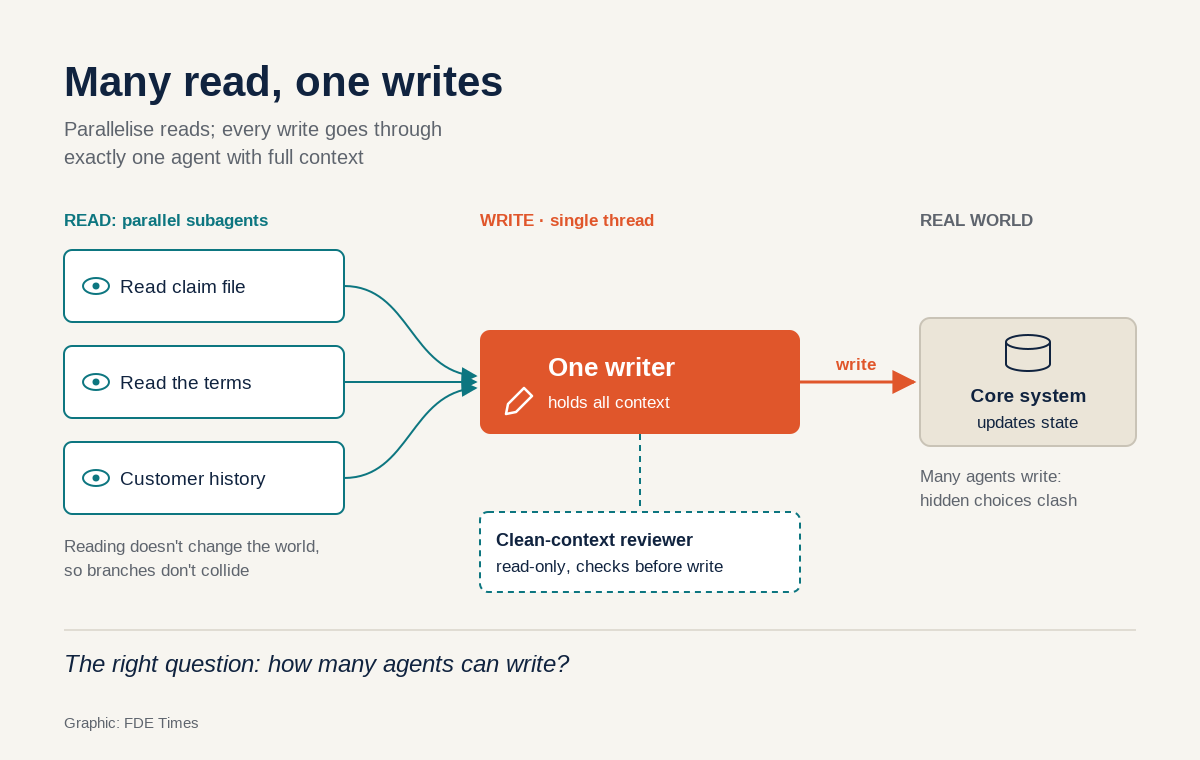
Consider a simple case. One subagent reads documentation on vendor A, another reads about vendor B. The two jobs never collide, because reading changes nothing in the world.
Now suppose the first subagent writes a date-handling function in UTC while the second builds the interface on an unstated assumption of local time. Each is “correct” on its own and wrong once combined. These are the implicit decisions Cognition warns about.
The cost goes beyond the bill
Anthropic’s figure of roughly 15 times the tokens of chat is easier to grasp with a hypothetical calculation: a question-and-answer turn that costs 10,000 tokens becomes about 150,000. For a market analysis report that takes an analyst a full day, that is cheap; for a chatbot that looks up the leave policy, it is absurd.
The token bill is only the visible part. Since late 2024, Anthropic has warned that agent autonomy brings higher costs and the potential for compounding errors. A second calculation: if each step of an agent is 95% accurate, a chain of 10 dependent steps is right only about 60% of the time (0.95 to the power of 10).
More agents mean more steps, more handoffs and more places for errors to multiply.
Why debugging gets much harder
With ordinary software, you rerun the same input and see the same bug. Agents do not behave that way. Anthropic writes that agents make dynamic decisions and are non-deterministic between runs, even with identical prompts.
Multiply that across several agents talking to one another and you have a system in which yesterday’s failure may not reproduce today. Anthropic also admits that LLM agents are not yet good at coordinating and delegating to other agents in real time. The hardest part of the architecture is the part where the models are weakest.
Cognition also talks about traces, from a different angle. Its first principle is to share context: pass other agents the full agent trace, not just individual messages. For Anthropic, the trace is a tool that helps engineers find bugs; for Cognition, it is what an agent needs to avoid making decisions without the full picture.
The purposes differ, but both point the same way: what needs to be kept is the whole chain of steps, as well as the final answer.
The pattern that works: many readers, one writer
In April 2026, Cognition returned to the subject with an update far gentler than the previous year’s headline. Its conclusion: multi-agent systems currently work best when writing stays in a single thread. That matches LangChain’s split between reading and writing.
The most useful concrete pattern in that post is the clean-context reviewer. According to Cognition, such a reviewer catches bugs that the coding agent itself cannot see. The reason is intuitive: the agent that wrote the code carries all its own assumptions, while the reviewer reads only the result, is not led by the earlier reasoning, and writes nothing at all.
Combining the sources gives a decision table that none of them sets out in full:
| Client situation | Read or write | Sensible architecture | Why |
|---|---|---|---|
| Synthesizing information from many independent sources | Mostly reading | Lead agent + parallel subagents | Splits cleanly; value is high enough to justify the token cost |
| Editing code across many files | Writing | One sequential agent | Implicit decisions from several agents will conflict |
| Checking code an agent has just written | Reading | Add a clean-context reviewer | Catches bugs the writing agent misses without touching the write path |
| Simple Q&A or lookups | Light reading | One model call or one agent | The simplest option is enough; the cost is not justified |
The last row is where many projects go wrong. Anthropic’s advice in “Building effective agents” still holds: find the simplest solution possible, and add complexity only when it is truly needed.
Where to start on a client site
Take an insurer that wants an agent to read claim files, check them against policy terms and update the claim status in its core system. The first step is not to sketch a diagram with five agents. List every action and label it: reading the claim, reading the policy terms and looking up the customer’s history are reads; updating the status is a write.
From there the architecture nearly designs itself. Independent reads can go to subagents running in parallel if the volume is large enough. The write to the core system is handled by exactly one agent, with the full context in hand. If mistakes are costly, add a read-only reviewer that checks before the write.
And before writing the first line of agent code, set up tracing. When the client calls to say “yesterday it approved a claim it shouldn’t have”, what you need is the full trace of that exact run, rather than a promise to try to reproduce it.
On a CV, the decision is the story
When a job description asks for “multi-agent experience”, do not read it as a demand to build systems with as many agents as possible. A well-informed interviewer may well turn the question around: why didn’t you use a single agent?
So when writing a CV or describing a project, describe the decisions and leave out the agent count. A line such as “split document lookup into parallel subagents, kept data updates in a single agent, added a reviewer and tracing” shows you understand both the benefits and the costs.
If you have ever collapsed a multi-agent system back into a single agent and it became more stable, that is an even better interview story.
The skill worth practicing alongside is reading traces. If you have followed a chain of tool calls and pinpointed where two implicit decisions collided, that is a concrete example for an interview, far more convincing than a list of orchestration frameworks.
More than a year after the dueling headlines of June 2025, the answer lies with neither camp. It lies in a simple classification you can make at the very first discovery meeting: does this job read, or does it write?
Was this article useful?
Thanks for the feedback!
5 sources
- How we built our multi-agent research system (Anthropic Engineering) · 2025-06-13
- Don't Build Multi-Agents (Cognition) · 2025-06-12
- Multi-Agents: What's Actually Working (Cognition) · 2026-04-22
- How and when to build multi-agent systems (LangChain) · 2025-06-16
- Building effective agents (Anthropic) · 2024-12-19