Forward Deployed Infrastructure Engineer: the FDE track for infrastructure engineers
Palantir and at least one other company are hiring a kind of FDE quite unlike the familiar model: someone who keeps software running reliably in environments the vendor cannot see into.

In brief
- Palantir has a dedicated Forward Deployed Infrastructure Engineer title, hires new grads into it, and the duties include deploys, migrations and on-call at customer sites.
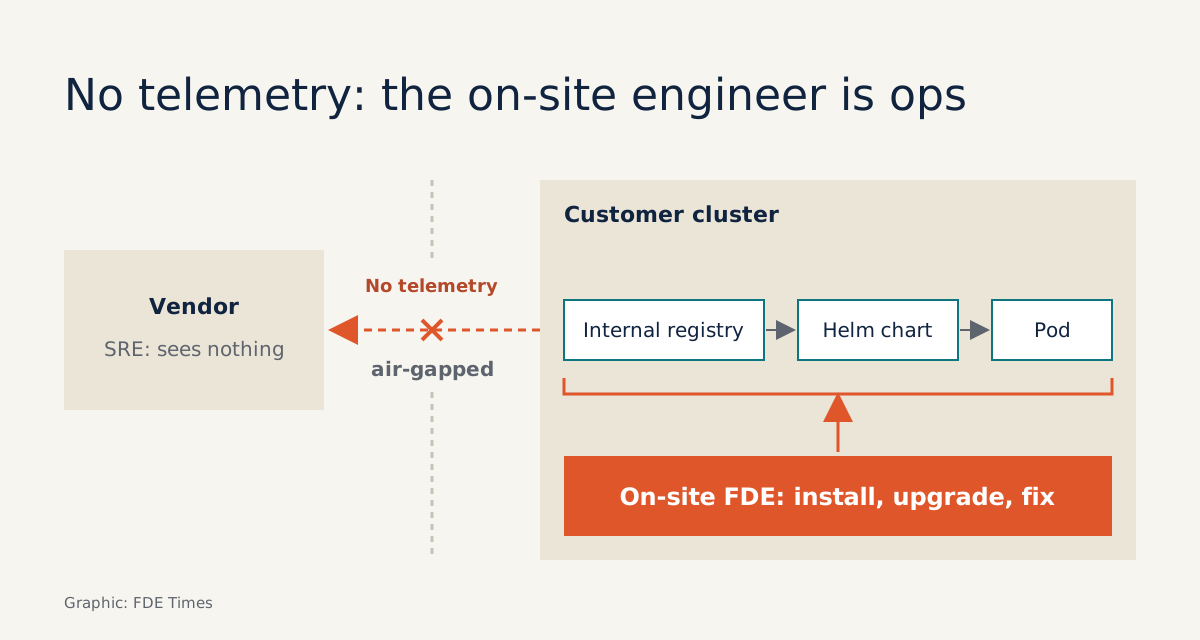
- In air-gapped environments the cluster cannot pull images from public registries or send telemetry to the vendor, so the engineer on site is the operations team.
- This is not DevOps renamed: Palantir demands strong coding, while Ultimate Knowledge's FDE ad requires Kubernetes, CNI, GitOps and experience delivering software into air-gapped environments.
Palantir does not put all its FDEs under one title. Its careers page lists a position called “Forward Deployed Infrastructure Engineer”, and the job description is blunt: you will develop software while also being responsible for the reliability and operation of software systems. There is even a new-grad version of the role.
That detail matters, because the prevailing picture of an FDE today is someone who builds agents, wires up data and sits with the customer. If your strength is Kubernetes, Terraform or networking, you may never have thought of FDE as a path for you.
The job ads suggest otherwise. There is an FDE track on which infrastructure skill is the core capability the customer needs, not a side skill. The track exists for a specific reason: some customers need software to run where the vendor cannot reach.
The customer’s environment creates the title
Documentation for Apollo, Palantir’s deployment platform, states that Apollo supports every major cloud environment, on-premises and disconnected (air-gapped) environments. A community-compiled FDE roadmap on GitHub describes the infrastructure FDEs typically meet as “hostile, legacy, air-gapped or hybrid”.
In an isolated cluster, even the most ordinary things are missing. CoreWeave’s air-gapped deployment documentation warns that the cluster cannot pull images from public registries, so every container image required must already be in the customer’s internal registry before deployment.
The second problem is what changes the nature of the job. TrueFoundry, describing how to bring LLMs into heavily regulated industries, says the common approach is to install with Helm into a customer-owned Kubernetes cluster, turn off automatic updates, and send no telemetry back to the vendor’s control plane.
Without telemetry, the SRE team at headquarters sees nothing: no dashboards, no alerts, no logs. When a pod dies at two in the morning, the only person who can look at the system is whoever has access on the customer’s side. That is why the title has to exist: the engineer on site is also the operations team.
An installation without internet
Imagine taking a Helm chart to the cluster of a financial-services customer. Say the chart references nine images: seven for the application, one for a log-collection sidecar and one for an init container that runs migrations. You have mirrored the seven main images into the internal registry, but forgotten the other two because they sit in a subchart.
On a cluster with internet access, almost nobody would notice this mistake, because the node pulls the images itself. In an air-gapped environment, the pods get stuck in ImagePullBackOff. To fix it, you have to find a way to get those two images into the internal registry, while the cluster has no route to the internet at all.
The lesson here is not about Kubernetes but about working habits. Before going on site, render the whole chart, extract a list of every referenced image, then write a script that checks that list against the target registry.
This is exactly the kind of “runbook automation” Palantir lists in its job description, alongside deploying new products across many production environments.
This is not DevOps renamed
Ultimate Knowledge’s FDE ad, posted on Workable, states plainly: you will work across both cloud and on-prem, and this is not a traditional DevOps or IT role. In the same ad, Kubernetes is listed as mandatory.
The two statements sound contradictory, but they are not. A DevOps engineer usually looks after their own company’s platform, where they choose the tools and have full access. A forward deployed infrastructure engineer carries one product across many environments that are not theirs, each with its own configuration and its own set of rules.
That is why Palantir puts its coding requirement on a par with the US government clearance requirement: you must be a strong coder, proficient in languages such as Java, Go, Python or JavaScript. Running a runbook by hand across ten different environments is bound to produce errors. Turning it into a tool is the software engineer’s part of the job.
Put the job ads side by side and the shape of the role becomes clear, along with what each requirement turns into when you work on a customer site.
| Requirement in the job ad | Where it appears | What it means on site |
|---|---|---|
| Strong coding in Java, Go, Python or JavaScript | Palantir | Turn runbooks into tools that run repeatably |
| Deploy products across many production environments | Palantir | One release has to work on many different configurations |
| Migrations to the latest infrastructure, on-call | Palantir, new-grad version | Upgrade running systems and handle incidents |
| Kubernetes is mandatory | Ultimate Knowledge | The product runs on the customer’s cluster, not yours |
| Familiarity with CNIs such as Calico, Cilium, Multus | Ultimate Knowledge | Work with whatever network layer the customer chose |
| GitOps, ArgoCD preferred, Flux accepted | Ultimate Knowledge | System state lives in a repo, not in someone’s memory |
| Experience delivering software into air-gapped or heavily regulated environments | Ultimate Knowledge | Prepare images, charts and file-transfer procedures in advance |
Networking is what separates the strong
In the table above, the CNI row deserves the closest reading. Ultimate Knowledge’s ad does not pick one plugin; it lists all three names, Calico, Cilium and Multus. The sensible reading is that you do not get to choose: the cluster belongs to the customer, and the network layer was decided before you arrived.
So when one service cannot call another, you need to be able to tell whether the fault lies in the application, in a network policy or in how the customer’s CNI handles traffic. Someone who only knows a default configuration gets stuck right here. Someone who understands networking can isolate the fault before the shift ends.
GitOps plays a similar role. Imagine you leave the project and a colleague takes over: with no telemetry going back, keeping the system’s desired state in a repo and letting ArgoCD or Flux sync it means the next person can understand the environment without guessing.
New grads have a way in, with evidence
Palantir’s new-grad version does not narrow the scope of the work. The duties are still deploying new products at customer deployments, carrying out migrations to the latest infrastructure, and taking part in on-call. In other words, even fresh graduates are expected to touch real production systems directly.
The way to prove you can do that is not another certificate but a lab project others can reproduce. Build a cluster, block its route to the internet, mirror images into an internal registry, install a real chart with Helm, manage it with ArgoCD and switch the CNI to Cilium to see how network policies behave differently.
On your CV, write about outcomes rather than just listing tools. A line such as “installed a nine-image system into a cluster with no internet access, with a pre-deploy check script” carries far more weight than one that only says “Kubernetes, Helm, ArgoCD”.
When reading job ads, look for the words air-gapped, on-call and migrations: they signal you are looking at the infrastructure track rather than the demo-building one.
For many infrastructure engineers, FDE has sounded like a job that demands learning a whole other skill set. But in places with no internet, infrastructure skill is precisely what customers need most.
Was this article useful?
Thanks for the feedback!
7 sources
- Palantir Technologies - Forward Deployed Infrastructure Engineer - US Government
- Forward Deployed Infrastructure Engineer, New Grad - US Government
- Introduction • Palantir
- Forward Deployed Engineer (Ultimate Knowledge)
- Deploy on Air-Gapped Kubernetes
- Air-Gapped AI: Deploying Enterprise LLMs in Highly Regulated Industries · 2026-05-12
- GitHub - pierpaolo28/Awesome-FDE-Roadmap