An FDE's real workload hides in the travel and on-call lines
One forward deployed engineer describes a 50-hour week, while most job ads leave hours out and show the real load only through travel percentages and on-call rotas.
In brief
- Most of the FDE job ads cited here give no weekly hours; the most specific figure is a 50-hour week described by one FDE.
- Travel rates of 20% to 60% and the wording about on-call duty are the real indicators of workload.
- Whether on-call time counts as working time depends on local law, so ask exactly how on-call is paid or compensated with time off.
“Ten clients, fifty hours, and context-switching so constant it makes your head spin.” That is how Milos Mandic, an FDE at the startup Lleverage, described his past week. He also said no two weeks are the same.
It is one week of one person’s working life, but it is still more specific than what most FDE job ads are willing to state. OpenAI’s FDE posting in San Francisco is typical: the listing mentions travel of up to 50% and a hybrid arrangement with 3 days a week in the office, but says nothing about working hours or on-call.
Anyone considering a move into forward deployed engineering needs to learn to read what a job description does say in order to infer what it leaves out. Real hours usually surface in two places: the travel percentage and a few short words about on-call. Add those two together and you can estimate what your own week will look like.
The travel percentage is the closest thing to a number of hours
The Pragmatic Engineer reports that Palantir expects FDEs to spend about 25% of their time at client sites, and cites an estimate of up to 50% at Commure. A PostHog blog post puts the range at roughly 20–50%, unless the FDE only visits clients online.
Swarm Aero’s listing for a Forward Deployed Engineer II sets a higher bar: up to 60% domestic and international travel, to test ranges and customer sites.
Convert that to a five-day working week. 20% is about one day away from home, 50% is two and a half days, 60% is three. These are averages, and time spent on planes, trains and in cars usually does not enter the calculation.
Nabeel Qureshi, a former Palantir FDE, wrote that the company used to say openly that staff worked long hours, were paid below market and had to travel a lot. He gave no figures, but at least applicants were warned. Where a company says nothing, the question is yours to ask: how many days a week did the team’s most recent project require on site?
Each source shows only one piece
Put the sources side by side in one table and no single one tells the whole story.
| Source | On-site time / travel | On-call, non-standard hours | Hours, shift schedule |
|---|---|---|---|
| Palantir (per The Pragmatic Engineer) | About 25% at client sites | Not stated | Not stated |
| Palantir (per Qureshi) | “A lot of travel” | Not stated | “Long hours”, no figure |
| Commure (per The Pragmatic Engineer) | Estimated up to 50% | Not stated | Not stated |
| PostHog (general description) | 20–50% | Not stated | Not stated |
| OpenAI, SF | Up to 50%, hybrid 3 days | Not stated | Not stated |
| Swarm Aero | Up to 60% | Non-standard hours, on-call, rotational coverage | Not stated |
| Twenty (TS/SCI) | Not stated | On-call via PagerDuty | Frequency and shift length not stated |
| PVM, Rosemead | Not stated | 24/7/365 coverage, including nights, weekends, holidays | 12-hour shifts, 2-2-3 rotation |
| Lleverage (one FDE’s own account) | Not stated | Not stated | 50 hours, one week |
The last column is almost empty, and the gaps are information in themselves. The only cell with a concrete schedule belongs to a 24/7 operations role, which shows that a job description can be explicit when a company wants it to be. Everywhere else, working out the load means adding up the first two columns yourself.
On-call is the hardest part of the week to see
Swarm Aero’s listing says FDEs support continuous operational environments, including non-standard hours, on-call response and rotational coverage. Those three phrases tell you your schedule will follow the client’s systems, but not for how many hours.
Twenty’s listing for a Forward Deployed Data Engineer (TS/SCI) requires joining an on-call rotation through PagerDuty, with clear escalation paths to the engineering team. Clear escalation is a good sign, because you will not be carrying incidents alone. How many weeks pass between turns, how long each shift lasts and whether on-call is paid are not stated.
PVM’s FDE listing in Rosemead, California shows what a transparent job description looks like: 24/7/365 coverage, 12-hour shifts rotating on a 2-2-3 cycle, including nights, weekends and holidays.
Does on-call time count as working time?
FDE work has no standard of its own, but SRE does. Google’s SRE book caps on-call at 25% of an SRE’s time, with up to another 25% for other operational, non-project work. If the FDE team you are about to join expects people to be on call for more than a quarter of their time, it has exceeded the limit Google set for its own dedicated operations teams.
Counting the hours is not simple either. In case C-344/19, the Court of Justice of the EU ruled that standby time, when the worker only needs to be reachable and able to return within an hour, is not automatically counted in full as working time. The exception is when the constraints objectively and very significantly affect the worker’s free time.
That ruling applies only in the EU; elsewhere, whether standby time counts depends on each country’s labor law.
A survey by The Pragmatic Engineer found that on-call pay for software engineers ranges from about $100 to about $1,250 a week, with some at Google earning more.
Whether the company pays, and how, is a question to ask before signing.
Is fifty hours a lot?
Research by the WHO and the ILO concluded that working 55 hours or more a week is associated with an estimated 35% higher risk of stroke and a 17% higher risk of dying from ischemic heart disease, compared with working 35–40 hours. Mandic’s week sat exactly 5 hours below that threshold.
Add one night spent on an incident or a Sunday flight, and the week can reach it. For another point of comparison, Vietnam’s 2019 Labor Code limits normal working hours to 48 a week; the law where you work may set a different limit, and it is worth looking up before accepting an offer.
One job ad, two very different weeks
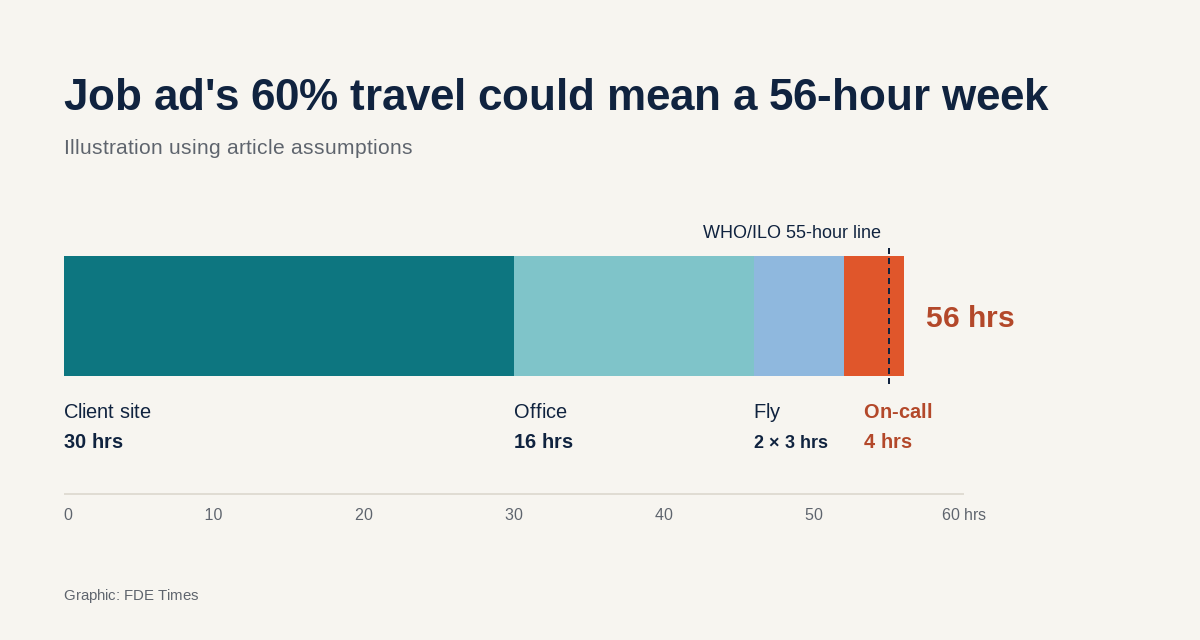
Take Swarm Aero’s listing. Travel of up to 60% means 3 of 5 working days away from home. The figures below are hypothetical assumptions for a worked calculation, not the company’s actual schedule, so they are better read as a range than as a single total.
At the low end, each day at the client site runs 8 hours, the two office days run 8 hours each, there are two legs of travel at 1.5 hours each, and it is not your on-call week: 43 hours in total, below the 48-hour limit in Vietnamese law.
At the high end, days at the client site stretch to 10 hours, there are two flights of 4 hours each, and it is your on-call week with two nights of being woken, 2 hours each time: 58 hours in total, above the WHO and ILO threshold of 55.
The same “up to 60%” line produces a 15-hour gap between the two weeks. Most of that gap lies in things the job description leaves out: how long a day at the client lasts, how far the trips are, and whether on-call is quiet or noisy. Run this two-level calculation for every offer, then take the empty cells into the interview.
The three most valuable questions are: how often each person is on call, whether on-call is paid or compensated with time off, and whether travel time counts as working time. Employers who answer clearly have usually thought this through.
On a CV, incident on-call experience is an asset if you back it with numbers: how many people were in the rotation, how many incidents you handled, how much you cut recovery time. Swarm Aero and Twenty both list on-call requirements, so a few specific lines about each rotation will carry far more weight than a generic “works well under pressure.”
Fifty hours can be a good week, or the first week of a year that ends in burnout. The difference lies in whether anyone counts the hours the job description leaves out, and the person best placed to count them is you.
Was this article useful?
Thanks for the feedback!
13 sources
- Forward Deployed Engineer II @ Swarm Aero (Ashby job board API) · 2026-11-24
- Forward Deployed Data Engineer – TS/SCI (Full Scope Poly) @ Twenty (Ashby job board API) · 2026-09-29
- Forward Deployed Engineer (FDE) - SF (OpenAI Careers)
- What FDEs Actually Do All Week · 2025-12-09
- Reflections on Palantir · 2024-10-15
- Forward deployed engineers (The Pragmatic Engineer) · 2025-08-12
- WTF is a forward deployed engineer? (and why everyone is hiring them) · 2026-02-11
- Being On-Call (Google SRE Book)
- Oncall Compensation for Software Engineers · 2022-08-02
- Long working hours increasing deaths from heart disease and stroke: WHO, ILO · 2021-05-17
- Khoản 1 Điều 105 Bộ luật Lao động 2019
- Forward Deployed Engineer, PVM, Inc. (Rosemead, CA) – SimplyHired
- CJEU Case C-344/19 / Judgment (European Union Agency for Fundamental Rights) · 2021-03-09