Swapping models is easy. Moving an agent's memory is not
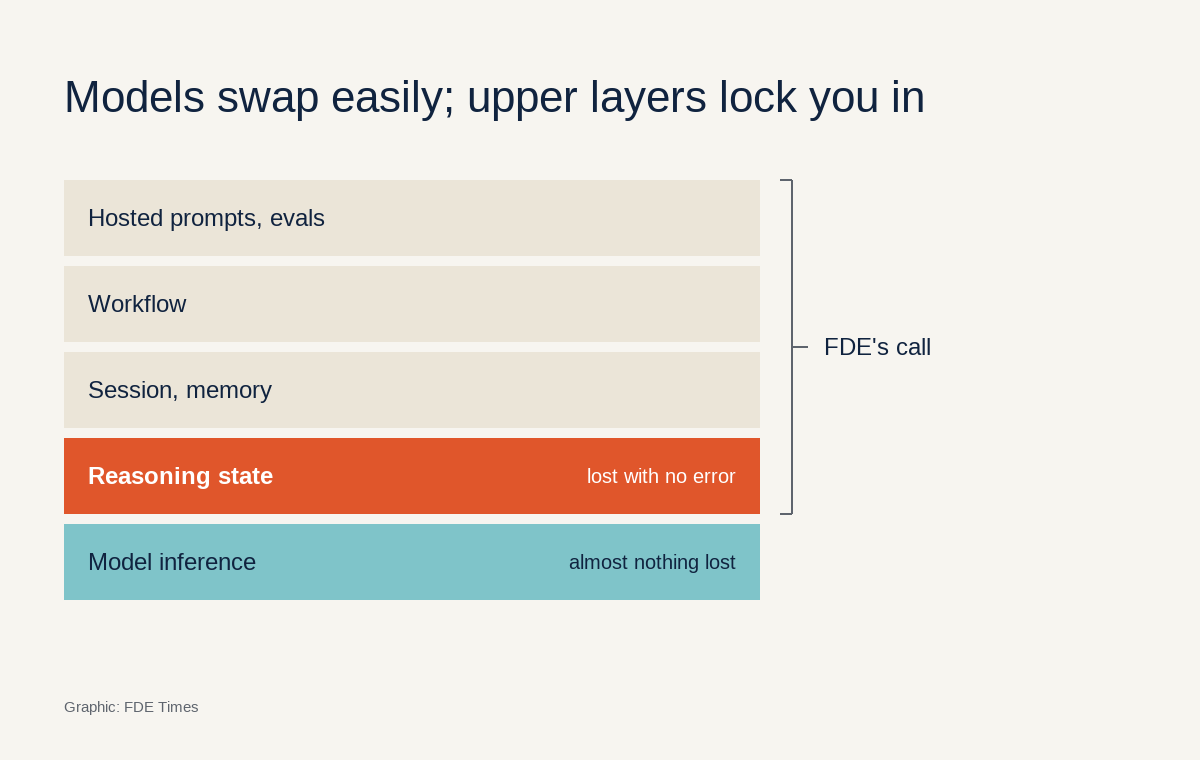
FDE clients are still locked in at the state, memory and orchestration layers, which are the parts forward deployed engineers build every day.
In brief
- OpenAI retires Agent Builder on November 30, 2026. The export does not convert the workflow graph and does not guarantee the agent will behave as before.
- OpenAI's compaction is encrypted data that cannot be read. On the Claude API, thinking blocks that become unusable after a model or account switch are dropped without an error.
- Gartner predicts that by 2028, 70% of enterprises will abandon agentic AI systems built by vendors' FDEs. An exit plan has to exist from day one and must list where state lives.
On November 30, 2026, two days from now, OpenAI retires Agent Builder, on a schedule that has been on the company’s Deprecations page since June 3. OpenAI’s own migration guide gives an uncomfortable warning in advance: the export will not convert the workflow graph, and there is no promise that every agent behavior will be preserved.
The shutdown targets the orchestration layer, the part that sits above the model. Calls to the model keep working as usual. What clients have to rebuild is the workflow graph and the behaviors that were tuned around it.
For FDEs, this is an everyday question. When a client asks “are we locked into the vendor?”, the familiar answer is “no, this architecture is model-agnostic”. That is true at the model layer and false at most of the others, and the FDE is the one who chooses those layers.
Switching models is easy, until the agent starts remembering
Harrison Chase of LangChain argues that switching model providers is still fairly easy today. But as soon as state is involved, he says, moving becomes “much harder”. He puts it bluntly: if you use a closed harness, especially one behind an API, you do not own your memory.
LangChain sells an open harness, so it benefits if this argument wins. Even so, the major vendors’ own documentation and two independent sources point the same way.
Take compaction. OpenAI’s API documentation describes the compaction item as encrypted, opaque data that was never meant to be interpreted by humans.
Earendil Engineering, the team behind the Pi harness, observes that reasoning APIs increasingly return a mix of text and provider-bound state that is deliberately made non-portable. Mozilla.ai likewise argues that continuous reasoning built on that hidden state cannot be carried straight over to another provider.
Take a customer support agent that runs for several weeks on the same long session. The “memory” it accumulates sits in a blob that neither you nor the client can read. If the client wants to move to another vendor, they can still switch models, but they have to leave that memory behind.
Some failures never show an error message
Anthropic’s documentation on preserved thinking describes a subtler case. On the Claude API, when you switch models or accounts and old thinking blocks can no longer be used, the request does not fail: the API drops those blocks from the request, does not charge for them, and Claude answers without that reasoning.
The documentation also makes clear that switching models does not permanently destroy the reasoning on its own; if you return to the original model, the blocks are read again. They are lost for good only when your own code deletes them from the history.
The consequences for FDEs are practical. Integration tests that only check return codes will all pass, while answers in later turns may get worse with no error on the dashboard to catch anyone’s attention.
Every time you switch account, region or model, run multi-turn evals that measure quality, and do not write history-cleanup code that accidentally strips thinking blocks.
Mozilla.ai advises treating provider-specific state as a temporary optimization. Translated into work: the agent must still run at an acceptable level when that state disappears, and you should have evals that prove it.
The orchestration layer has an expiry date too
Agent Builder is not the only case. AWS closed Bedrock Agents Classic to new customers from July 30, 2026 and moved the service into maintenance mode. Existing agents keep running, there is no migration deadline yet, and AWS recommends moving to AgentCore.
No deadline sounds reassuring, but a product in maintenance mode is not where new work should be built. Within a single year, two major providers have put an orchestration layer on a path to retirement, while the models underneath remain in use.
Anthropic has taken a different route with Claude Managed Agents, still in beta. The service is deliberately stateful: conversation history, sandbox state and outputs all live on the server side, so it is not yet eligible for ZDR or a HIPAA BAA, with an exception for ZDR in the self-hosted version.
For healthcare clients, where state lives decides whether they can use the product at all.
In return, Managed Agents memory consists of files that developers can read, edit, import and export through the API or the Claude Console, a real advance over an encrypted blob. Still, an exportable file does not mean behavior carries over, and OpenAI’s warning about Agent Builder shows the two are different things.
Five layers to check before saying “no lock-in”
| Layer | Example from documentation and sources | What the client loses on leaving | Question the FDE should ask |
|---|---|---|---|
| Model | Chase: switching model providers is still fairly easy | The least of the five layers | Is anything in the code hard-wired to one provider? |
| Reasoning state | OpenAI’s encrypted compaction, Claude thinking blocks dropped on a model or account switch | Accumulated reasoning, lost without warning | Can this state be read, and does our code delete it? |
| Sessions and memory | Managed Agents stores history and sandbox server-side, file-based memory can be exported | History, sandbox, what the agent has memorized | What format does it export to, and has anyone tried loading it elsewhere? |
| Orchestration | Agent Builder retires November 30, 2026, Bedrock Agents Classic in maintenance mode | Workflow graph and tuned behavior | Does this product already have a retirement date or maintenance mode? |
| Operational knowledge | The operational dependency Activant describes, the knowledge transfer Gartner recommends | The ability to fix and keep developing the system themselves | Can the client’s team deploy on its own without the FDE? |
The “model-agnostic” promise answers only the first row. The other four are choices the FDE makes directly while building the system: where sessions are stored, which harness to use, who on the client’s team understands the system.
The most dangerous layer is not necessarily the costliest to move. The orchestration layer at least comes with an announced retirement date, while dropped reasoning sends no signal at all.
Sometimes the FDE is what locks the client in
Gartner predicts that by 2028, 70% of enterprises will abandon agentic AI systems built by vendors’ FDE teams. It is only a forecast, but it lands squarely on the last row of the table above.
Activant Research, in a piece by Emma Rowand, looks at the same phenomenon from the investor’s side. In its view, the race to put FDEs in front of clients is a race to install operational dependency before the capabilities of frontier models become a commodity.
Both are describing the same mechanism. Investors see the dependency as a moat; Gartner sees it as what drives clients away. An FDE who builds a system the client cannot run on its own may keep the contract for another year, then lose the client the year after.
Gartner’s advice is specific: co-own the project with the client, transfer knowledge, and have an exit strategy from day one.
The five-layer table above should be the backbone of that exit plan, with each kind of state recorded by which account it lives in, whether the format is readable, who holds access and whether a move has ever been tested.
The first job at a client should be moving prompts and the eval suite into the client’s own repo. If the quality benchmark lives on the vendor’s platform, then when the platform shuts, the client also loses the ability to tell whether the new system is as good as the old one.
A skill worth putting on your CV
In FDE interviews, an architecture answer should go beyond choosing a model: where state lives, what disappears without an error when the account changes, how the handover works. On a CV, replace “built agents on platform X” with handover outcomes: prompts and evals in the client’s repo, a state inventory, an internal team able to deploy on its own.
The cheapest way to practice is to build a small agent on two providers, switch models in the middle of a long conversation and record what it no longer remembers. At handover, ask the client: if this account were shut off tomorrow, what would the agent still remember? If nobody can answer, the client is locked in, even with a free choice of model.
Was this article useful?
Thanks for the feedback!
12 sources
- Your harness, your memory · 2026-04-11
- Compaction (OpenAI API docs)
- Preserved thinking (Claude Platform Docs)
- Claude Managed Agents overview
- Built-in memory for Claude Managed Agents · 2026-04-23
- Using agent memory (Claude Platform Docs)
- Amazon Bedrock Agents Classic maintenance mode
- Migrate from Agent Builder (OpenAI API docs)
- Gartner Predicts 70% of Enterprises Will Abandon Agentic AI Built by Vendor Forward-Deployed Engineering by 2028 · 2026-09-30
- Forward Deployed Lock-In — Activant Research · 2026-06-16
- The Session You Cannot Take With You · 2026-07-30
- How Frontier Labs Are Building Subtle Developer Lock-In · 2026-07-30