Having an API does not mean your agent may call it
From SAP to Slack, the real limits sit in the terms of service: who makes the calls, what gets stored, and how the app is distributed.

In brief
- SAP, HubSpot and eBay now refer explicitly to agents, MCP and LLM-driven bots in their terms. A connector that works technically can still breach the contract.
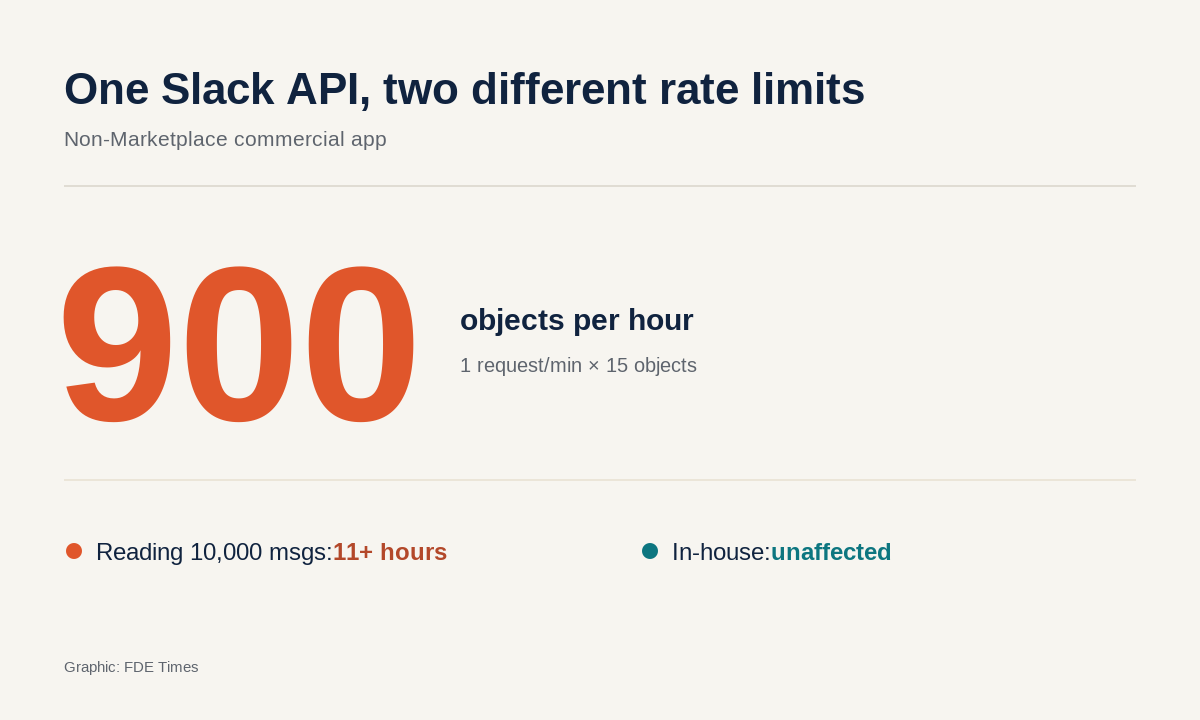
- At Slack, internal apps are unaffected, while commercial apps distributed outside the Marketplace get 1 request per minute on two message-reading APIs.
- The ruling in Amazon's case against Perplexity shows that winning under computer access law does not mean escaping the terms of service.
In late April 2026, SAP published an API Policy with a clause written specifically for AI agents.
According to the text quoted by The Register, SAP prohibits using its APIs to interact or integrate with autonomous, semi-autonomous or generative AI systems, meaning systems that plan, select and execute a sequence of API calls on their own. The exception is use within architectures and pathways that SAP has approved.
The endpoint is still there. The token is still valid, and the request still returns 200. What has changed is who, or what, is sending that request, and that question is now written into the terms.
For an FDE, this is a risk no integration test will catch. A connector built over two weeks at a client site can run smoothly in staging, then breach the terms on go-live day simply because the caller is an agent. Reading the terms therefore has to come before writing code, and it matters as much as reading the technical documentation.
Platforms draw the line with three questions
Read the terms from SAP, Slack, HubSpot or eBay and a pattern emerges: they rarely ban API use outright. They sort use along three axes: who decides the sequence of calls, where the data goes once retrieved, and how the app is distributed. Each axis is an architectural decision an FDE has to settle early.
SAP is the clearest example of the first axis. According to a SAPinsider piece republished by ERP Today, the restriction applies when an AI system decides for itself which SAP APIs to call and in what order.
The telling detail lies in what is not banned. The same article says deterministic automation, running a predefined sequence of calls, falls outside the restriction on agentic AI. The same chain of API calls is out of scope if it is hard-coded in advance, and falls into the area SAP wants to control if a model chooses it at runtime.
Putting the agent behind an intermediary layer will not help. Thomas Wieberneit, writing on CustomerThink, notes that the policy also prohibits circumvention through proxies, intermediary services, custom code or impersonation.
Interpretations still differ. Techzine reads section 2.2.2 as meaning external AI agents can no longer use SAP’s APIs, while ERP Today describes SAP-approved pathways that still exist for autonomous access.
Fivetran, a data integration company and therefore an interested party, said in late April 2026 that this was a policy rather than a contract, so enforcement at that point was limited. Loose enforcement, though, does not replace the wording the client’s legal team will read.
Slack shows one API with two rate limits
The third axis, app distribution, is easiest to see at Slack. A changelog entry dated May 29, 2025 states that for commercially distributed apps outside the Slack Marketplace, conversations.history and conversations.replies are limited to 1 request per minute, with at most 15 objects per request.
Do the arithmetic: 60 requests an hour at 15 objects each gives a ceiling of 900 objects an hour per method. Take a vendor that wants an agent to summarize a support channel with 10,000 messages: reading it once takes more than 11 hours, before the model has been called even once.
The same page says internal apps built by customers themselves, and existing installations, are unaffected. Same code, same endpoint; the only difference is who owns and distributes the app.
For an FDE working inside a client’s infrastructure, then, the question “who owns this app?” decides whether the connector is capped at 900 objects an hour.
The data axis at Slack is just as tight. API terms effective October 10, 2025 prohibit third-party apps from bulk exporting messages and files unless a supplementary agreement explicitly allows it.
The Real-time Search API is open only to Marketplace-listed apps and internal apps, and the documentation forbids storing or copying data retrieved through it. A familiar RAG architecture, pulling every message and embedding it into a vector store, needs to be checked against these lines before anyone writes the first line of embedding code.
Agents now have their own name in the contract
What the platforms have in common is that they have stopped treating an agent as an ordinary client. The table below sets each platform’s terms side by side to show where each one forces an FDE to change the design.
| Platform | What the terms target | Stated path | Design question for the FDE |
|---|---|---|---|
| SAP | AI that plans, selects and executes call sequences; circumvention through proxies or custom code | SAP-approved architectures and pathways | Which steps does the model choose, and which are a predefined deterministic flow? |
| Slack | Bulk export of messages and files; storing data from the Real-time Search API | Internal apps unaffected; supplementary agreement for bulk export | Who owns the app, and does it need to store data or only look it up in real time? |
| HubSpot | Solutions with agent features, including access via MCP | The same Developer Terms apply | Does the MCP server you built comply with the Developer Terms? |
| eBay | Buy-for-me agents, LLM-driven bots, end-to-end order flows without human review | eBay’s express prior permission | At what step does the user review before an order is placed? |
| Anthropic | Claude.ai login in third-party apps; using Free, Pro or Max plan credentials on users’ behalf | Not stated | Whose account does the product authenticate with? |
Since May 4, 2026, HubSpot’s Developer Terms state explicitly that solutions using or providing agent features, including access via MCP, are subject to the same terms. If you are wrapping a client’s API in an MCP server for agents, that territory now has clear rules.
eBay’s User Agreement goes further: it prohibits buy-for-me agents, LLM-driven bots and any end-to-end ordering flow without human review, unless eBay has given express prior permission. Here the human review step is a condition for the flow to exist at all; it is no longer a nice-to-have UX feature.
Model providers restrict access through their own terms, too. Anthropic does not allow third-party developers to offer Claude.ai login in their own apps, or to route requests through Free, Pro or Max plan credentials on behalf of users.
A quick prototype on a personal account may run, but it is not something to hand over to a client.
Winning in court is not winning on the contract
Some will assume the law will side with agents. Amazon’s case against Perplexity, decided by the Ninth Circuit Court of Appeals on August 4, 2026, gives a conditional answer.
A footnote in the ruling, quoted on Eric Goldman’s blog, says the outcome does not diminish Amazon’s ability to regulate access to its site through its terms of service with users.
The law firm Cooley also notes that the ruling is limited to the computer intrusion statutes CFAA and CDAFA, and that AI developers should not treat it as clearing them of liability on other grounds, such as terms of service.
For anyone writing connectors, the lesson is that computer access law may not stop you, but a platform’s terms of service still can.
Put the terms into customer discovery
The practical step is to add a row to the discovery checklist, right next to “is there an API?” and “how does authentication work?”. For each target system, write down three answers: may an agent call it directly, may the data be stored, and how will the app be registered and distributed.
Any question left unanswered is a risk to log now, and should not be deferred as a detail.
Those three answers lead to concrete design choices. For eBay, put a human approval step before an order is placed. For Slack, consider real-time lookup instead of storing data, and let the client own the app as an internal one.
For SAP, separate the part where the model proposes from the part that executes, then ask the client and SAP which pathway is approved. SAPinsider’s reading on deterministic automation is still only one reading, and analysts have interpreted the policy in several different ways.
The terms are a matter between the client and the vendor, so the final call belongs to the client’s legal or procurement team. The FDE’s job is to spot the issue early, write the questions clearly into the design doc and bring the right people in before the first sprint starts.
This skill belongs on your CV
When describing a connector on your CV, do not stop at the technology, such as Python, OAuth or webhooks. A line like “reviewed Slack’s API terms before design, chose an internal-app model to avoid commercial-app rate limits, stored no data beyond what was permitted” says far more about how you work.
That line shows you understand that a client’s systems sit inside a web of contracts as well as a network of servers.
When reading a job posting that leans heavily on enterprise system integration, ask in the interview how the team handles platform terms.
In a system design round, if the prompt is “give an agent access to the client’s ERP or Slack”, ask about the platform’s terms before drawing the diagram, because every box on it depends on the answer.
The FDE who opens the terms page before opening the IDE will be the one whose connector still runs after go-live.
Was this article useful?
Thanks for the feedback!
13 sources
- AI clause in new SAP API policy has partners worried over lock-in · 2026-04-29
- What Customers Need to Know About SAP’s API Policy · 2026-09-14
- SAP Draws a Perimeter around Agentic AI and What That Means for the Rest of US · 2026-05-09
- SAP's latest API policy raises the stakes for your AI strategy · 2026-04-29
- SAP blocks external AI agents. Salesforce and ServiceNow don't. · 2026-05-13
- Slack API Terms of Service · 2025-10-10
- Rate limit changes for non-Marketplace apps · 2025-05-29
- Real-time Search API
- Our Ecosystem Vision for the Agent Era & Updated Developer Terms · 2026-05-04
- eBay User Agreement
- Ninth Circuit Lifts Restrictions on Agentic AI Accessing Amazon · 2026-08-06
- Ninth Circuit Rules on AI Agent ‘Access’ to Third-Party Websites Under CFAA · 2026-08-06
- Legal and compliance