Working as an FDE from Vietnam for a foreign company: contractor or EOR decides who files your taxes
Two job offers with the same US dollar salary can still lead to two different ways of filing tax in Vietnam, with very different legal risks and amounts of paperwork.
In brief
- Tax residents of Vietnam are taxed on worldwide income, so a US dollar salary from a foreign company must still be declared in Vietnam.
- With no income payer in Vietnam, you file quarterly yourself and settle the annual return no later than the last day of the fourth month after the year ends.
- One hiring guide calls Vietnam a contractor-unfriendly environment, so an EOR is usually the safer choice for a role as closely tied to a company as an FDE's.
From 1 July 2026, Vietnam applies a new Personal Income Tax Law. The number of progressive brackets falls from seven to five, and the personal deduction rises to 15.5 million dong a month.
For an engineer sitting in Hanoi or Ho Chi Minh City and earning a US dollar salary from an AI company abroad, the new law is a good moment to answer a question many people skip when signing an offer: on what basis am I actually being hired?
It sounds like a matter for HR, but the answer decides who files the tax, how often, and who bears the risk if the contract is judged not to reflect the real relationship.
An FDE sits close to customers, works to the rhythm of the product team and is accountable for deployment results. Because the role is so tightly bound to the company, the form of an FDE’s contract matters more than it does for a freelancer paid by the task.
What follows is not a substitute for tax advice. The aim is to make the options clear enough that you can ask the right questions before signing and do the first calculation yourself.
A foreign company cannot simply hire you as it would at home
The starting point is a rule few people notice. According to the 2026 Vietnam hiring guide from Rivermate, an EOR provider, Vietnamese law requires a business to be a registered legal entity before it can employ citizens as staff.
A San Francisco startup without a Vietnamese subsidiary therefore has only three routes: set up an entity, go through an EOR, or sign a contractor agreement with you.
An EOR exists as an alternative to setting up a local entity. The EOR entity is your legal employer in Vietnam, while day-to-day work is still assigned by the foreign company. A contractor arrangement looks simpler on paper: one service contract, one invoice a month, money sent straight to your account.
That simplicity has a price. The same Rivermate guide describes Vietnam as a contractor-unfriendly environment and warns that misclassifying employees as contractors can lead to back-payment of social insurance, back-payment of employee benefits, and penalties from the tax and labour authorities.
Why FDEs easily fall into misclassification territory
Picture a typical FDE day: a standup with the product team, tickets from an engineering manager, customer meetings scheduled at the account lead’s request, a company laptop and company accounts. From the outside, that is an employee, not an independent contractor who decides how to do the work.
That is why a contractor agreement for an FDE role deserves a closer reading than one for a logo design project.
When the actual work looks like employment but the paperwork says service contract, the misclassification risk begins with that very mismatch. So if a company lets you choose between the two, do not compare only the headline salary.
Ask the way you would in customer discovery: find the real constraints before discussing solutions. When the conversation turns to terms, ask whether the company hires people in Vietnam through an EOR, through its own entity or on a contractor agreement, and which party is the income payer.
If they answer clearly straight away, most of the paperwork is already handled by someone. If they hesitate, you may be one of their first hires in Vietnam, and you should look carefully into both the tax and the contract before signing.
A US dollar salary is still taxable income in Vietnam
It is easy to assume that money paid from abroad into a foreign account is beyond the reach of Vietnamese tax. Vietnam Briefing states the opposite: tax residents of Vietnam pay personal income tax on worldwide employment income, regardless of where it is paid or arises.
The next question is who handles the filing. According to a guide for remote workers from Global Law Experts, individuals with no income payer in Vietnam, meaning those who self-declare, must file personal income tax quarterly.
On top of that comes the annual settlement, due no later than the last day of the fourth month after the year ends, which is 30 April for a calendar year.
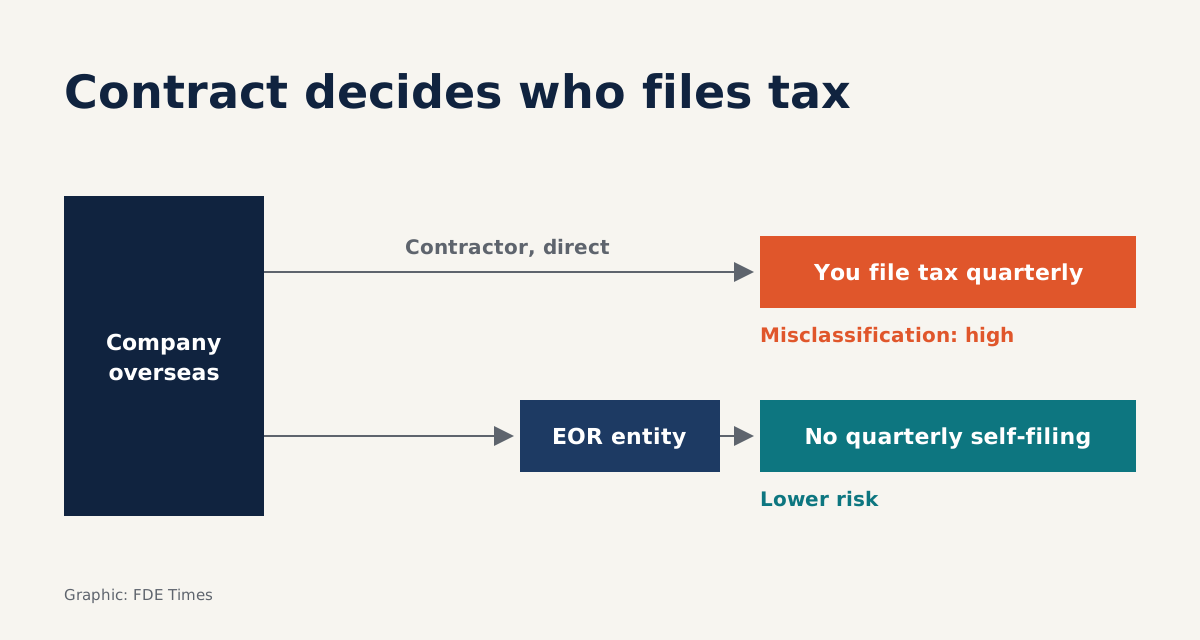
From there, the difference between the two arrangements becomes fairly clear. If you are a contractor paid directly by a foreign company, you almost certainly fall into the quarterly self-declaring group.
If you go through an EOR, there is a Vietnamese entity paying your income, so you are not in the “no income payer” group. Even so, ask the EOR how far it handles withholding and the annual settlement.
| Question | Direct contractor | Through an EOR |
|---|---|---|
| Who is the legal employer in Vietnam? | Nobody; you are the service provider | The registered EOR entity |
| Is the US dollar salary taxable in Vietnam? | Yes, if you are a tax resident; you convert it yourself at the interbank rate on the day received | Yes, it is still taxable income in Vietnam |
| Is there an income payer in Vietnam? | No, so you file quarterly yourself | Yes |
| Annual settlement | You do it; deadline is the last day of the fourth month after the year ends | Ask exactly what the EOR does and what is left to you |
| Misclassification risk | High if the work looks like employment, as most FDE roles do | Lower, because the employment relationship is on paper |
| 500 million dong annual revenue threshold | May be relevant if the income is declared as business income | Does not apply to salary |
A calculation with the new deduction
Try a hypothetical figure, deliberately set low to keep it easy to follow. An engineer receives a salary equivalent to 25 million dong a month, before insurance and other deductions. Subtracting the 15.5 million personal deduction leaves taxable income of 9.5 million dong.
Under the new schedule as summarised by LuatVietnam, the first bracket charges 5% on taxable income up to 10 million dong a month. All 9.5 million falls into this bracket, so the tax is 475,000 dong a month. If the engineer has one dependant, worth a further 6.2 million deduction, taxable income drops to 3.3 million and the tax to 165,000 dong.
Do not treat 475,000 dong as your own tax bill. An FDE offer paid in US dollars is likely to be much higher than this example, so your taxable income will exceed 10 million dong a month and reach the higher brackets.
The top bracket is 35% on the portion above 100 million dong a month. There are three more brackets between those two points, and that is where you need the full five-bracket schedule in the legal text rather than guesswork. The method stays exactly the same: take income, subtract deductions, then split what remains across the brackets.
The exchange rate on the day you are paid is the one that counts
US dollars add a step that people paid in dong never have to think about. According to Vietnam Briefing, foreign-currency income must be converted into dong at the average interbank exchange rate published by the State Bank of Vietnam at the time the income arises.
The consequence is very practical. The rate used for tax is neither the rate at which you changed your money nor an average you estimate for the whole quarter.
A contractor paid twice a month will have six different exchange rates on a quarterly return. The only way to avoid reconstructing the figures in April is to record the rate on the day the money arrives.
The 500 million threshold is not a tax-free pass for contractors
Another change is easy to misread. RÖDL & Partner reports that the revenue threshold for personal income tax exemption for individuals and household businesses has risen from 100 million to 500 million dong a year. For a freelancer declaring income as business income, that is notable news.
But the threshold matters only if your income really is business income. A full-time FDE working for one company, to that company’s rhythm and under its direction, will struggle to argue that they are a household business.
Relying on this threshold to choose a contractor agreement is a bet placed squarely in the misclassification zone described above.
The US dollar figure in an offer is only the starting point. What you actually take home is what remains once tax has been filed on time, with no back-payment waiting down the road.
Was this article useful?
Thanks for the feedback!
6 sources
- Vietnam – New Personal Income Tax Law Reshapes Taxation for Individuals from July 2026 · 2026-02-24
- Vietnam's new personal income tax regime: What foreign workers and investors need to know · 2026-07-16
- Vietnam Personal Income Tax (Vietnam Briefing)
- Tax Guidance for Remote Workers in Vietnam: Understanding and Complying with Tax Obligations on Cross-Border Income · 2025-06-13
- Vietnam Employer of Record - Hiring Guide for 2026 · 2026-03-30
- 2026 Updates in Vietnam's Personal Income Tax Law (RÖDL) · 2026-02-18