Two FDE job posts, two ways of talking about visas: how to read screening questions and what to ask recruiters
The $100,000 H-1B fee is still being fought over in court, so the "do you need sponsorship?" box on an application form matters more than it did. Whether you are inside or outside the US can make a large difference to what it costs to hire you.
In brief
- The question "Will you now or in the future require sponsorship?" is a company filter. It does not tell you whether the company sponsors.
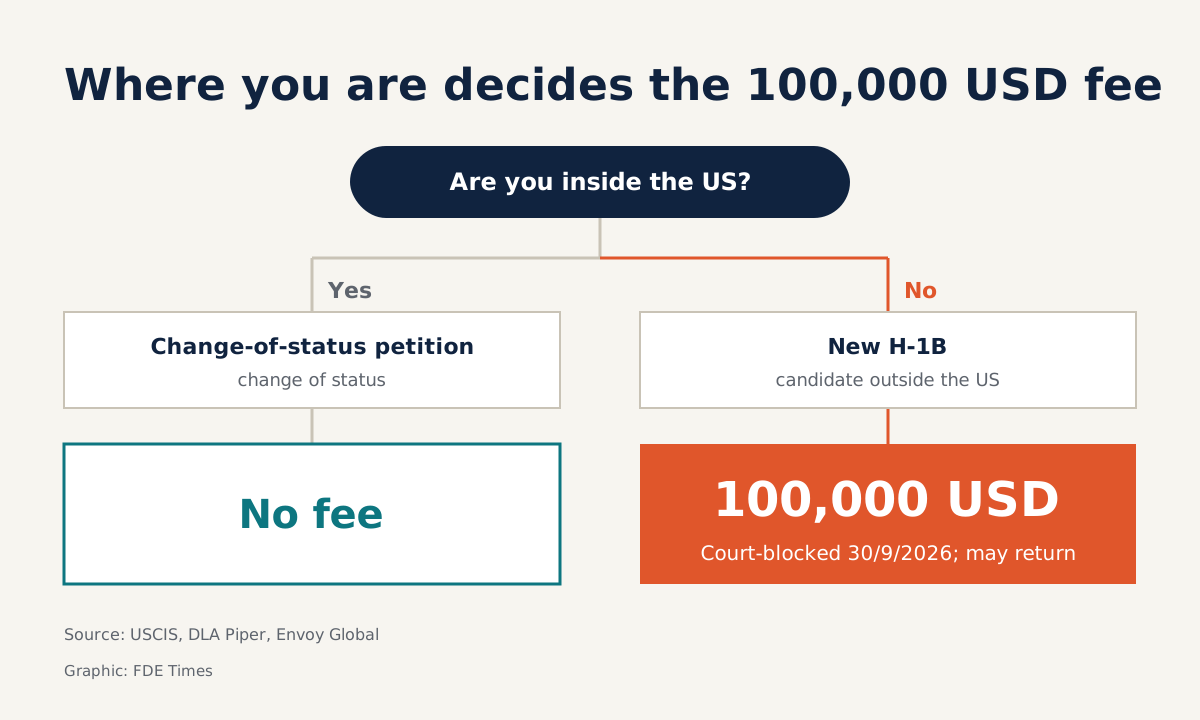
- The $100,000 fee applies to new H-1B petitions for people outside the US, not to change-of-status petitions filed inside the US. Courts are blocking the fee, but USCIS says it will collect if the injunctions are lifted.
- State your visa status clearly and ask about the specific role you are applying for on the very first recruiter call.
The application form for FieldAI’s Forward Deployed Engineer role in Irvine, California has two questions side by side. The first asks whether you are legally authorised to work. The second asks whether you now or in the future will require the employer to sponsor a work visa or work permit. Neither question tells you whether FieldAI sponsors.
Anthropic’s FDE posting in Munich is blunt: “We do sponsor visas!” Straight after that comes a condition: the company cannot successfully sponsor every role and every candidate.
If you are an engineer who needs papers to work in another country, you will meet every kind of wording between those two. This year, reading those lines correctly matters far more. A new fee has split H-1B candidates into two groups with very different costs, even when their skills are identical.
What is the screening question really asking?
FieldAI-style double questions have two parts. The first is whether you can legally work here. The second is whether you need sponsorship, now or in the future. The words “in the future” target people who are allowed to work today, but only on temporary authorisation that will later require another petition.
An F-1 student on OPT in the US can answer “yes” to the first question and still have to answer “yes” to the second.
Do not tick “no” on the second question just because you can work today. A wrong answer here will surface sooner or later when the company prepares the paperwork, and by then you will have wasted both sides’ time.
More importantly, understand what the question is for. It gives the company data to sort your application. It does not tell you whether the company has a sponsorship policy.
Who does the $100,000 fee hit?
According to USCIS guidance as summarised by Boston University’s international students office, the $100,000 fee applies to new H-1B petitions filed after 21 September 2025 for workers who are outside the United States, that is, people who will have to obtain their visa at a consulate.
Petitions filed before that date are not subject to the fee. Employers must attach a pay.gov payment receipt or proof of an exemption. Without it, USCIS rejects the petition.
The law firm DLA Piper notes two further points. The fee is charged once per petition, not every year. And amendments, extensions and change-of-status petitions for people already inside the US are not covered by the fee.
Picture two candidates applying for the same FDE role. The first is on OPT in Boston, so the company only needs to file a change-of-status petition inside the US. The second is an engineer in Bangalore, so the company must file a new H-1B petition for him to get a visa at a consulate.
The two could do the same take-home and get the same score. But only the second candidate’s petition falls under the $100,000 fee: for now the fee is blocked by the courts, but it could be collected if the injunctions are lifted.
Which group you are in changes the conversation with the recruiter. So before you hit submit, you need to know for certain whether your case is a change of status or a new petition.
The courts are blocking the fee, but it has not gone away
The fee’s legal status is still shifting. According to Envoy Global, on 30 September 2026 a court in California issued a preliminary injunction vacating the policies used to collect the fee.
Envoy Global also reports that the First Circuit Court of Appeals declined to stay a June ruling pending appeal. Even so, the presidential proclamation itself has not been struck down.
Business Today reported that as of 25 October 2026, USCIS had begun approving some petitions filed without the fee. The agency says it is complying with the court orders but will collect the fee if those orders are lifted.
For job seekers, the point to note is that USCIS could still collect this fee later. A fee that is paused but could be reclaimed is still a risk that hiring teams have to account for when planning headcount.
Do not bring court news to a recruiter to argue that the fee no longer exists. Your job is to state clearly which type of petition your case requires, so they can weigh the risk correctly themselves.
Which signals in a job post are real?
Anthropic’s line is a good example of a policy put into words, even though that posting is for Germany and has nothing to do with H-1B. It has all three parts: an affirmation, a limit, and a commitment to make reasonable efforts once an offer has been made.
The company itself also advises candidates to ask the recruiter about their specific role. Set against FieldAI’s screening question, you can see how differently the two styles inform you.
| Line in the job post | What it tells you | What it does not tell you | What to ask the recruiter |
|---|---|---|---|
| FieldAI’s double question (authorised to work? need sponsorship now or in the future?) | The company wants your status in order to sort applications | Whether the company sponsors, and for which petition type | Does this role accept candidates who need sponsorship? |
| “We do sponsor visas!” (Anthropic, Munich) | The company has a sponsorship policy | Whether that policy applies to your role and profile | Has this role sponsored candidates with a profile like mine before? |
| The “not every role, every candidate” limit plus a commitment to reasonable efforts after an offer | There are exceptions, and the company promises reasonable efforts once an offer is made | Where the exceptions lie, and what “reasonable efforts” means in practice | If a visa cannot be obtained for this role, what are the alternatives? |
The last column is what you bring to the call yourself. No job post answers those questions for you, not even the clearest one.
Ask in the first round, and ask specifically
Imagine going through several interview rounds, each taking a week of preparation, only to learn in the final round that the role does not sponsor people abroad. All that time is lost. So raise the visa question on the first recruiter call, before anyone has invested much effort.
Open with a statement of fact, not a request for a favour. If you are on OPT, you might say you will need an H-1B through a change of status inside the US from next year.
If you are outside the US, say plainly that the company will need to file a new H-1B petition. That single sentence tells the recruiter which of the two groups above you belong to.
Then ask exactly what Anthropic’s posting admits needs asking: does this specific role sponsor? Next, ask whether the company is filing petitions for candidates outside the US.
The third question covers the worst case: if an H-1B is not feasible, does the company hire FDEs in other offices? Anthropic has an FDE posting in Munich, so this is not a far-fetched question.
This is an FDE skill too
Treat the call as a miniature customer discovery session: the hardest question should come early, before either side has invested much. When you state your visa status clearly and ask directly about policy in the first round, the recruiter also sees how you ask questions.
On your CV, put a short line about work authorisation right at the top, using the correct terms, for example “F-1 OPT, requires H-1B change of status”. Do not leave the reader guessing. The advice holds whether you are applying to Munich, London or any other city that requires a work permit.
The rules on the fee will keep changing with each ruling. Your status, and the questions you put to the recruiter, are in your hands from the very first call.
Was this article useful?
Thanks for the feedback!
6 sources
- USCIS Publishes Additional Guidance Regarding $100,000 H-1B Fee (BU ISSO) · 2025-10-20
- White House proclamation introduces $100,000 H-1B visa fee: Key considerations (DLA Piper) · 2025-09-23
- US approves H-1B petitions without $100,000 fee. Here's what workers and employers need to know (Business Today) · 2026-10-25
- U.S. Court Vacates H-1B $100,000 Fee Policy Pending Rulemaking (Envoy Global) · 2026-10-01
- Forward Deployed Engineer (Irvine, CA) – FieldAI on Lever
- Forward Deployed Engineer (Anthropic, Munich) – General Catalyst job board