Palantir posts the same $135,000–$200,000 base band for FDSE roles in Government, New York and Seoul
Three Palantir FDSE listings in three cities carry the same base band. What you actually take home depends on your level, on RSUs that sit outside the posted figure, and on a security clearance that no amount of coding skill can substitute for.
In brief
- Palantir's Government listing in Colorado Springs, its New York listing and its Seoul listing all post the same base band of $135,000–$200,000 a year.
- The New Grad - Commercial listing tops out at $145,000. The gap is tied to level and is not enough to show that Commercial pays less.
- The Government listing states that the base band excludes signing bonus, benefits and the future value of RSUs, and it requires an active Top Secret clearance.
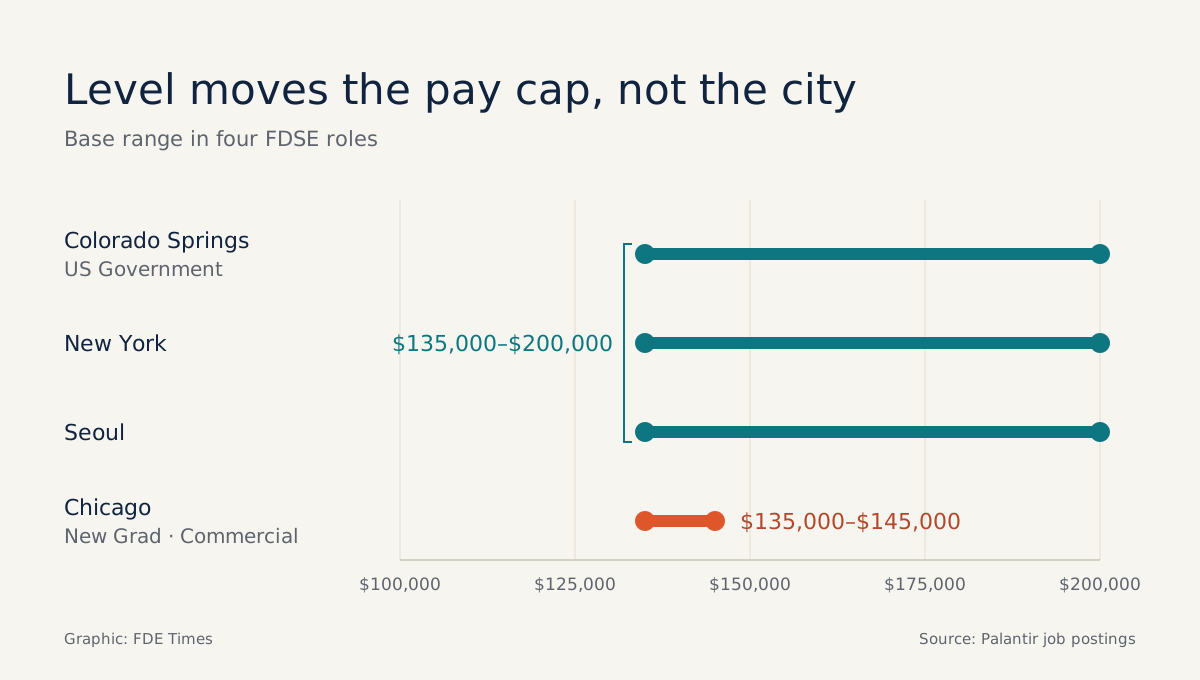
Palantir has three job listings for Forward Deployed Software Engineers (FDSEs) in three different places. One is in Colorado Springs for US Government work, one is in New York with no business-unit label, and one is in Seoul. All three post the same estimated base band: $135,000–$200,000 a year.
A fourth listing is for a Commercial new grad in Chicago. The floor is still $135,000, but the ceiling stops at $145,000.
If you are about to apply, or are holding an FDE offer, this detail deserves a close look. In these listings, neither the Government label nor the location changes the posted base band. The differences most likely come from level, from the part of pay the listing leaves out of the figure, and from a requirement that technical skill cannot make up for.
Three cities, one band
The three listings differ quite a lot in context. The Colorado Springs role sits in US Government. The New York role is hybrid and names no business unit. The Seoul role carries the label “Korea Forward Deployed”.
Even so, all three show the same $135,000–$200,000 band. The Colorado Springs and New York listings also both state that total compensation may include RSUs and a signing bonus.
So, on paper at least, location neither raises nor lowers the band. The band spans $65,000, meaning the gap between floor and ceiling is almost half the floor. With a range that wide, the real question is where in the band you are placed, not which city you apply in.
The table below puts the four listings side by side to show which variables change and which stay fixed.
| Listing | Location | Posted base band | Clearance requirement | RSUs / signing bonus |
|---|---|---|---|---|
| FDSE - US Government | Colorado Springs | $135,000–$200,000 | Active Top Secret | May be included |
| FDSE (no business unit) | New York, hybrid | $135,000–$200,000 | Not stated | May be included |
| FDSE - Korea Forward Deployed | Seoul | $135,000–$200,000 | Top Secret, willing to obtain SCI | Not stated |
| FDSE, New Grad - Commercial | Chicago | $135,000–$145,000 | Not stated | May be included |
The column that changes most is the ceiling. And the listing with the lowest ceiling is not the Government one. It is the new-grad one.
Does Commercial pay less, or is it just new grad?
At a glance, it is tempting to conclude that Commercial pays $55,000 less than Government at the top of the band. But that conclusion has no solid basis. Of the four listings, the only one explicitly labelled Commercial is also the only one for new grads, so the two variables are tangled together.
Another source supports this reading. Aced (formerly Exponent) compiled official listings from September 2026 and records that new grads in the NY/DC band earn a base of $135,000–$145,000, matching the Chicago listing. In other words, $145,000 is the ceiling for the new-grad level, not the ceiling for Commercial.
The lesson for reading job descriptions: look at the level label first, then the business-unit label. A regular FDSE listing in Commercial, if one exists, would quite possibly use the same $135,000–$200,000 band as the other three. There is no such listing yet to check against, so this remains an inference, not a verified fact.
What the listing leaves out is what matters
The Government listing says plainly that the band is base pay only. The estimate excludes signing bonus, benefits and the future value of long-term incentives. The same listing also says total compensation may include RSUs, a signing bonus and future long-term incentives.
This is where many people compare the wrong things. Aced cites levels.fyi data putting median total compensation for FDSEs at about $208,000, and states clearly that this is an estimate, not a figure Palantir publishes. Levels.fyi calculates total compensation as base plus annualised stock plus bonus.
So setting $208,000 next to the $200,000 base ceiling and concluding that “stock barely adds anything” compares two different things. One is the median of total compensation; the other is the ceiling of base pay alone.
In the UK, levels.fyi gives only a median total of £140,114 for FDEs, without splitting out base, stock and bonus. With a figure like that, all you know is the total. You do not know how much is guaranteed cash and how much depends on the share price.
A hypothetical offer shows why each year needs to be calculated separately. Suppose a base of $150,000, an RSU grant of $200,000 vesting evenly over four years, and a $20,000 signing bonus. In year one you receive $150,000 + $50,000 + $20,000 = $220,000. In year two that falls to $200,000, because the signing bonus is paid once.
The example also quietly assumes the share price stays flat. The future value of RSUs is excluded from the posted band precisely because it is uncertain. When you hear a first-year total, ask which part is cash and which part depends on the market.
Clearance is an entry requirement, not a pay premium
The real dividing line is the entry requirement. The Colorado Springs listing requires an active US security clearance at Top Secret or above. The Seoul listing requires an active Top Secret clearance and willingness to obtain SCI.
Nor does clearance appear as an addition to pay: the Government listing demands Top Secret yet posts exactly the same base band as the New York listing. Without an active clearance, though, the door to roles like these two is all but closed, however good you are at deployment.
Most engineers in the world do not have, and cannot train their way into, a US security clearance. For them, the place to look first is Commercial listings and listings with no business-unit label. The New York listing shows that an FDSE role without a Government label still posts the full $135,000–$200,000 band.
Which numbers to negotiate with?
When the base band spans $65,000 and RSUs and signing bonus sit outside the posted figure, the conversation with the recruiter should centre on three questions: what level you are placed at, what vesting schedule the RSU grant follows, and whether the signing bonus is paid at once or in instalments, and on what conditions.
The listing answers none of these, so you have to ask directly.
Palantir does not say what places a candidate near $135,000 or near $200,000. The most plausible reading of the gap between the new-grad listing and the regular FDSE listings is level, and level is something you can prepare for now. In your CV and in interviews, do not just list the technologies you have used.
Describe which part of a deployment you owned: who the customer was, what you decided when nobody was assigning you work, and what the measurable result was.
New graduates should read the $145,000 ceiling for what it is: the ceiling of a level, not of the profession. The step up to the regular FDSE band already has a public price, and that price is the same in Colorado Springs, New York and Seoul.
Was this article useful?
Thanks for the feedback!
6 sources
- Forward Deployed Software Engineer - US Government (Palantir, Lever)
- Forward Deployed Software Engineer (Palantir, Lever, New York)
- Forward Deployed Software Engineer, New Grad - Commercial (Palantir, Lever)
- Forward Deployed Software Engineer - Korea Forward Deployed (Palantir, Lever)
- Palantir FDE salary (Aced / Exponent) · 2026-09-02
- Levels.fyi – Forward Deployed Software Engineer Salary (UK) · 2026-10-26