Digital twin or AI agent is the wrong question for factories
A twin tells you what will happen and an agent decides what to do, and an agent that touches a live line without a twin can do real damage.
In brief
- Agents usually handle planning and execution, while digital twins usually monitor passively. Combined, they make an asset both intelligent and true to reality.
- LLM-based agents do not understand physics, so they can recommend breaching safety thresholds or optimize locally in ways that damage the whole system.
- Twins are expensive, slow to pay back and useless with poor data, so do not assume the twin comes first.
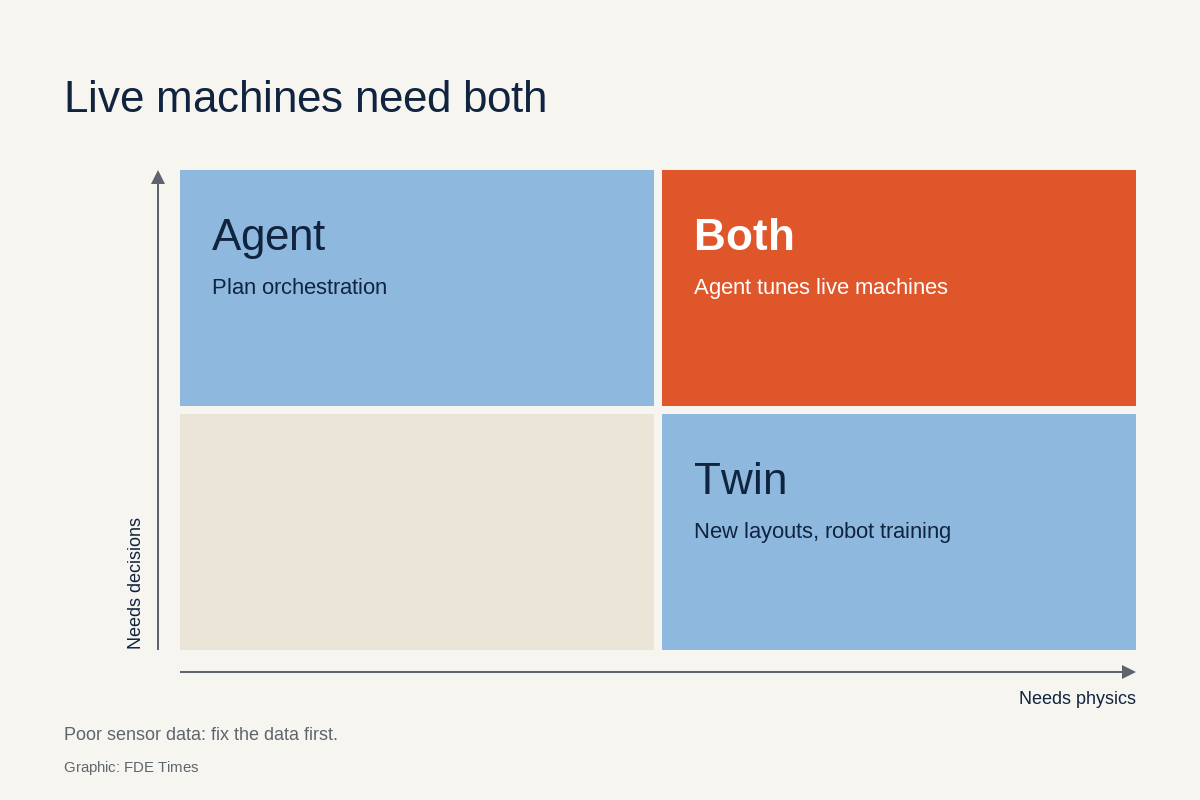
A systematic comparison of software agents and digital twins in industrial manufacturing, published on arXiv in 2023, draws a fairly sharp line between the two. Agents are typically used to co-plan and execute production processes. Digital twins are typically more passive: they monitor production resources and process information.
That line matters the moment a manufacturing client asks an FDE whether to invest in a digital twin or an AI agent. The question sounds like a choice between two options, and it is framed wrongly. The two technologies do not compete, because they answer different questions, and an agent that touches a real production line without the other can cause harm.
For an FDE, the boundary works as a diagnostic tool. Once you know whether the client needs something to make decisions or something to understand the physical world correctly, you will not sell the wrong solution or spend six months building something the client does not yet need.
The twin knows physics, the agent knows how to act
A useful way to think about it: the twin answers “if we do this, what happens?”, and the agent answers “so what should we do?” One is a model; the other is a decision-maker. Which side a factory problem belongs to depends on whether real actions will be taken on equipment that is running.
Some problems need only a twin. Siemens and NVIDIA describe using AI to simulate hundreds of factory layout options to find the most efficient design.
That is design-stage work, before any agent is running a production shift. Rev Lebaredian of NVIDIA goes further: training robots in a virtual environment before any hardware is installed.
NVIDIA also cites a result it published itself: BMW Group gained up to 30% in efficiency when planning new factories from scratch. This is a vendor’s figure. Read it as a signal of the kind of problem twins handle well, rather than a promise for every client.
Why an agent cannot stand alone on the factory floor
The agent’s strength, by contrast, is planning and execution. Trouble starts when an LLM-based agent is allowed to recommend settings for physical equipment. XMPro, an industrial software vendor, states the weakness bluntly: LLMs learn from internet text, so they have no built-in understanding of physical systems.
From that weakness, XMPro identifies two failure modes. The obvious one: without explicitly declared operating limits, an agent can recommend actions that exceed safety thresholds. The subtler one: the agent optimizes for a local goal and creates problems for the system as a whole.
Take a hypothetical confectionery plant. A scheduling agent receives a rush order and proposes speeding up the conveyor in the packaging area to make the delivery date. Viewed in isolation, the decision makes sense.
But if the new speed forces the upstream oven to run hotter than its permitted limit, or piles up product in the cooling area, the agent has made both mistakes at once.
Because the root of the error is that LLMs lack built-in physical knowledge, a few lines of instruction in a prompt are unlikely to prevent it. A sturdier safeguard is a model that knows how many degrees the oven can withstand and how material flows between areas, and that is precisely what a twin provides.
NVIDIA positions the twin as a safe environment for training, testing and validating AI. In this example, that means running the agent’s proposal on the twin before it touches the real machine.
Combined, each covers the other’s weakness
The arXiv study concludes that when agents work alongside twins, production assets become intelligent, autonomous and cooperative while also closely reflecting reality. The division of roles is clear: the agent brings autonomy and coordination, the twin brings fidelity.
XMPro’s CEO goes further, calling the twin an essential foundation for building trustworthy industrial agents. Bear in mind that XMPro sells a twin platform, so there is a conflict of interest. Even so, the two failure modes above are real, and they make a technical case as well as a commercial one.
Twins are not free, and poor data rules them out
This is where every “build the twin first” proposal deserves scrutiny. TechTarget notes that the cost of creating and running a twin can mean many organizations wait a long time for a positive ROI. Worse, missing or poor-quality data limits the use of a twin and can even make it unusable.
So the first question an FDE should ask a client is “what does your sensor data look like?”, rather than “twin or agent?” A plant with patchy sensors, frequent dropped samples and unsynchronized timestamps is not ready for a twin. Building one there pours budget into a wrong model.
The table below helps read a client request quickly:
| Situation at the client | What is needed | Why |
|---|---|---|
| Designing a new factory layout | Twin | Simulate many options; there is no live operation yet for an agent to act on |
| Robots about to be installed, need training first | Twin | A virtual environment stands in for hardware that does not exist yet |
| Coordinating plans, paperwork and tasks that do not touch machine settings | Agent | Plays to planning and execution strengths; little physical risk |
| Agent recommends or adjusts settings on running equipment | Both | The twin checks safety limits and system-wide impact before execution |
| Sensor data missing or poor | Neither yet, for the physical side | Fix the data first; a twin running on poor data is unusable |
The third row is an inference from the boundary the study draws; no source offers it as a ready-made recommendation. Still, it explains why a first agent project in a factory should start at the coordination layer: value arrives quickly, risk is low and there is no need to wait for a twin.
What FDEs should practice from this boundary
The key skill is turning physical limits into constraints in code. Every threshold an operations engineer gives you should become a check the agent must pass before acting, instead of sitting in a document nobody reads.
The second skill is judging whether the data is ready before making promises. An FDE willing to say “don’t build a twin yet; first we need to do these three things with the data” usually earns more trust than one pitching the biggest solution.
When reading FDE job descriptions at industrial companies, check whether the role involves sensor data, simulation or safety constraints. If it does, that is where the skill of standing between these two worlds gets used, and you should prepare concrete examples for the interview.
On your CV, do not just write “built AI agents”. Spell out which real-world limits you constrained the agent with, how you validated it in simulation and what the results were. That shows you understand that in a factory, a wrong decision is more than a bug.
Next time you sit down with an operations engineer, bring four questions: which settings must never be exceeded, which areas does a change here ripple into, which sensor data is complete and reliable enough to model, and will the agent be allowed to touch machine settings or only coordinate work.
Those four answers are enough to tell whether the client needs a twin, an agent, or both.
Was this article useful?
Thanks for the feedback!
5 sources
- Systematic Comparison of Software Agents and Digital Twins: Differences, Similarities, and Synergies in Industrial Production · 2023-07-17
- Digital Twins: The Essential Foundation for Trustworthy Industrial AI Agents · 2025-05-08
- What Is a Digital Twin? | NVIDIA Glossary
- Siemens and NVIDIA preview technology for AI-era manufacturing · 2025-10-30
- 9 advantages and disadvantages of digital twin technology · 2024-05-30