Trovata's treasury agent runs alone but cannot touch the database
The agent works unprompted, yet reads data only through a vetted API layer and never with more permission than the user it runs on behalf of.
In brief
- On 10 November 2026, AWS published a case study on Trovata's move from AI that surfaces insights to an autonomous treasury agent running on Amazon Bedrock AgentCore.
- The agent gets data only through a vetted API layer, never directly from the database, and RBAC keeps its permissions within those of the user.
- The agent runs on a schedule or when an alert fires, uses Claude Sonnet 4.6, and must be enabled both per role and at the organisation level.
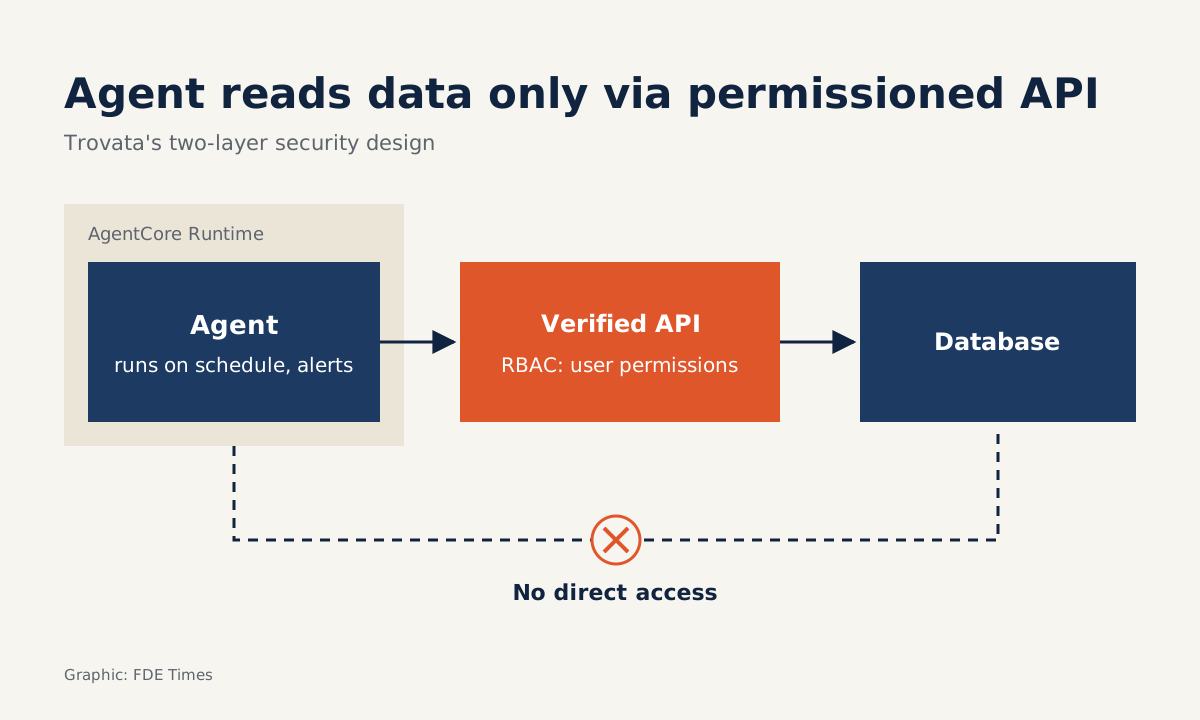
Trovata has let an AI agent run on its own inside the treasury systems of its corporate customers. There is one thing it does not let the agent do: read the database directly. That is the most valuable detail in the case study AWS published on 10 November 2026, co-written by Joseph Drambarean, Trovata’s CTO, and Kushal Mangtani of AWS.
The piece describes how Trovata moved from AI that merely offers insights to an autonomous treasury agent, built inside Trovata’s own treasury management platform. On the surface, it is a product story.
For an FDE, it is close to a reference design for the question that financial customers, and any tightly regulated customer, usually ask first: what can the agent see?
The agent sees only what the user can see
Trovata’s security design rests on two layers. First, the agent fetches data only through Trovata’s vetted API layer and never accesses the database directly. Second, role-based access control keeps the agent within the permissions of the real user.
Picture an agent triggered when a cash balance runs low. It runs under the role of an analyst who may view the accounts of only two subsidiaries.
If the agent had a direct path to the database, a single badly written query would let it read a third account as well. When the agent goes through an API that checks permissions, that kind of error cannot happen, because the API never returns that data to this role.
Trovata’s help centre documentation adds another layer. The agent feature must be granted per role and switched on at the organisation level. In other words, customers decide for themselves whether to use the agent at all, and who may use it.
An analyst that runs on a schedule
According to the help centre, Trovata’s agent works like an analyst: it runs on a schedule, or is triggered when an alert fires.
This matches the AWS article’s description of agents that run on schedules, triggers and rules. The help centre also states that the model behind the agent is Claude Sonnet 4.6.
Most treasury work follows a fixed rhythm or reacts to thresholds, so the agent does not need a chat window to be useful. A schedule and alerts are enough to set it to work.
During discovery with a customer, ask which tasks they repeat every morning and which thresholds make them stop and check. Those are the jobs to hand to an agent first.
Which part of the problem does AgentCore handle?
The whole system runs on Amazon Bedrock AgentCore. Trovata’s help centre describes it as an isolated, secure environment, but bear in mind that this is the vendor’s own documentation, not an independent audit.
AWS launched AgentCore in July 2025, presenting it as a platform for building, deploying and operating agents securely at scale.
The layer credited with isolating the agent is Runtime, a serverless environment with per-session isolation. Beyond Runtime, AgentCore has separate blocks for memory, OAuth identity, observability, converting tools to MCP, a browser and code execution. The architecture is modular, so teams use only the parts they need.
The platform handles isolation; the permission boundary Trovata draws itself, in its API layer. If a customer does not yet have a permission-controlled API layer like this, the FDE’s first job is to build it, and only then the agent.
Putting the lesson on your CV
If you want to move into FDE work, do not write only “built an agent” on your CV. Describe how that agent accesses data, how its permissions are limited and which test proves it cannot read what it is not allowed to.
When applying for roles that serve financial customers, prepare a concrete answer to the question of what the agent can see. Trovata’s design is a good example to take into the interview.
With tightly regulated customers, the worrying question is not how clever the agent is. It is where the agent is stopped, and the FDE needs that answer ready before the demo.
Was this article useful?
Thanks for the feedback!