An eight-week FDE prep plan targets the round most candidates fail
The round that sinks the most candidates involves no code at all, and this plan has candidates practising it from the first five weeks.
In brief
- DevPREP's pull request #46 adds an eight-week FDE prep plan of roughly 8–10 hours a week.
- The first five weeks cover coding, customer discovery, integration, prototyping and decomposition; weeks 6–7 pick a track; week 8 is a mock loop.
- The round that decides an FDE offer often has no code, and the most common reason for rejection is jumping straight to a solution.
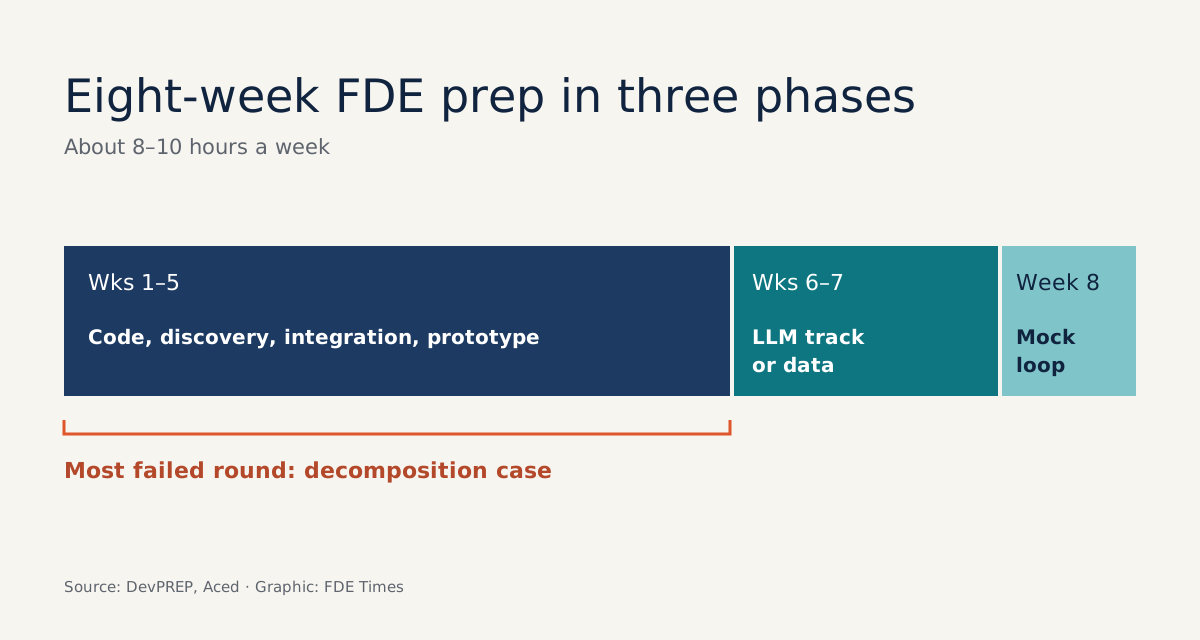
Pull request #46 to DevPREP, an interview-preparation repository on GitHub, adds an eight-week plan for the Forward Deployed Engineer role. It budgets roughly 8–10 hours a week, manageable for an engineer in a full-time job.
A single PR is not big news in itself. What stands out is where it spends the time: the first five weeks include dedicated sections on customer discovery and the decomposition case interview, the round that Aced, an interview-guidance site, identifies as the one where FDE candidates fail most often.
If you are a software engineer preparing mainly with LeetCode, this is almost certainly your gap.
In what order do the eight weeks run?
The first five weeks start with coding fluency and customer discovery, then move on to systems integration, prototyping and decomposition case practice. In weeks 6 and 7 you choose a track: LLM applications is the default, with data integration as the alternative. Week 8 is given over entirely to a mock loop.
The coding section contains exactly one problem, “latest-customer-records”, with solutions in two languages that both pass its test suite. The name reveals the author’s choice: customer records, not binary trees.
Picture a customer file with three rows for the same person, each updated at a different time, where you must keep only the most recent one. By making this kind of problem the only coding exercise, the plan implicitly bets that messy customer data is more worth practising than pure algorithms.
Why does the round without code decide the offer?
TechInterview observes that the round deciding an FDE offer often contains no code at all, and only about four in ten candidates get through. The coding round is the closest thing to a conventional technical interview; most of the process is conversation.
Educative lists four FDE interview rounds: alongside technical and behavioural, there are decomposition and customer simulation. According to Educative, the decomposition round tests whether you can tackle an ambiguous problem methodically.
Aced is blunter still: FDE candidates fail this round more than any other. The most common reason for rejection, according to Aced, is jumping straight to a solution in the decomposition round.
One prompt, two answers
Take this prompt: “A logistics company wants to use AI to cut the time it takes to process returns.” A candidate used to LeetCode will sketch a complete agent architecture in the first five minutes. That is precisely the mistake Aced names.
A candidate who has practised asks questions first: who handles returns today, which system holds the order data, and is “faster” measured in hours or in the size of the backlog. Only then do they break the problem into smaller parts.
Aced’s framework ends with a memorable step: propose a walking-skeleton MVP, then iterate. For the prompt above, that might be a single end-to-end flow for one type of return, before any talk of scaling up.
How do you build your own schedule?
You do not need DevPREP to follow the same logic. One way to split 10 hours a week across the first five weeks: 3 hours on customer-data coding problems, 3 on discovery, 4 on decomposition. Decomposition gets the most hours because, according to Aced, it is the round most people fail.
For coding, cut back on pure algorithm time and replace it with problems in the “latest-customer-records” mould: deduplicating, keeping the most recent record, merging two sources with mismatched formats, always with tests. For discovery, ask a friend to play a difficult customer to simulate the customer simulation round.
For decomposition, set a 45-minute timer, record yourself, then listen back and count how many questions you asked before proposing a solution. In weeks 6–7, pick your track to match the job postings you are targeting: LLM applications if the description mentions agents, data integration if it mentions pipelines. In week 8, run all four rounds back to back.
The story you take into the interview
A plan with a single coding problem is a skeleton, not a full curriculum. What it cannot prepare for you is real experience.
AI Engineering Insider describes the core of the job as ownership: FDEs are responsible for production code in the customer’s environment after the contract is signed. The newsletter therefore advises candidates to prepare one concrete project they handled from discovery to deployment, not just the build.
Put that story on your CV and into the behavioural round. FDE interviewers want to hear what you asked before you wrote code, not just how fast your code runs.
Was this article useful?
Thanks for the feedback!
5 sources
- Study plans: an 8-week Forward Deployed Engineer plan · Pull Request #46 · adamsdenniskariuki/DevPREP · 2026-11-10
- Understand the Four Interview Rounds for Forward Deployed Engineers
- Forward Deployed Engineer (FDE) Interview: The Definitive 2026 Guide
- What the forward deployed engineer interview really tests · 2026-08-05
- Cracking the Forward Deployed AI Engineer Interview · 2026-07-21