OpenAI's Colin Jarvis: enterprise AI is stuck at deployment, not at the model
OpenAI's head of global Forward Deployed Engineering argues that the model is only a small part of the problem. Most of it lies in data, access, evaluation and how the customer organises its teams.

In brief
- Colin Jarvis, who leads global FDE at OpenAI, estimates the model accounts for about 20% or less of the deployment gap
- The rest is the customer's organisation: data, access, evaluation and team structure
- The FDE goal is to make customers self-sufficient and leave reusable playbooks behind, not to sell services
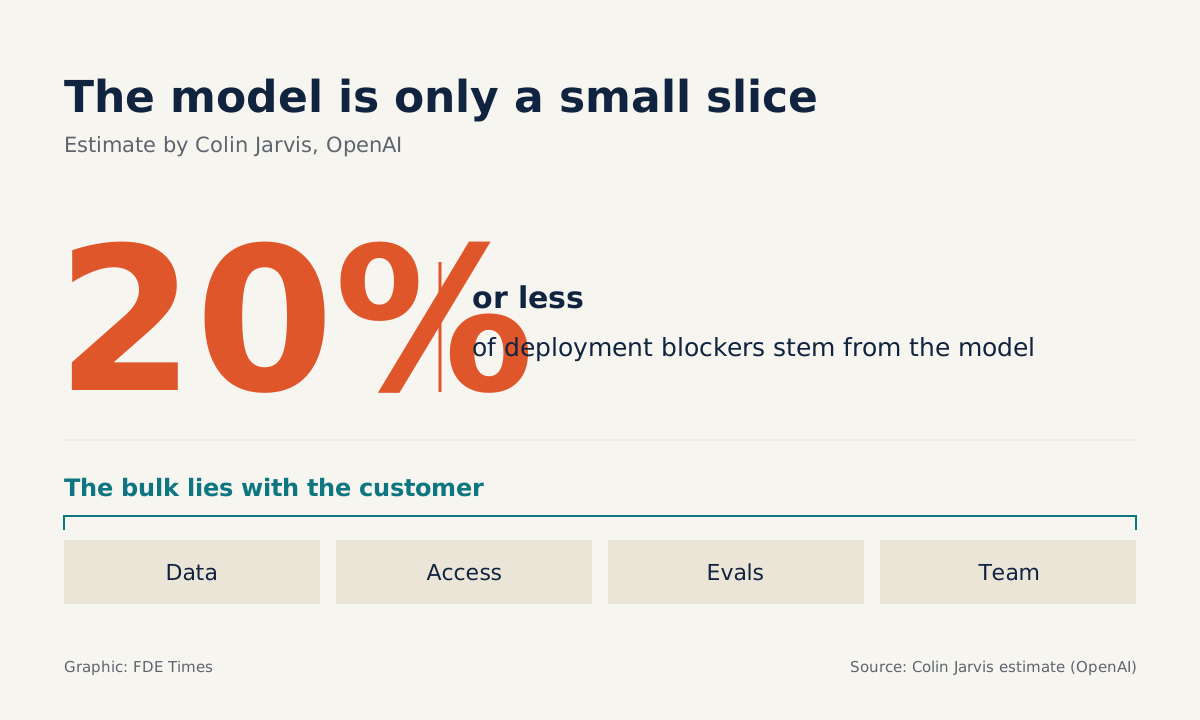
Colin Jarvis estimates that model capability accounts for “about 20% or less” of the deployment gap in enterprise AI. Jarvis leads Global Forward Deployed Engineering at OpenAI. In his view, most of the rest sits not with OpenAI but inside the customer’s organisation: data, access, evaluation and team structure.
The claim carries weight because he has done the work. His speaker biography at HumanX says he was responsible for OpenAI’s technical deployments at Morgan Stanley, Klarna, Coca-Cola and elsewhere. At HumanX Amsterdam he gave a session titled “Turning the Promise of Frontier AI into Reality”.
If you work as an FDE, or want to move into the role, the claim doubles as a job description: the hard part of the job is not calling an API.
The model is no longer the bottleneck
Picture a bank that wants an agent to answer questions for its financial advisers. The demo on sample documents runs well. Once it goes into real use, the hard questions surface one by one.
The real documents are scattered across three systems. Advisers at one branch are not allowed to see client files from another branch.
Nobody has defined what a “correct” answer looks like. And no team has agreed to own the system after launch.
None of these problems is solved by a stronger model. They are the larger share Jarvis is talking about. They are also why OpenAI has to put engineers inside companies rather than simply sell access.
Trust comes before ROI
In an Altimeter Capital podcast episode released in November 2025, Jarvis was introduced as OpenAI’s Head of Forward Deployed Engineering. There he described work with Morgan Stanley and with a European semiconductor company.
The episode summary stresses that concrete ROI requires FDEs to stay close to the customer, understand their specific needs and build trust.
The order matters. You are allowed to touch sensitive data, obtain access or change a team’s workflow only once the customer trusts you. Working with stakeholders is therefore not an optional “soft skill” but the condition for the technical work to begin at all.
Success is when the customer no longer needs you
Jarvis states the goal plainly: “We want to help customers build the capability to do the next use cases themselves.” Another summary of the episode says the FDE team aims for reusable product playbooks, not services revenue.
The team’s size makes the same point. According to that summary, published around November 2025, OpenAI’s FDE team had only 39 engineers at the time, with a target of 52 by the end of the year.
With that headcount, the team cannot stay with each customer indefinitely. Every deployment has to leave behind a capability the customer can run on its own, and a lesson the team carries to the next customer.
What this changes on your CV
If you are applying for an FDE role, do not just write “built a RAG application”. Describe which customer-side bottleneck you cleared: which data sources you consolidated, how you designed access control, how many test cases the evaluation set had, and which team runs the system now that you have left.
Take the hypothetical bank above. The CV line before: “Built a RAG chatbot for a bank.” The CV line after: “Consolidated documents from three systems, set up branch-level access control, defined a correct-answer evaluation set with the advisers, then handed the system over to an internal team to run.”
When reading job descriptions, look for words such as “enablement”, “playbook” or “handover”. They signal that the company understands the job the way Jarvis does.
The self-sufficiency goal Jarvis sets suggests a simple yardstick for your own work: a deployment is truly finished only when the customer’s team can deliver the next use case without calling the FDE back.
Was this article useful?
Thanks for the feedback!