Itaú opens its ia.i assistant to 300,000 customers and runs several models behind it
Two years ago the Brazilian bank's CIO said generative AI was not ready for customers. Now Itaú is rolling it out in stages to its whole customer base, on a platform it built itself.

In brief
- Itaú began expanding its ia.i assistant to 300,000 customers on 27 July 2026, after a pilot with a small group on 9 June.
- ia.i runs on a multi-LLM architecture that Itaú orchestrates itself; the bank's generative AI tools are built on its in-house platform, Inteligência Itaú.
- For FDEs, the model is now just one component. Clients need people who can help them run the orchestration layer, evaluate quality and scale up in stages.
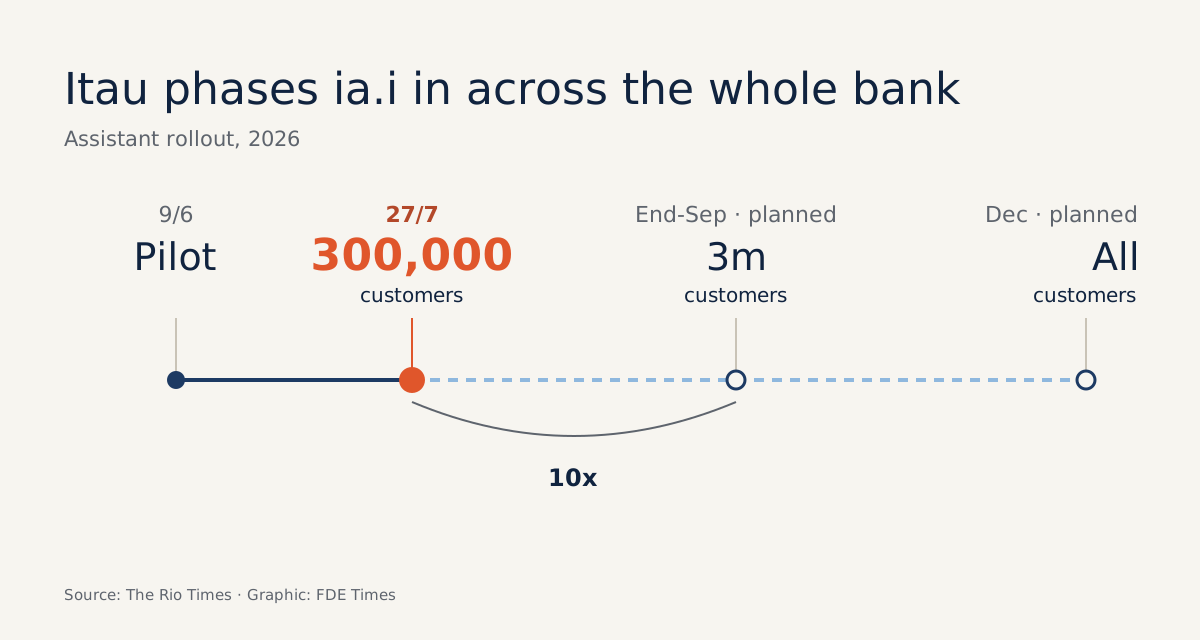
On 27 July 2026, the Brazilian bank Itaú Unibanco began expanding its generative AI assistant, ia.i, to 300,000 customers. Those customers can now type or say what they want in everyday language instead of tapping through buttons and menus.
The 300,000 figure is only an intermediate stage. Before that, on 9 June, a small group of customers was given access to a pilot. According to The Rio Times, the bank’s plan at the time was to open ia.i to 3 million customers before the end of September 2026, and then to all customers in December 2026.
What matters for FDEs lies in two other details: how Itaú built the system, and how quickly it changed its mind. That is the pattern of enterprise client you will meet more and more often.
From “not ready” to the whole bank in two years
In June 2024, Ricardo Guerra, Itaú’s CIO, said the technology was “still not ready to be offered to customers at scale”. He added that the bank could see it advancing quickly. Two years later, the same bank has scheduled the assistant for its entire customer base.
Itaú did not stand still in those two years. According to Canaltech, the bank almost doubled the number of generative AI projects in operation during 2025. Its generative AI tools are built on an in-house platform called Inteligência Itaú.
Carlos Eduardo Mazzei, the bank’s CTO, told a Gartner conference that this in-house platform approach had increased the number of initiatives running in production by 141% in a single year. The figure is the bank’s own and has not been independently audited.
The model is a component; the orchestration layer is the product
According to The Rio Times, ia.i runs on a multi-LLM architecture that Itaú orchestrates itself, rather than relying on one vendor’s model. For a bank, the choice makes sense. It keeps the freedom to switch models when price or quality changes, and it keeps safety rules and customer data in a layer it controls.
The consequence for FDEs is clear. If you work for a model provider and walk into a client like Itaú, do not expect it to build the whole system on your product.
Your model is only one of several options in its router, and you have to prove that it wins on the client’s own tasks, measured with the client’s own evaluation suite.
Imagine the client wants your model to handle questions about card statements. The first step is not a demo.
You ask for a few hundred real, anonymised questions, run your model alongside the one the client already uses, and produce a comparison of accuracy, latency and cost per interaction.
That is what the platform team at a bank like this needs to make a decision.
A staged rollout is a skill, not a formality
Itaú’s schedule moves from a small pilot group to 300,000, then 3 million, then every customer. Going from 300,000 to 3 million is a tenfold jump, and with each jump of that size, errors that were rare in a small group become daily events.
So whoever runs the deployment has to know in advance which metrics must hold before the next stage can open. In that role, you can tie each stage to a checkpoint: in the pilot, measure accuracy on real questions; at 300,000, track the hand-off rate to human staff and the rare errors.
Before moving to 3 million, check latency and cost per interaction; open the final stage only when those metrics stay stable.
This is something you can practise now, in any country. When you read FDE job descriptions at banks or fintech companies, look for phrases such as LLM orchestration, evaluation, staged rollout or guardrails.
On a CV, a line such as “scaled an assistant from a pilot group to N users while keeping the hand-off rate to staff below X%” carries far more weight than “experience with LLMs”.
The question for December is not whether ia.i will work, but what kind of engineers a bank that owns its orchestration layer will need alongside it, and whether you are one of them.
Was this article useful?
Thanks for the feedback!
4 sources
- Brazil's Itaú Bank GenAI Assistant Tops 300,000 Users · 2026-07-28
- Itaú expande uso de IA generativa em apps, Pix e prevenção a fraudes em 2025 · 2026-02-11
- Carlos Eduardo Mazzei | Gartner Data & Analytics Summit
- Ricardo Guerra, Itaú: IA Generativa ainda não está pronta para ser ofertada em escala aos clientes · 2024-06-26