Anthropic is training 10,000 deployed engineers. Agent experience is optional; a habit of tackling big problems is not
Anthropic is not hiring these FDEs. It is training its customers' own staff, and the way it picks them shows what AI deployment work is short of.

In brief
- Anthropic aims to train 10,000 Frontier Deployed Engineers by the end of 2027, and none of them will be Anthropic employees.
- Agent-building experience is not required. Anthropic wants strong fundamentals, experience with LLMs and a habit of going after the business's most important problems.
- Entry is by nomination from your organisation: participants lead a real Claude use case for 12 weeks and earn two badges.
Anthropic will spend $100m to train 10,000 engineers, and it will hire none of them. Claude Frontier Academy aims to produce 10,000 Frontier Deployed Engineers by the end of 2027, and according to Let’s Data Science, no graduate will go to work for Anthropic. They stay at their own companies.
That sets the programme apart from the FDE model many people are aiming for. These are engineers on the customer side, not vendor staff sent out to clients. Even so, the selection criteria repay close reading, because they show which skill a major AI company considers hardest to find when putting AI into production.
No agents needed, but LLMs are
Anthropic’s announcement page says plainly that prior experience building AI agents is not required. What it stresses instead is a habit of throwing yourself at the most important problems in your own business. Digital Applied also confirms that the programme does not require agent-building experience.
Do not read that as “anyone can get in”. Beri.net reports that Anthropic wants hands-on software engineers with strong fundamentals who have already worked with LLMs. Agents are optional; experience with language models is close to a minimum requirement.
Setting the bar this way implies that the agent side can be taught on the programme. The instinct to aim at what matters most is much harder to teach. FullStack describes FDE work as running from choosing the use case through to security review and handover. That first step decides whether every later step is worth doing.
So when you revise your CV, do not give all the space to a list of frameworks. Picture a line like this: slow reconciliation meant the finance team closed the books late every month; you rewrote the pipeline and helped them close X days earlier, where X is a real number you measured.
One sentence shows technical grounding, business sense and a verifiable result.
Learning through a real use case
During a 12-week residency, each participant leads a real Claude use case at their own organisation. The first cohorts run in San Francisco, New York and London. According to AI Weekly, there are two assessment milestones tied to two badges: Claude Resident Engineer, then Claude Frontier Deployed Engineer.
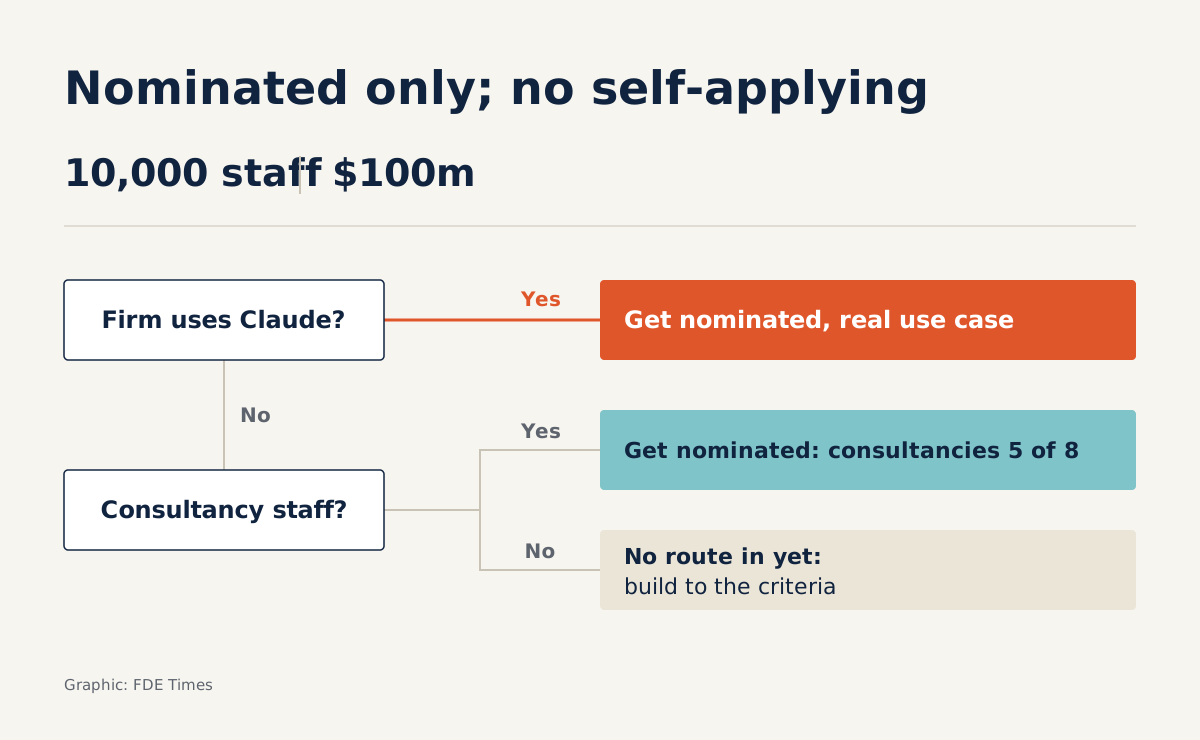
You cannot apply yourself. Digital Applied reports that participants must be nominated by their organisation. It also notes that five of the eight organisations named in the first cohort are consultancies: Accenture, Bain, Capgemini, Deloitte and McKinsey.
For anyone looking to change careers, the consequence is practical. If your company uses Claude, become the person your manager thinks of first when a nomination slot opens, by taking on a genuinely painful process yourself and getting it into production. If you work at a consultancy, the door is probably wider than elsewhere.
If your employer neither uses Claude nor is a consultancy, the criteria still work as a self-assessment. Are your fundamentals strong? Have you worked with LLMs? Have you ever taken on an important business problem and got it running in production, with any model?
Two kinds of FDE, two kinds of credential
The FDE role began at Palantir, with Forward Deployed Software Engineers taking the company’s own platform to customers and deploying it for them. The Academy goes another way. Beri.net sets the Academy model beside the practice of vendors sending pods of five or six engineers into a single customer: in the Academy, participants are the customer’s employees, and they keep the badges.
Steve Corfield of Anthropic said no AI company has invested this deeply in developing talent inside its customers and partners. Rather than hiring thousands of FDEs itself, Anthropic is seeding deployment capability inside the organisations already using Claude.
A note of caution is due here. The badges are issued by a vendor and tied to Claude, so how much they are worth if you move to another ecosystem remains an open question. Take a place if you are offered one, but build your professional record on what travels with you: how you choose use cases, measure results and hand systems over.
If 10,000 more people carry the title Frontier Deployed Engineer by the end of 2027, the badge will no longer be rare. What will still be rare is someone who can explain how they solved the most important problem a business had.
Was this article useful?
Thanks for the feedback!
7 sources
- Anthropic invests $100 million to train 10,000 engineers and tackle the enterprise AI talent gap · 2026-10-02
- Anthropic Launches Claude Frontier Academy, Commits $100M to Train 10,000 Enterprise AI Engineers by 2027 · 2026-10-02
- Anthropic Will Spend $100 Million Training 10,000 Engineers It Will Never Hire · 2026-10-05
- Anthropic's $100M Frontier Academy: How the Residency Works · 2026-10-02
- Claude Frontier Academy Wants Your Best Engineer and Names No Price · 2026-10-02
- What are Forward Deployed Engineers, and why are they so in demand? · 2025-08-12
- Claude Frontier Academy and the push to train FDEs · 2026-10-16