Let eval scores, not instinct, decide when a prompt needs more
A laptop test of zero-shot, few-shot, chain-of-thought and ReAct on 20 labelled tickets shows how to pay for heavier techniques only when the numbers say so.
In brief
- Start with zero-shot. Instruction tuning has made newer models good at many simple tasks without examples.
- Few-shot is still worth using if the examples are few, diverse and correctly formatted. CoT helps with reasoning problems, but you have to verify the results yourself.
- ReAct underpins today's agent loops. Once you have an agent, choosing what goes into the context matters more than the wording of the prompt.
In September 2025 Anthropic wrote that context engineering is the natural progression of prompt engineering. Yet in the same piece it still made room for a very old technique, few-shot prompting, describing examples as the “pictures” worth a thousand words to an LLM.
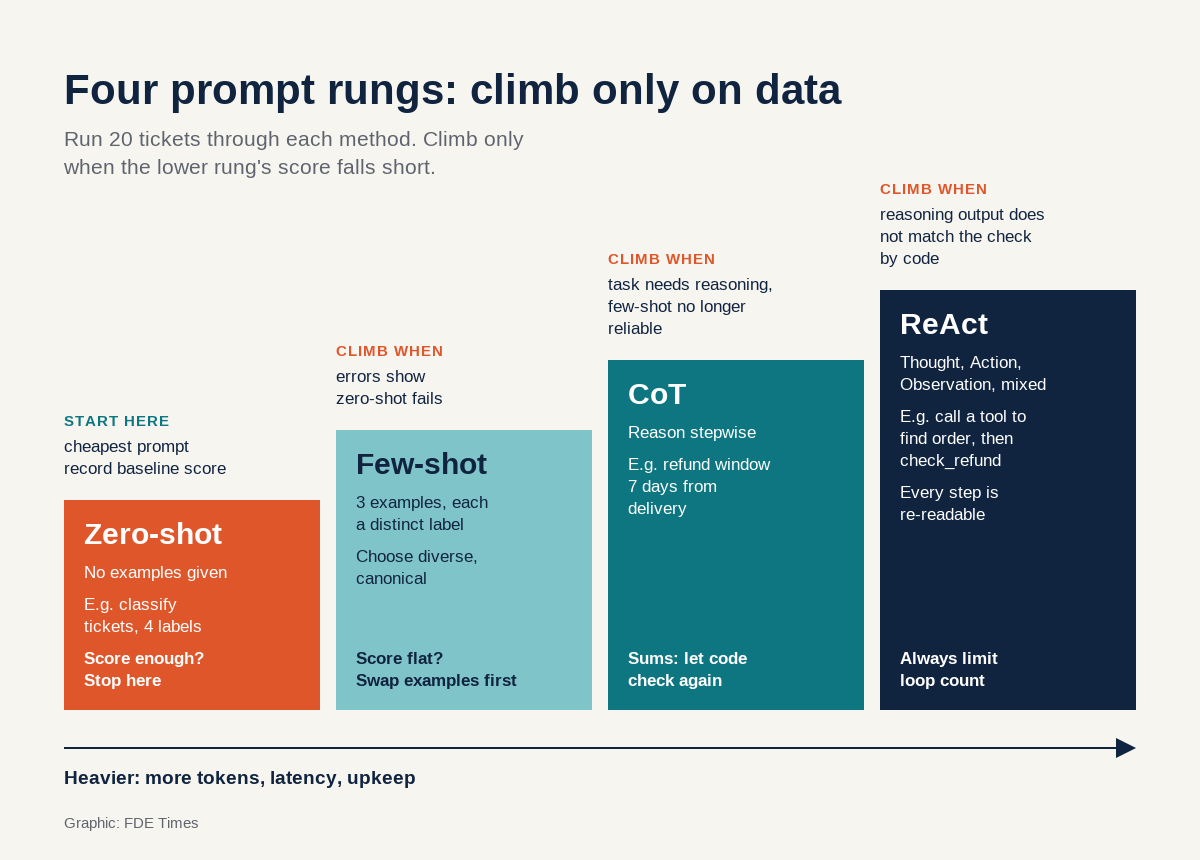
So asking which technique is obsolete is the wrong question. For an FDE, the more practical one is when to move to a heavier technique. Every step adds tokens, latency and maintenance, so you should only move when the numbers show the previous step falls short.
This guide shows how to answer that question on a laptop. You build a small test set, run four techniques in turn on the same task, and decide on the scores rather than on gut feel.
What do you need?
Take an e-commerce client that asks you to sort support tickets into four labels: refund, shipping, account, other. The scenario is hypothetical, but it closely resembles the work you will meet in your first week with a client.
The kit is 20 hand-labeled tickets, API access to any model, and a call_model(prompt) function you write yourself around that API. The code here is simplified: call_model and the tools are your own functions, not any provider’s API names.
eval/
  tickets.jsonl      # 20 lines: {"text": ..., "label": ...}
  prompts/
    zero_shot.txt
    few_shot.txt
    cot.txt
  run.py             # calls call_model, compares with label, prints accuracy
Step 1: zero-shot is often enough for simple tasks
Zero-shot means the prompt contains no examples or demonstrations. It works because models have been through instruction tuning and RLHF. Instruction tuning has been shown to improve zero-shot ability, so newer models usually handle simple tasks well without being shown a pattern.
Classify the following support ticket into exactly ONE label:
refund, shipping, account, other.
Return only the label name, no explanation.

Ticket: {text}
Check: run all 20 tickets and record how many are correct. That number is your baseline. If it already meets the level the client will accept, stop here. Read each wrong answer on its own, because the failures are what tell you whether you need step 2.
Step 2: few-shot still earns its place, if the examples are chosen with care
Few-shot prompting is a way to create in-context learning: the examples in the prompt steer the model’s answer. Anthropic recommends curating a set of diverse, canonical examples that clearly show the desired behavior, instead of stuffing every edge case into the prompt.
Classify the ticket into exactly ONE label: refund, shipping, account, other.

Ticket: I returned the item last week and still haven't seen the money.
Label: refund

Ticket: The order says delivered but I never received it.
Label: shipping

Ticket: I can't log in even after changing my password.
Label: account

Ticket: {text}
Label:
The most common mistake is choosing examples lazily. A literature review covering the work of Min and colleagues (2022) shows that both the format and the label distribution of the examples significantly affect results. If all three examples carry the refund label, the model will tend to lean toward that label.
If one example says “Label:” and another says “Label -”, the output will be just as messy.
IBM also notes that few-shot effectiveness depends largely on the quality of the prompt design. Check: compare the score with the baseline and see exactly which tickets changed. If the score does not rise, swap the examples before concluding that few-shot is useless.
Step 3: CoT is for reasoning problems, on condition that you verify it
Now the client also wants to know which refund tickets are still within the deadline. Few-shot usually stops being reliable here. This is precisely the kind of reasoning problem chain-of-thought was invented for.
Policy: customers may get a refund within 7 days of receiving the goods.
Date received: {received}. Date of request: {requested}.
Reason step by step, then write the final verdict on one line
in the form: VERDICT: valid or VERDICT: invalid
IBM warns that CoT can produce reasoning chains that sound plausible but are wrong. Take a case: goods received on October 3, refund requested on October 12. The gap is 9 days, so the verdict must be invalid. A smooth argument that miscounts the days can still reach the opposite conclusion.
So whatever code can calculate, let code calculate. The snippet below is simplified:
from datetime import date

def check_refund(received: date, requested: date, days: int = 7) -> bool:
    return (requested - received).days <= days

# compare with the model's VERDICT; count the mismatches
assert check_refund(date(2026, 10, 3), date(2026, 10, 12)) is False
Check: count how often the model’s verdict disagrees with the check function. If it disagrees often, do not try to write a better prompt. Move the calculation out of the model, which is also the reason to go on to step 4.
Step 4: ReAct underpins agents, and it has a cost
ReAct lets an LLM generate both reasoning traces and concrete actions in an interleaved way, and it is the foundation of today’s agent loops. In the running example, instead of counting the days itself, the model calls a tool to look up the order and then calls the check_refund function from step 3.
# Simplified: call_model, parse_action and TOOLS are all written by you
history = [f"Ticket: {text}"]
for _ in range(5):                      # always cap the number of rounds
    step = call_model(REACT_PROMPT + "\n".join(history))
    history.append(step)                # Thought + Action
    action = parse_action(step)
    if action.name == "finish":
        break
    observation = TOOLS[action.name](**action.args)
    history.append(f"Observation: {observation}")
The gain is interpretability: every Thought, Action and Observation step can be read back. The loss is that ReAct’s rigid structure reduces the model’s flexibility in building its reasoning steps. Do not use ReAct for the classification in step 1. Save it for tasks that genuinely need outside data.
Check: print the full history for the tickets that came out wrong. Because every step can be read back, first see whether the model called the wrong tool or misread an observation, and only then think about rewording the prompt.
Once you have an agent, the content of the context matters more than the wording
Elastic separates the two ideas neatly. Prompt engineering is how you communicate with the model. Context engineering is the information the model has at hand when it answers, including retrieved documents, tool results and conversation history, along with actively curating what goes into the context window.
Look again at the loop in step 4: history grows with every round. The next useful job is therefore deciding which observations to keep verbatim, which only need a summary, and which policy passage to retrieve for each ticket. Tweaking a few more words in REACT_PROMPT comes a distant second.
How does this skill help with clients?
In your first week with a client, what persuades people is a tickets.jsonl file with 20 labeled lines of their own data, plus a score table comparing the techniques. A flashy agent demo does less. The test set also answers the question the client will put to you: why not use something simpler?
If you are preparing to apply for FDE roles, read job descriptions closely for phrases such as “evaluation”, “prompt and context design” or “agent reliability”. On your CV, replace “proficient in prompt engineering” with a line that has numbers, for instance: built a 20-case eval, showed zero-shot was sufficient for the classification step, and moved the refund-deadline calculation from CoT to verification code.
The stronger the model, the further zero-shot goes. What is left for the FDE is knowing which step to stop at, and having the numbers to show the client why.
Was this article useful?
Thanks for the feedback!