The AI use case to build first is rarely the most valuable one
Score ten ideas on value and feasibility, then agree one success measure in writing with whoever controls the budget.
In brief
- Score each idea 1–5 against pre-written descriptions, weighting value most heavily, then feasibility, time to value, reusability and risk.
- Score feasibility against the client's real data and context, not on whether a demo runs.
- The matrix only produces a shortlist; the final decision is a narrow pilot with a written success measure.
The first workshop with a client usually ends with a whiteboard covered in ideas. The head of operations wants demand forecasting. The customer service manager wants a chatbot. Someone in IT has just seen an email-summarization demo and was impressed. Then everyone turns to the person who will have to build it and asks: which one first?
The answer shapes the next three months. Choose badly and you burn a quarter on a project with no data, or ship something that runs beautifully and that nobody needs.
Sunny Rekhi, CTO of the FDE organization at Decagon, argues that requirements gathering starts in the very first conversations about contract scope. Choosing the use case, in other words, is the FDE’s job before a line of code is written.
At that stage, the value-feasibility matrix is a lightweight tool you can use straight away. It is no smarter than you are. What it does is move the argument in the room from “whose voice is loudest” to “what score, and why”.
Two axes, five numbers
Umbrex, a network of independent consultants, defines the two core axes. Business value is the impact on service, cost, cash flow and quality.
Feasibility is the ability to deliver, technically and operationally, within the target timeframe. That last clause matters: an idea that can only be delivered in a year does nothing for this quarter’s pilot.
For finer scoring, Umbrex suggests five weighted criteria: value 35–45%, feasibility 25–35%, time to value 10–15%, reusability 10–15%, risk 5–10%.
A practical set of weights that sits within those ranges is 40/30/10/10/10. For risk, agree that a high score means low risk, so every column reads “higher is better”.
Each criterion is scored on a 1–5 scale, and both Umbrex and Moveworks stress the need for a pre-written description of each level to reduce bias.
Take feasibility: 1 means the data does not exist or is scattered across several systems nobody has access to; 3 means the data exists but needs a few weeks of cleaning; 5 means the data is clean, available through an API, and the client has people ready to work with you.
An example: a distributor’s ten ideas
Take a consumer-goods distributor. After the workshop you have 10 ideas. The table below is a hypothetical scoring round, with the total calculated as 0.4×value + 0.3×feasibility + 0.1×(time, reusability, risk).
| Idea | Value | Feasibility | Time | Reusability | Risk | Total |
|---|---|---|---|---|---|---|
| Agent that answers inventory questions for the head of operations | 4 | 4 | 4 | 4 | 4 | 4.0 |
| Complaint ticket classification | 3 | 4 | 4 | 4 | 4 | 3.6 |
| Supplier invoice data extraction | 3 | 4 | 4 | 3 | 4 | 3.5 |
| Anomalous order detection | 4 | 3 | 3 | 3 | 3 | 3.4 |
| Supply-chain-wide demand forecasting | 5 | 2 | 1 | 3 | 3 | 3.3 |
| Warehouse process document search (RAG) | 2 | 4 | 4 | 4 | 4 | 3.2 |
| Internal email summarization | 1 | 5 | 5 | 2 | 5 | 3.1 |
| Customer service chatbot on the website | 3 | 3 | 3 | 3 | 2 | 2.9 |
| Delivery route optimization | 4 | 2 | 2 | 2 | 3 | 2.9 |
| Automated discount approval | 4 | 2 | 2 | 2 | 1 | 2.7 |
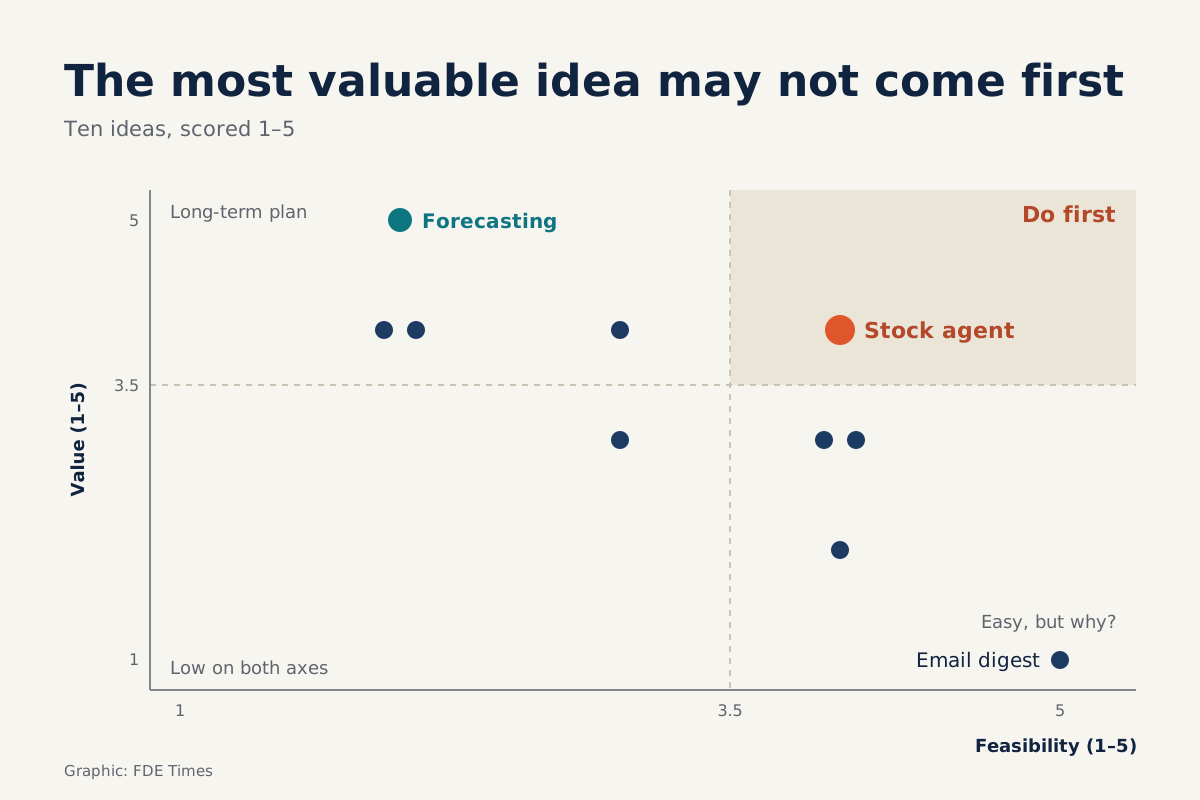
The two rows most worth reading closely are not at the top. Demand forecasting has the highest value score, 5, yet finishes fifth because the sales data is not ready. Moveworks stresses that data readiness deserves special attention when scoring feasibility, and this is a textbook case.
Email summarization is the opposite: feasibility 5, demo-ready in an afternoon, but value 1. Moveworks warns that building a demo is genuinely exciting, yet it delivers no business value on its own. That is why the “time to value” column should run until the system works on real data inside a real process, rather than stopping when the prototype works.
Draw the 2×2 so the whole room can see it
Umbrex recommends presenting the results as a 2×2 map: impact on one axis, feasibility (or time to value) on the other. Draw the dividing lines at 3.5 and the table above splits into four clear quadrants. Only the inventory agent lands in the high-value, high-feasibility corner.
The high-value, low-feasibility corner holds demand forecasting, delivery routes, discount approval and anomaly detection. This is the long-term roadmap, a destination rather than a starting point.
The low-value, high-feasibility corner holds email summarization, document RAG, ticket classification and invoice extraction: easy to build, but each needs a real reason to be chosen. The customer service chatbot falls into the remaining corner, low on both axes.
The picture persuades stakeholders in a way a table of numbers struggles to. The head of operations sees that demand forecasting has not been dismissed, only scheduled for later. Moveworks has a line worth remembering: a use case can be technically feasible and still not be the right move for that business.
From scores to a bounded pilot
The inventory agent comes out on top, but that is not yet a scope. AI Codex advises FDEs to persist until they have a measurable definition of success, agreed by the person who controls the budget. Decagon likewise says the deployment team needs to establish what success means with the client, ideally in writing.
A good measure is usually a change in behavior rather than a technical metric. AI Codex gives an example: “the head of operations stops asking IT for inventory reports” is a real finish line. For the distributor above, that sentence is practically written for the inventory agent.
Next, narrow it down. AI Codex advises treating a pilot as a way to answer one question, and resisting the urge to run it as a miniature rollout. Here the question might be: can the agent correctly answer inventory questions for one warehouse over four weeks?
PostHog’s FDE handbook explains why narrow is better: expanding a tight scope is far cheaper than unwinding a loose one.
PostHog also defines the unit of value in FDE work as a measurable customer outcome, agreed before work begins. The matrix leads you to an idea; a measurable outcome turns the idea into a commitment.
Do it yourself in five steps
Start by listing every idea on its own line, each phrased as “who does what differently”. Then write the 1–5 descriptions for all five criteria before scoring a single line, so the scores are not pulled toward the idea you already favored.
Score with the client, never alone: the operations people know the value, the IT people know the data. Calculate the weighted totals, draw the 2×2, and take the top three ideas as a shortlist. Finally, for the number one idea, write the success measure and the pilot’s question, and send them to the budget holder for confirmation.
The mistakes that make the matrix lie
The most common mistake is scoring feasibility on the strength of a demo. A model that answers sample questions does not mean the real data is ready, access has been granted, or the process has room for an agent. Ask “where does the data live, who grants access, and how long will it take” before giving a 4.
The second mistake is scoring without descriptions, so everyone reads “3” differently and the meeting slides back into arguing on gut feel. The third is leaving the risk column running in the opposite direction to the others, which rewards the most dangerous idea with extra points.
The last is treating the total as a verdict: a 0.1-point gap is no reason to drop an idea that has an enthusiastic sponsor.
What this skill looks like on a CV
On a CV, show that you know how to demote an idea for a clear reason. A line such as “scored 12 use cases with the client and chose a four-week pilot with a measure signed off by the head of operations” says more than any list of frameworks. When a job posting mentions scoping, discovery or prioritization, this is the skill it means.
In an interview, if you are asked “the client gives you ten ideas, what do you do?”, walk through the sequence: described scales, weights, the 2×2, then a written measure.
Add one idea you ranked lower because its data was not ready, along with the reason. That detail shows you have used the matrix on real work and do not just know the theory.
The most valuable idea on the whiteboard will still be there next quarter. The job today is to choose something that proves its value early enough for the client to still trust you when that idea’s turn comes.
Was this article useful?
Thanks for the feedback!
5 sources
- AI Use-Case Prioritization Framework (Umbrex)
- How to Prioritize AI Use Cases That Deliver Fast Wins and Long-Term Enterprise Value · 2026-10-06
- Scoping an FDE engagement: the first week decides the next three months · 2026-08-21
- How forward deployed engineers work - Handbook (PostHog)
- How Forward Deployed Engineering is done at Decagon (AI Engineer World's Fair 2026)