When the boss sits in, users stop describing how they really work
How to ease a client's manager out of user interviews without offending anyone, and how to recover the real workflow when they refuse to leave.
In brief
- Asking users "do you mind if your manager sits in?" achieves nothing, because they feel they cannot say no.
- Negotiate with the manager in advance: give them a session of their own, promise an unattributed summary, and schedule users privately.
- If the manager still stays, only the facilitator asks questions; hand the user a real task and book a separate one-on-one session.
Nielsen Norman Group (NN/g), one of the most respected user experience research firms, advises teams to make it a formal rule: managers do not attend research sessions with their own reports. The advice is clear. The trouble is that FDEs rarely get to set the rules at a client’s site.
On site, the decision about who sits in the room is not entirely yours. And when a manager is the one who nominates staff to take part, the people nominated can easily feel pressured to say yes, as the UK government’s user research team at GDS has noted.
For an FDE, the cost is concrete. In front of their manager, users tend to describe the process as it appears in the documentation. You write prompts, choose data and build rules for an agent on that version, and only in the first week of production do you discover that real users work quite differently.
The skill required is getting the real version while keeping the relationship with the project’s sponsor intact.
Asking “do you mind?” solves nothing
Many engineers’ first reflex is to turn to the user and ask permission. That is usually not enough, because employees may feel obliged to go along with the request. Even when told it is voluntary, plenty of people still feel they cannot refuse.
The reason is easy to see. Employees are uncomfortable being watched by managers or colleagues, and they worry that what they do in the session will affect how they are evaluated. Few people will own up to a shortcut their manager never approved while the person who reviews their performance sits two meters away.
Researchers call this the observer effect: people behave differently when they know they are being watched. So the question “do you mind?” tells you nothing. Everything has to be arranged with the manager, and it has to be settled before the interview starts.
Invite the manager out with a better offer
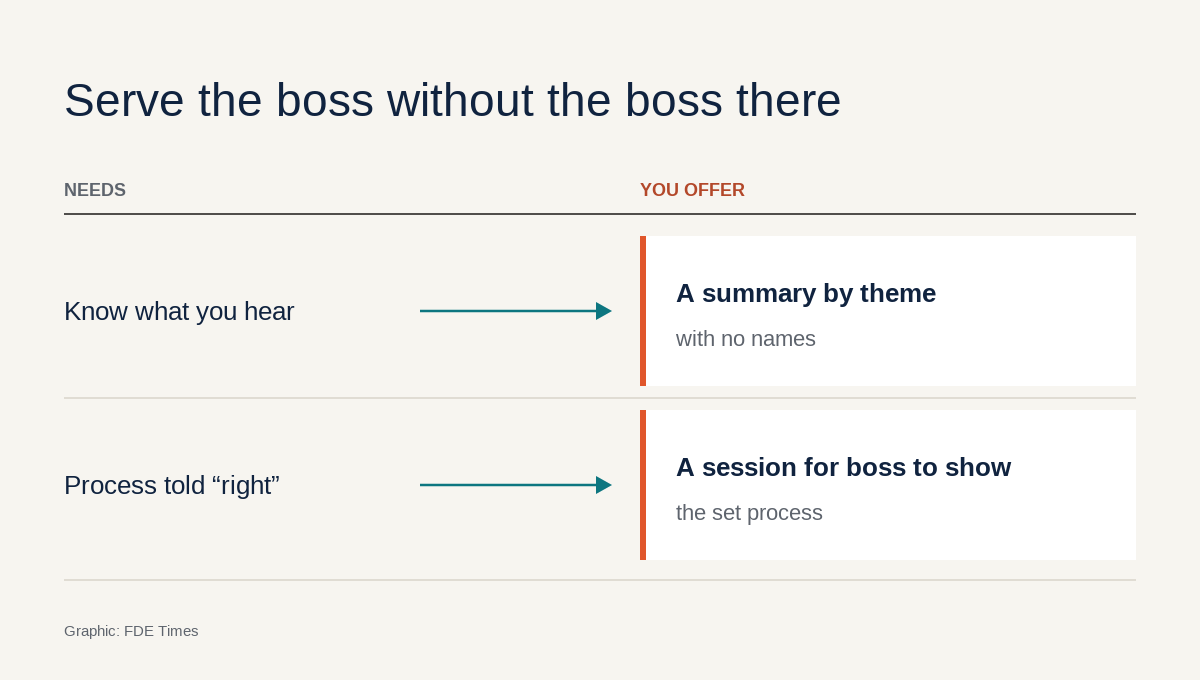
Managers who want to sit in usually have two needs: to know what you heard, and to be sure the process is described “correctly”. Both are legitimate, and you can meet them without the manager being present.
The first need has a familiar solution: record the session and produce a transcript, so others can see the raw data without entering the room. But when research takes place inside a single organization, the risk of participants being identified from the recording is much higher. So what you promise the manager should be a summary by theme, with no names attached.
For the second need, give the manager a session of their own to walk through the standard process. They get a full hearing, and you get an “on paper” version to compare against reality later.
There is one more step before you promise users anything. Before researching with their own colleagues, the GDS team asked human resources how far confidentiality could actually extend.
At a client, the equivalent is asking the project lead who has the right to demand your notes and recordings, and committing to anonymity only when it is real.
Example: a claims-processing team
Take an FDE deploying an agent that extracts information from insurance claim files for an insurer. The head of operations has already picked four staff members and plans to sit in on all four sessions. The day before, you call her and say something close to this:
“You know the standard process better than anyone, so I’d like a session with you alone to go through every step. With your team, I need to see how they handle real claims.
User researchers usually advise against managers sitting in, because when the boss is there, staff find it hard to say no or to say anything different. At the end of the week I’ll send you a summary by theme, with no names attached.”
Next, ask her to send the invitations as private appointments on each person’s calendar. That way, people who are not involved will not know who spoke to you or when.
In the interview itself, the most important opening line concerns the interviewee’s rights: they can withdraw from the research at any time, even after the interview is over.
“Today I need to understand how you work. I’m not grading anyone. What you tell me will only appear in a combined summary, without names. If you want to take anything back after this session, just message me and I’ll delete it. Could you open the most recent claim you’ve just finished?”
The last sentence is where the real data starts to appear. Redoing a case just completed is a familiar, hands-on task close to everyday work, and giving users natural tasks like this is one of the three ways NN/g suggests for reducing the observer effect.
When they open a private Excel file or retype figures from another system, you have seen what your agent will have to handle.
If the manager still insists on staying
Sometimes you lose the negotiation anyway. In that case, only the facilitator asks questions, rules for observers are agreed in advance, and everyone debriefs together afterwards. Tell the manager beforehand that if she has questions, she should write them down and pass them to you.
The two other ways to limit the damage are building rapport so the user trusts you, and giving them more time. Do not treat the session with the manager as the only one. Book a short session sitting beside the user during a normal shift, when you are by then a familiar face rather than a visitor the boss brought in.
Afterwards, compare what you heard in the session with the manager against what you saw sitting beside the user. Where the two diverge is usually where the project is most likely to break, and where you should write tests first.
Mistakes that ruin a whole round of discovery
The most expensive mistake is promising more confidentiality than you can keep. If the contract gives the client the right to see every note, a promise that “nobody will know” backfires the first time something leaks, and users at that company will rarely tell you the truth again.
Almost as costly is sending raw recordings to the manager because they asked, when voices and job details are enough to identify who is speaking. Also common: letting observers interject and turning the interview into an inspection, or drawing conclusions from a single crowded session in a meeting room.
When you interview for an FDE job and are asked about a difficult discovery, describe how you negotiated with the sponsor and which step you found that differed from the documentation; a line like that on a CV is more persuasive than any adjective about “communication skills”.
The manager knows the process on paper, the users know the real one, and your agent will have to run on the real one. To hear it, settle things with the manager before the users walk into the room.
Was this article useful?
Thanks for the feedback!
6 sources
- Team Members Behaving Badly During Usability Tests · 2016-05-29
- Winning Over Wary Participants · 2015-03-09
- Conducting ethical internal research · 2023-02-09
- How to carry out user research with colleagues · 2019-02-12
- 5 Facilitation Mistakes to Avoid During User Interviews · 2021-06-06
- The Hawthorne Effect or Observer Bias in User Research · 2023-05-21