Turing's FDE job post: every line needs evidence
Many readers close the tab at "5–8+ years". The description further down is what tells you what the recruiter actually wants to see from you.

In brief
- Turing places FDEs in its Enterprise AI Engineering group, hires in New York, Bengaluru and Hyderabad, and offers an In Training version for people new to the field.
- The requirements ask for Python, LangChain, LangGraph, SQL, a deep grasp of APIs, microservices and event-driven systems, and experience shipping GenAI to production; AWS, Azure and GCP appear under responsibilities.
- Prepare evidence for each requirement rather than learning more tools: every line needs a story with context, a decision and a result.
You open Turing’s Forward Deployed AI Engineer posting, reach the line asking for 5–8+ years of experience and get ready to close the tab. Not so fast. An FDE job post is not a list of boxes to tick. It describes someone who has already taken a GenAI system to real customers, and the recruiter needs you to show you are that person.
Turing is a useful example because its posting is fairly clear. On its Greenhouse page, the forward-deployed roles sit in the “Enterprise AI Engineering” group. The same group includes Engagement Managers, an AI Engagement Lead and a Head of Engineering, a sign that FDEs work closely with the people who manage customer relationships.
The role is open in New York, Bengaluru and Hyderabad. Turing also has an “In Training” version for people new to the field in New York, and is hiring a Field Engineer, AI Labs, a role in a separate Field Engineering group.
The Principal version is an old posting that no longer accepts applications and reportedly required 10 or more years of experience, so check the live board before choosing a level.
Read closely, it is a deployment cycle
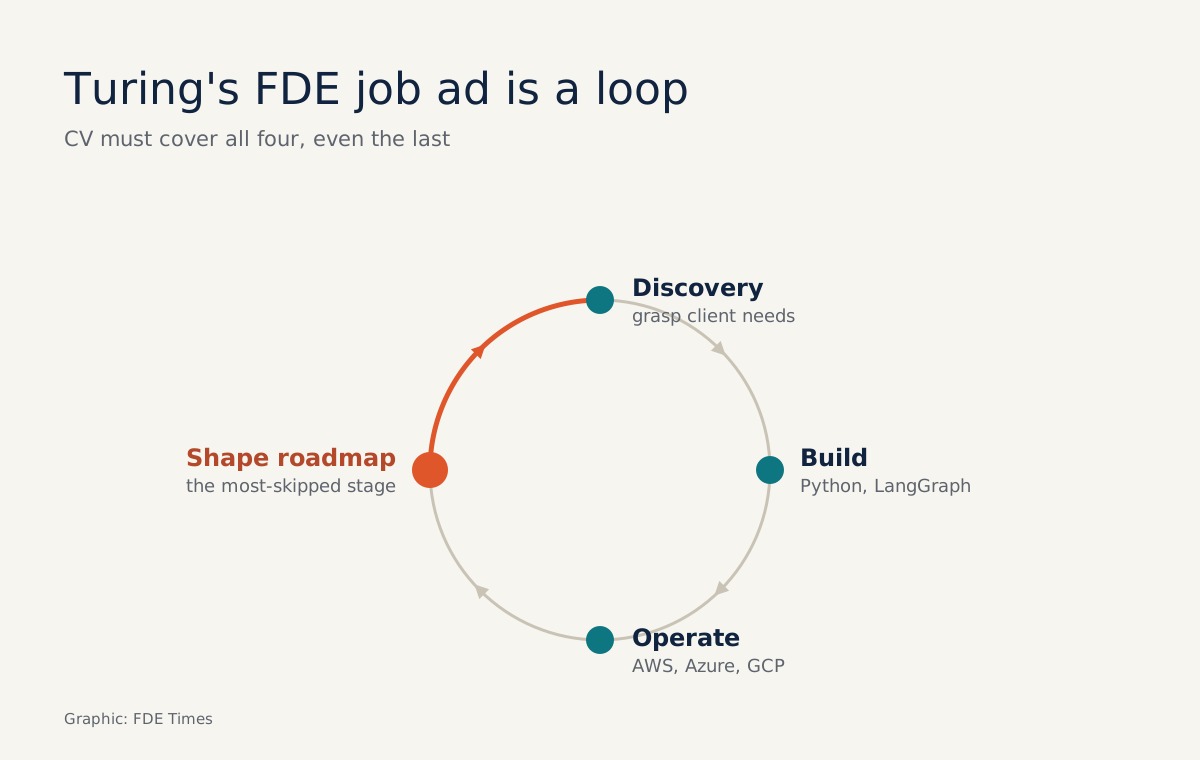
Read the responsibilities in the order the work happens, not in the order of the technologies. The first sentence asks you to lead end-to-end GenAI application deployments for customers, starting with discovery and ending with handover. Every line that follows is a stage of that cycle.
In the stage of understanding the problem, you are the customer’s trusted technical adviser: you must grasp their needs and design an AI solution specifically for them. In the build stage, you design and write the system in Python, LangChain/LangGraph and LLM frameworks. In the operations stage, you work on AWS, Azure and GCP so that the infrastructure is secure and fast enough.
The last stage is the one most often overlooked: working with the product, ML and engineering teams to have a say in the roadmap and the platform’s core features. Turing wants each deployment to leave behind something reusable. On top of that come the requirements to work autonomously, explain complex matters to customers and run several deployments at once.
Every requirement needs a story
One word in the requirements matters more than all the tools: production. Turing wants to see that you have designed and successfully shipped GenAI applications into production, not just built demos. It also asks for a deep understanding of architecture: APIs, microservices and event-driven systems, plus Python, LangChain, LangGraph and SQL.
The most effective way to prepare is an evidence-matching table. Each row covers one requirement, what the interviewer really wants to know, and the kind of evidence that answers it.
| Requirement in the post | What the interviewer wants to know | Evidence to have |
|---|---|---|
| Discovery to handover | Can you own the whole cycle? | A project you started with a needs interview and finished with handover documentation |
| GenAI in production | Has the system run with real users? | What you monitored, what failed, how you fixed it |
| APIs, microservices, event-driven | Can you plug an LLM into an existing system? | A flow where an event triggers the agent, not someone pressing a button |
| SQL | Can you work with a customer’s real data? | Queries on a messy schema, with access control handled |
| Technical adviser | Will you say “no” at the right moment? | A time you changed a project’s scope for technical reasons |
| Several deployments in parallel | Can you manage without someone assigning tasks? | How you split your time and reported progress to each party |
Any row you cannot fill is a gap to close. There are usually fewer empty rows than you fear; you have simply not told those stories in the language of this job before.
Applying it to a backend engineer with four years’ experience
Picture a backend engineer with four years of experience who has written APIs and microservices and uses SQL daily, but has never put an LLM into production and rarely talks to customers directly. Checked against the table, the three architecture rows are nearly full, while the production GenAI row, the discovery row and the years of experience remain empty.
The advice for this engineer has two branches. If they are targeting Turing specifically, the In Training version is a more sensible way in than the standard role. Whichever door they choose, they should build a project that fills the production row precisely, rather than learning yet another framework.
The project should be small but go through the whole cycle: a LangGraph agent that answers business questions over a SQL database. The agent is triggered by an event, such as a new ticket, and deployed to a cloud. A minimal skeleton looks like this:
from typing import TypedDict
from langgraph.graph import StateGraph, END

class State(TypedDict):
    question: str
    sql: str
    rows: list
    answer: str

def generate_sql(state: State) -> dict:
    # Call the LLM with the schema filtered by the asker's permissions
    return {"sql": "..."}

def run_sql(state: State) -> dict:
    # Allow SELECT only, set a timeout, log the query
    return {"rows": []}

def answer(state: State) -> dict:
    # Answer with the executed query attached so users can check it themselves
    return {"answer": "..."}

graph = StateGraph(State)
graph.add_node("generate_sql", generate_sql)
graph.add_node("run_sql", run_sql)
graph.add_node("answer", answer)
graph.set_entry_point("generate_sql")
graph.add_edge("generate_sql", "run_sql")
graph.add_edge("run_sql", "answer")
graph.add_edge("answer", END)
app = graph.compile()
The code is not the hard part. What the interviewer wants to hear is in the comments: why allow only SELECT, why return the query with the answer, who gets alerted when the agent generates bad SQL. These are the decisions an FDE has to make alone when sitting with the customer.
After the project, the bullet points in the CV must change too. “Built a chatbot with LangChain” only says which tool you used. A better line describes the context, the decisions and the operating status: built a LangGraph agent for Q&A over SQL, triggered by ticket events, running on a cloud, with read-only permissions, logging and handover documentation.
Do it yourself in four steps
First, copy out the job post and split each sentence into a single requirement, dropping the adjectives and keeping the verbs. Second, match each requirement with a real story of your own, using the three columns in the table.
Third, pick the single most important empty row and fill it with a project that goes through the whole cycle, from a mock discovery session with a friend playing the customer to a handover README.
Fourth, practise telling the stories: fit each into two minutes, and make it understandable to non-technical listeners, because the post asks for exactly that skill.
Mistakes that sink an application
The most common mistake is listing tools. Writing Python, LangChain, LangGraph, SQL, AWS, Azure, GCP on one line proves nothing, because everyone else writes the same. Tools only count when tied to a system that has run.
The second is passing off a demo as production. The interviewer will ask what happens when the data is dirty, when the model answers wrongly, when the customer changes requirements halfway, and a demo has no answer to any of those questions.
The third is forgetting the last stage: saying nothing about bringing lessons from customers back to the product team, when Turing states plainly that it wants people who can have a say in the roadmap.
The last is ruling yourself out over the years-of-experience figure, when the In Training level exists. Conversely, do not apply for the Principal role just because the title looks familiar; that posting has closed.
Next time you read an FDE job post, at Turing or anywhere else, do not ask which tools you are missing. Ask which stage of the deployment cycle you have never seen through on your own.
Was this article useful?
Thanks for the feedback!