Reading Chalk's Forward Deployed Engineer job ad: what each line asks for, and how to prepare
The ad runs to only a few lines, but each one can become a small project, a memo or an interview answer that shows a recruiter evidence instead of claims.

In brief
- Chalk asks for at least two years of backend experience and proficiency in Python and SQL; ML and MLOps experience is a plus.
- Chalk's product is built around the freshest data at inference time, so the real test is whether you understand real-time features.
- Communication, storytelling and suggesting products to customers sit alongside the technical requirements, so you need evidence for both.
You open Chalk’s Forward Deployed Engineer ad and find it surprisingly short. Two years of backend, Python, SQL, then one line about communication, problem solving, storytelling and analysis.
Skim it and almost anyone feels they fit. That is exactly what makes it hard: when the requirements sound this familiar, the people who get interviews are those who can prove them, not those who merely say they have them.
The way to read an FDE ad is to set each line beside the real work it describes. Chalk’s ad says plainly that the day-to-day job is writing code to deploy Chalk’s technology for customers and prospective customers. In other words, you are not just writing code: you are writing it inside someone else’s system, sometimes before they have even signed a contract.
If you work in backend and want to move into FDE work, this line-by-line reading applies to other ads too, not only Chalk’s.
The product decides what you will be asked
To guess what the technical interview will cover, look at what you will be deploying. Chalk describes itself as a real-time data platform for AI inference, helping customers make predictions with the freshest data at the moment of inference. Companies using Chalk every day include Doppel, Sunrun, Whatnot, Socure, Found, Medely and iwoca.
Seen that way, “proficient in Python and SQL” means something far more specific than a generic line. You will write feature logic, query customers’ data and explain why a number in production differs from the one seen in training.
The pluses in the ad point the same way: experience building ML or data products, an understanding of MLOps and ML infrastructure, and prior FDE work at a fast-growing ML startup.
Example: a midnight feature that misses a fraudster
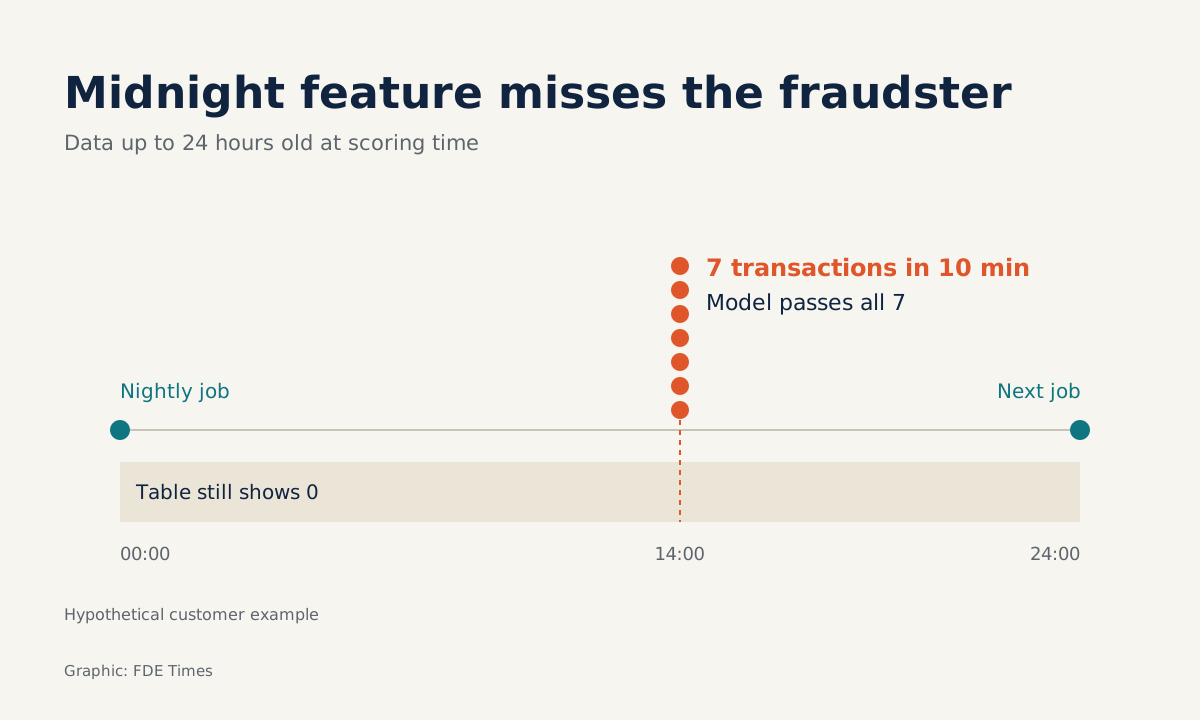
Picture a hypothetical customer that runs an online lending business. Its fraud model uses the feature “number of transactions by the user yesterday”, computed by a job that runs at midnight.
A compromised account makes 7 transactions in 10 minutes at 2pm. The precomputed table still shows 0 for that account, so the model approves all 7.
This is the table the customer is using:
-- Nightly job: data is always up to 24 hours stale
SELECT user_id, COUNT(*) AS txn_count_1d
FROM transactions
WHERE created_at >= CURRENT_DATE - INTERVAL '1 day'
  AND created_at <  CURRENT_DATE
GROUP BY user_id;
The fix is to compute the feature when the scoring request arrives, from the latest data. The Python below is generic, not Chalk syntax, but it is exactly the kind of logic you would write on the customer’s side:
def txn_count_10m(conn, user_id, now):
    # Count transactions in the 10 minutes immediately before scoring time
    row = conn.execute(
        """SELECT COUNT(*) FROM transactions
           WHERE user_id = %s
             AND created_at >  %s - INTERVAL '10 minutes'
             AND created_at <= %s""",
        (user_id, now, now),
    ).fetchone()
    return row[0]
This is where careful data engineers separate themselves from people who can only write queries. To retrain the model on the new feature, you must compute it as of the exact time of each past event, not as of now:
-- Point-in-time join: only use data that existed before each event
SELECT l.event_id, l.label, COUNT(t.id) AS txn_count_10m
FROM labels l
LEFT JOIN transactions t
  ON  t.user_id = l.user_id
  AND t.created_at >  l.event_time - INTERVAL '10 minutes'
  AND t.created_at <= l.event_time
GROUP BY l.event_id, l.label;
If you slip and use now() instead of l.event_time, the model learns from transactions that happened after the moment it needed to decide. Offline scores look excellent; production cannot keep up.
Explaining this bug in two minutes, with a worked numerical example, is the answer an interviewer at a real-time data company wants to hear.
Storytelling is not a soft extra
Chalk’s ad puts storytelling next to analytical ability, and the reason lies in the example above. The customer’s engineers understand the SQL. Their risk manager needs the story: one account, 7 transactions, 10 minutes, and a system that missed it because its data was a day old.
The ad also says FDEs work closely with Engineering and Sales, and suggest new products to customers as their business changes. That is the commercial side of the role. An FDE who can tell the story “stale features are costing you money right here” is also the person who can open a conversation about expanding the deployment.
Chalk is also hiring a Forward Deployed Strategist, a role in the same forward deployed track, and that ad is more direct about communication than the FDE one.
The first task is running technical discovery: understanding in depth how the customer’s systems work, what is broken and what they want to launch.
The person hired must also be willing to tell customers what they do not want to hear, including when their plan is wrong.
The FDE ad does not list this requirement, but because the two roles sit in the same track, it is worth preparing for. In the example above, suppose the customer proposes “run the midnight job every hour instead”: the honest answer is that fraudsters would still have a full hour to act, and you should practise saying so politely but without dodging.
Turning the ad into evidence
First, turn the code above into a small repo with synthetic data, tests for the point-in-time join and a README explaining the difference between batch-precomputed features and features computed at inference. That repo demonstrates Python and SQL better than any “proficient” line on a CV.
Second, write a one-page discovery memo for that same repo: how the customer’s system works today, where it breaks, what you propose and how you would measure the result. That is evidence of the written communication the ad mentions.
Third, revise your CV. Each bullet should follow the pattern: the user’s or customer’s problem, what you did, the measured result. If you have built data pipelines, caches or low-latency services, frame them around “how fresh is the data when the system makes a decision”.
The track also has a long career path: Chalk is hiring a Director of Forward Deployed Engineering in New York, requiring at least 10 years of technical experience, including at least 3 leading engineering teams that work directly with customers, and working in the office 5 days a week.
Common mistakes
The most common mistake is treating the storytelling line as decoration and revising only algorithms. In a role where you write code for prospective customers too, the ability to explain matters as much as the ability to code.
The second is talking about ML in the abstract without touching data. If you cannot point to the SQL line where data leaks, the “understands MLOps” plus will convince no one.
The third is being too accommodating. The willingness to say “this plan is wrong” appears in the Strategist ad rather than the FDE one, but a scenario answer along the lines of “I would do exactly what the customer wants” is hard to sell for any role in this track.
Before you apply, have a repo with a point-in-time join and an accompanying one-page memo ready. Together they turn the “Python, SQL” line and the “storytelling” line into things a recruiter can check for themselves.
Was this article useful?
Thanks for the feedback!
5 sources
- Forward Deployed Engineer (Chalk) – General Catalyst Jobs
- Forward Deployed Strategist (Chalk) – General Catalyst Jobs · 2026-09-12
- Director, Forward Deployed Engineering (Chalk) – General Catalyst Jobs · 2026-09-06
- Chalk Raises $50M Series A to Power AI Inference · 2025-05-28
- Chalk: $50 Million Series A Raised At $500 Million Valuation For AI Inference Data Platform · 2025-06-02