The CDRs a telco gives its AIOps team are often filtered first
Mediation cleans call records for the billing team, so compare them with the raw data before an anomaly model learns from them.
In brief
- Mediation drops CDRs that are not used for billing and merges the partial CDRs of a single call, so a model trained on this data can miss the very network changes it is meant to catch.
- With syslog, filter on Severity first, and ask exactly which device groups send over which transport, because RFC 5424 allows multiple transport protocols.
- Alarms should flow through TMF642 into the tools the NOC already uses, and every automation promise should be tied to a measurable autonomy level.
The CDRs an operator hands its AIOps team are usually not what the network equipment actually wrote. Before they reach the team, they pass through a mediation layer. There, records that have nothing to do with billing are filtered out, and the partial CDRs of a single call are merged into one.
This dry-sounding detail decides which network a model gets to see. An anomaly detection model trained on data already cleaned up for the billing department will understand invoices very well and incidents very poorly.
That is why the first weeks of an AIOps project at a telco are mostly mapping work: which system holds the data, how it has been transformed, and where the final alarms need to flow. Four pieces turn up in the first week: OSS/BSS, mediated CDRs, syslog and the TM Forum Open APIs.
Two data domains, two owners
OSS are the computer systems an operator uses to manage its network. BSS are the business support systems. Each side holds its own data and is responsible for its own services.
A use case that sounds as simple as “detect incidents before customers complain” almost always needs data from both domains. The failure signal sits on the network management side.
To answer who is affected and how badly, the business side is usually the place to look. The two domains have two owners, so every join means asking another team for access and agreeing definitions with them.
The first task, then, is a data source inventory, with each row tied to exactly one accountable person:
| Source | Domain | Processing already applied | Question for the owner |
|---|---|---|---|
| Post-mediation CDRs | BSS / billing | Validated, filtered, partial CDRs merged | Can we get the raw records from before mediation? |
| Traffic statistics feed | OSS | Passes through mediation but not used for billing | Who uses this feed, and for what? |
| Device syslog | OSS | Usually unprocessed | Which device groups send over which transport? |
| Existing alarms | OSS / NOC | Follows the conventions of the current tool | Does the system support TMF642, and which version? |
Post-mediation CDRs are a different dataset
Mediation converts call data into predefined layouts that the billing system or other OSS applications can ingest. The mediation platform reads raw records from network equipment, collects and validates them, then normalizes them into a common format before passing them on.
Every step makes sense for accounting. Every step also strips away some information about how the network behaves.
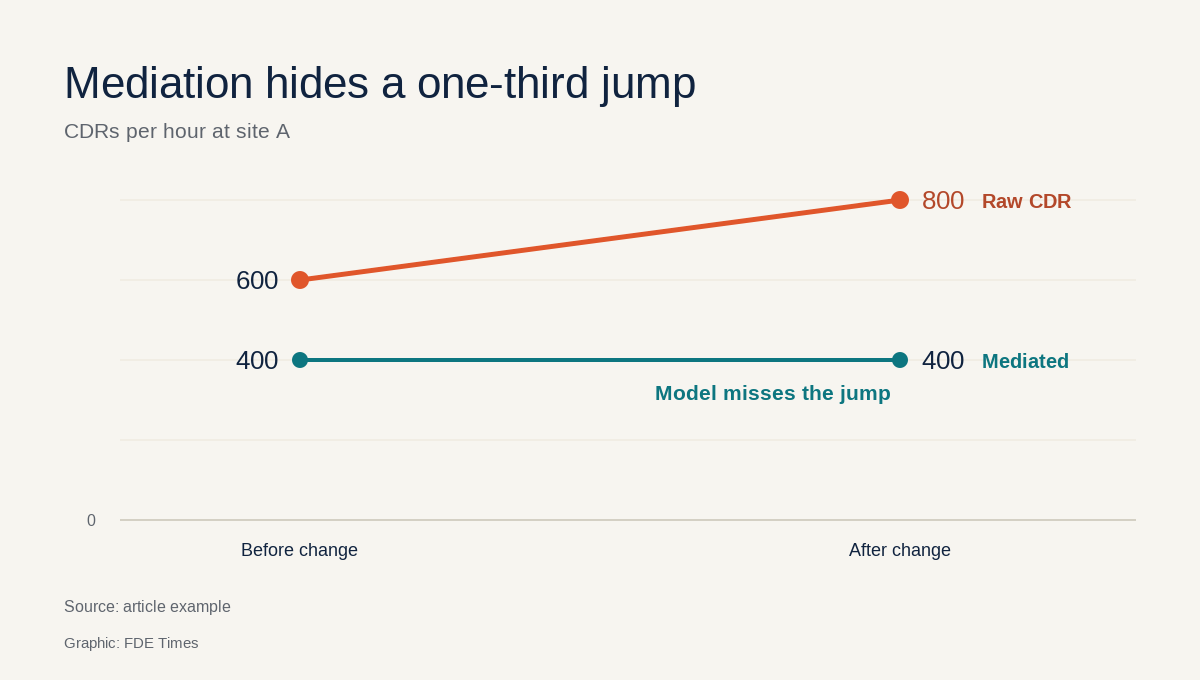
Say cell site A handles 400 calls in an hour. At the equipment, 100 of those calls each produce 3 partial CDRs, so the raw record count is 300 + 100 × 3 = 600. After mediation merges them, 400 records remain, one per call.
Now suppose a configuration change doubles the number of calls split into fragments, to 200. The raw count jumps to 200 + 200 × 3 = 800, up by a third. The post-mediation count stays at 400, perfectly flat.
A model trained on billing data will never see this event. Records that mediation deems irrelevant to billing vanish entirely, even though they may be precisely the signal being sought.
The good news is that not everything passing through a mediation platform is used for billing. Traffic statistics, for instance, can serve other purposes. Ask whether such a feed exists before pushing for access to the raw data.
With syslog, read Severity first and do not guess the transport
RFC 5424 separates syslog message content from the transport layer through a layered architecture, so any number of transport protocols can be used. In practice, different device groups may send logs in different ways. The collector has to receive all of them, and the client’s network configuration has to allow it.
Each syslog Priority carries a Severity value as a decimal number. Filtering on this field takes the least effort and pays off immediately. Split streams by Severity at the collector, before any model touches the data, so low-level logs do not drown out the lines that matter.
Do not assume every equipment vendor assigns Severity the same way. Sample a week of logs and compare them with the NOC’s actual incident records.
Alarms must flow into the tools the NOC already uses
TM Forum treats Open APIs as the precondition for a plug-and-play ecosystem in which products and services integrate smoothly. For AIOps, the API most worth knowing is TMF642, the Alarm Management Open API. ServiceNow, for example, built its Alarm Open API on the TMF642 user guide v5.0.0, released in September 2023.
The lesson for an FDE is practical: do not build yet another dashboard that the shift team has to keep open alongside everything else. If the model’s output lands in the same alarm queue they already work through, via a standard API, one argument about process disappears, and swapping tools later gets easier too.
Ask early which TMF642 version the client’s platform supports, because that version determines which fields the model has to populate.
Measure autonomy before promising automation
TM Forum created ANLET (Autonomous Network Levels Evaluation Tool) to give operators a clear measure of how automated their networks are. An ANL assessment tells an operator how autonomous its network currently is. In November 2024, TM Forum, Huawei and partners published a whitepaper on how this assessment works.
Bain & Company, in its own assessment of the use cases it examined, recorded average maturity rising by about 1.1 points, to 3.7, over 2024-2025.
Bain also stresses that high autonomy takes more than tooling. It demands changes to process, governance and culture. That is part of an FDE’s job alongside the code: who is allowed to approve an automated action? When the model recommends the wrong thing, who is accountable, and how is it rolled back?
Write the answers down before switching on any automated action. Tying each use case to a specific autonomy level also guards against overpromising to senior management.
The mistakes that cost a project a quarter
A common mistake early in a project is treating billing CDRs as the truth about the network and going straight to training. Just as common is building a syslog collector for a single transport, only to discover that an entire group of devices has never managed to send a single log line.
A less obvious one: building a separate, good-looking alarm interface that nobody on shift ever opens.
All three share a root cause: starting to build before understanding how the data and the processes actually work. A data source inventory, a comparison of record counts before and after mediation, and one question about the TMF642 version will head off most of the risk in a few days.
Anyone aiming for an FDE role in telecoms should put exactly these things on their CV. A line such as “reconciled raw CDRs against post-mediation CDRs and found a gap that masked per-site anomalies” says more than a list of frameworks.
This week’s exercise: request two CDR samples for the same hour, one before and one after mediation, and count records per cell site. The site with the biggest gap shows where the model is blind.
Was this article useful?
Thanks for the feedback!
8 sources
- The Syslog Protocol (RFC 5424) · 2009-03
- Telecommunications mediation (Wikipedia)
- Consolidate and simplify a cost-effective mobile Billing, centralized with mediation (Comviva) · 2015-11-06
- Operations support system (Wikipedia)
- Open APIs industry standardization simplifies the introduction of new services and technologies · 2023-09-06
- Alarm Management Open API: TMF642 Basis (ServiceNow)
- Is Your Telco Winning the Race to Autonomous Networks? (Bain & Company) · 2026-02-19
- TM Forum, Huawei, and Industry Partners Jointly Release Autonomous Networks Levels Evaluation Whitepaper · 2024-11-08