Why a working agent stalls in week six, and who should fix it
The blocker is rarely code but a steering meeting with no decisions on its agenda, and the engineer who built the agent should design it.
In brief
- Demos usually stall because there is nowhere for a decision to be made, and seldom because of the code
- Settle decision rights before kickoff, with a single accountable owner for each decision
- Keep the meeting schedule fixed even when progress is slow, and end every demo with a recorded decision
Six weeks into a project, the ticket-triage agent you built is running smoothly on the client’s real data, and the support team likes it.
You ask when it can go live across the whole queue. The head of support says to ask IT. IT says to ask security. Security says to wait for the steering meeting. Then this month’s meeting is cancelled because there is “nothing new”.
The code is not what holds that demo back. It is stuck because the project has nowhere for a decision to be made. The person who built the agent usually sees most clearly which decision it is waiting on, so you should be the one who designs that meeting, even if you do not chair it.
The committee exists to decide, not to hear reports
A steering committee is a project’s senior decision-making layer, and three kinds of work belong to it: scope changes, resource allocation and risk (as Rocketlane describes it).
Extending the agent to the whole queue is a scope change. Granting read access to the CRM is a risk to be handled. Both should have been on the steering agenda from week two.
A steering session that produces progress slides and no decisions has failed, even if everyone leaves happy.
The committee also needs to know what it does not decide. LeverX, writing about governance for SAP S/4HANA projects, says the charter should state clearly what the committee does not own.
Without that line, the agent’s misclassification bugs can end up in front of senior leaders, while the CRM access request sinks among the minor items.
The two people you need most are the sponsor and the champion. In an FDE-style deployment, the sponsor is one of four key roles, and the champion keeps every party pointed in the same direction.
Who gets to say “yes” must be settled before kickoff
Decision rights need to be settled before kickoff, not mid-project. When the escalation path is clear, the delivery team does not have to fight fires while also inventing who decides what. The “ask IT, IT says ask security” loop at the start of this piece is a textbook case of improvising a decision process under pressure.
The tool for settling it is RACI. Each decision has exactly one Accountable person, the one who carries final responsibility, because, as Bob Kantor wrote in Computerworld, multiple As make decisions slow and contentious. Three department heads jointly “accountable” for switching the agent on in production means nobody is.
What a one-page charter looks like
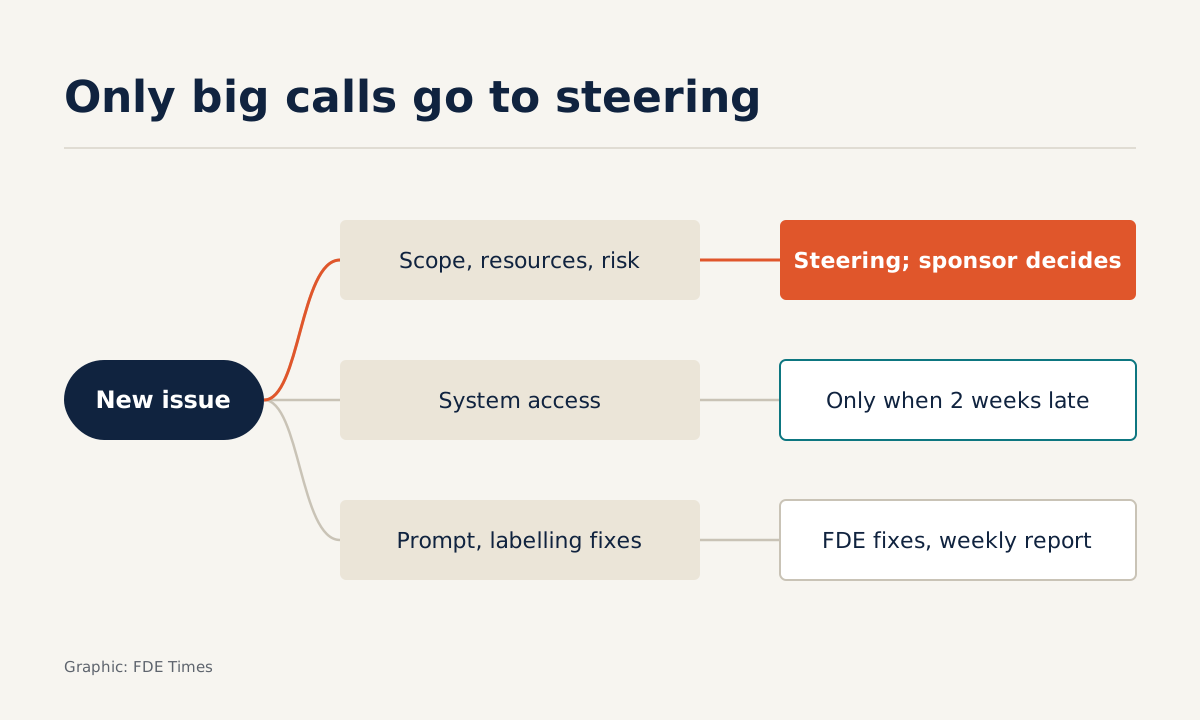
Back to the ticket-triage agent. The charter need not be long, but it must answer three questions: what the committee decides, what it does not, and which issues get escalated to it. The table below is the core, an example to adapt to your own client.
| Type of issue | Final decision-maker (A) | Goes to steering? |
|---|---|---|
| Extending the agent from one queue to all of them | Client-side sponsor | Yes, this is a scope change |
| Granting read access to another internal system | Head of security | Only if it is more than two weeks overdue |
| Prompt fixes, misclassification bug fixes | FDE | No, recorded in the weekly report |
| Assigning more client staff to data labeling | Client-side sponsor | Yes, this is resource allocation |
| Switching model provider | Both sides propose, sponsor decides | Yes, this is a risk |
The last column is the escalation threshold, and it deserves the most thought. When every scope change, every bug and every risk is pushed upward, senior governance becomes ineffective, so the threshold has to match the program’s size and risk. A three-month agent pilot needs a very different threshold from a multi-year ERP migration.
Below the table, add a section called “Not owned by the committee”. For this project that means the technical details of the pipeline, the team’s day-to-day schedule and library choices. It protects you from meetings that turn into code reviews for executives.
How often you meet matters less than you think
The debate over weekly versus fortnightly meetings usually misses the point. No cadence suits every program; the real test is whether the CRM access request reaches the head of security in time.
A good cadence is regular without being too frequent, enough to keep momentum without getting in the way of daily work. For an FDE pilot of a few months, like the ticket agent, every two weeks can be a starting point, as long as it passes that test.
If the CRM access request has to wait too long to reach the head of security, meet more often, or open an urgent escalation channel outside the schedule for anything that matches the “Yes” column in the table above.
The hardest rule to keep is not cancelling. Eric Ethington of the Lean Enterprise Institute writes that a steering meeting should never be cancelled for lack of progress, because that only starts a spiral in which each cancellation slows things further. A slow week is exactly when decisions are needed most: the meeting cancelled at the start of this piece should have been the one that settled the access request.
A demo in the steering room is a request for a decision
A demo for senior leaders is no longer a feature showcase. Its purpose is to give the person with authority enough evidence to say “yes”. Open with the decision you are asking for, and close with the same request.
First, the demo must not break. Fatskills’ FDE 101 guide advises rehearsing exactly as you will present, on the same network with the same access, and always having a fallback. An agent that runs on your laptop but fails on the client’s network costs you one meeting cycle, or two weeks.
Nor should you promise dates in the room. An opening line along the lines of “Today we will present this part; the timeline will be confirmed afterward” keeps you from committing too early. A demo for the ticket agent might run like this:
Opening (2 minutes): "Today we need you to decide one thing: extending the agent
  to the entire support queue. The detailed timeline will be confirmed afterward."
Evidence (8 minutes): demo on real data, on the client's network with the client's access.
Risks (5 minutes): the pending access request, and who decides it.
Close (5 minutes): the sponsor says yes / no / yes with conditions.
After the meeting, record the decision in a shared log that holds every change, decision and request the committee has approved. Each entry needs an owner and a deadline:
2026-xx-xx | Extend agent to entire queue | Approved, with conditions
Condition: security grants read access to the CRM system
A: Head of security | Deadline: 2 weeks | If late: goes to urgent escalation channel
The mistakes that keep demos stuck
The most common mistake is treating steering as a reporting session. You present ten progress slides, the executives nod, and nobody is asked to decide anything. If you cannot name the decision you need, shorten the meeting rather than cancel it.
Next comes having more than one A. When the RACI table says “IT and security jointly accountable”, you have recreated the back-and-forth loop from the start of this piece. Conversely, pushing everything up to the committee out of fear of responsibility buries the big decisions under dozens of small bugs.
Finally, there is settling decision rights too late. Ask “who switches on production?” in week six and the answer is already tangled up in politics. Ask it in kickoff week and it is just a row in a table.
Turning this skill into an interview story
In a case interview, describing a time you unblocked a stuck decision is more persuasive than any claim to “strong communication skills”. Tell it in four beats: which decision was stuck, why nobody could make it, what structure you changed (a charter, an escalation threshold, a single A), and how the project moved on.
On a CV, describe concrete work rather than adjectives: drafting the charter, setting escalation thresholds, keeping the decision log, and which decision moved the project from pilot to production. If possible, keep an anonymized sample charter, with client details removed, in your portfolio to bring to interviews.
Code gets the demo to the meeting-room door. A one-page charter written before kickoff is what gets it into production.
Was this article useful?
Thanks for the feedback!
7 sources
- SAP S/4HANA Steering Committee: Roles, Decision Rights, and Governance Best Practices · 2026-03-09
- Transformative Steering (Eric Ethington, Lean Enterprise Institute) · 2018-12-14
- What is Project Governance? A Complete Guide to Frameworks, Components, and Best Practices in 2026 · 2026-03-27
- How to design a successful RACI project plan (Bob Kantor) · 2012-05-23
- 6.1 Purpose and Role of a Steering Committee (Umbrex)
- Forward Deployed Engineer 101: Demo and Stakeholder Communication (Fatskills)
- The FDE Playbook: Three Implementation Patterns That Consistently Improve Success Rates · 2026-06-22