The demo works. Then security asks how fast leavers lose access
The first enterprise contract brings a security questionnaire: SAML handles sign-in, SCIM handles revoking accounts, and an FDE needs both before going to production.
In brief
- SAML gets users into the application; SCIM manages their accounts. Security teams care about both, above all about revoking access.
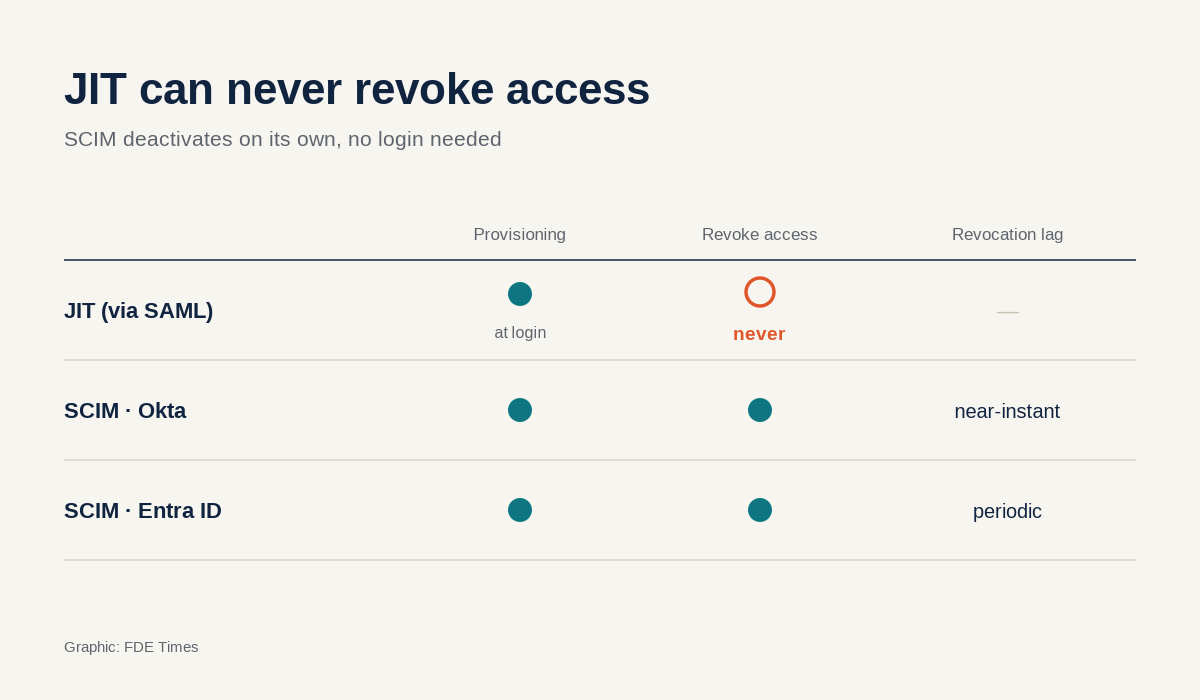
- JIT provisioning is enough when a customer is starting out, but it cannot revoke access because it only runs when someone signs in.
- Each IdP supports only part of the SCIM standard and syncs with different delays, so test separately with Okta, Entra ID and every other IdP.
On your third day at the customer’s site, the demo runs well and the business users already want to use it for real. Then an email arrives from the customer’s security team with a questionnaire several dozen lines long attached. The first line asks whether the application supports SAML SSO.
According to a playbook on enterprise SSO onboarding published by CIAM Compass, the first enterprise B2B SaaS contract usually comes with a security questionnaire that requires SAML SSO.
A 2026 FDE career guide from Georgia Southern goes further, placing enterprise SSO and compliance constraints such as SOC 2, HIPAA, FedRAMP and data residency at the centre of much of the role’s day-to-day work.
Most developers think of sign-in as a form with a username and a password. An FDE has to treat identity as a system with a lifecycle: how users get in, what they are allowed to do, and when they lose access. Only by answering those three questions clearly do you win the security team’s trust.
Signing in and managing accounts are two different problems
SAML is an XML-based protocol for exchanging authentication data with an identity provider. When a customer’s employee clicks “Sign in with your company account”, an IdP such as Okta or Entra ID authenticates that person and sends your application a signed assertion stating who they are and which groups they belong to.
SCIM solves a different problem. It is a REST + JSON protocol for synchronising identity data: the IdP actively calls your API to create, update or deactivate accounts. Authgear sums up the difference neatly: SAML lets users sign in, while SCIM creates and manages their accounts.
Between the two sits JIT (just-in-time) provisioning. The first time someone signs in through SAML, the application creates their account from the information in the assertion. It is fast and cheap, but it has a weakness every security team will ask about.
Clerk’s article on SCIM 2.0 states plainly that JIT cannot deprovision. An employee whose account is locked in the IdP will never sign in again, so the application never receives any signal. If they still have an open session or an old API token, their account in your system remains valid.
SCIM fixes this because the deactivate command runs independently, without waiting for anyone to sign in.
An example: a hospital on Entra ID
Imagine you are deploying a data analysis tool for a hospital bound by HIPAA, and the hospital uses Microsoft Entra ID. Before writing a line of configuration, the first question to settle is whether the customer mandates SAML or will accept OIDC.
The CIAM Compass playbook advises asking directly whether the customer’s procurement team specifically requires SAML.
A discovery conversation might go like this.
FDE: Do you strictly require SAML, or is SSO through Entra ID enough? IAM lead: The policy says SAML. For OIDC we’d have to check with procurement. FDE: Do your assertions include group claims? Which groups do you have today that relate to this tool? IAM lead: Yes. One group for clinical analysts, one for the management team. FDE: When an employee leaves, how quickly does your internal policy require them to lose access?
The last question matters most. It decides whether you can stop at JIT or must build SCIM from the start.
Once you have group claims, the next step is to map them onto the application’s role model, as the playbook recommends. The principle here is deny by default: anyone who is not in a declared group does not get in.
GROUP_TO_ROLE = {
    "hosp-tool-admins": "admin",
    "hosp-clinical-analysts": "analyst",
}
ROLE_PRIORITY = ("admin", "analyst")

def resolve_role(group_claims: list[str]) -> str | None:
    roles = {GROUP_TO_ROLE[g] for g in group_claims if g in GROUP_TO_ROLE}
    for role in ROLE_PRIORITY:
        if role in roles:
            return role
    return None  # no group matched: deny, do not assign a default "viewer"

def on_saml_login(assertion):
    role = resolve_role(assertion.groups)
    if role is None:
        raise PermissionError("User is not in an authorised group")
    user = upsert_user(email=assertion.email, role=role)  # JIT
    return start_session(user)
The on_saml_login function refreshes the role on every sign-in, so if someone is moved out of the admin group they lose admin rights the next time they sign in. But if they never sign in again, nothing changes.
That is where SCIM has to step in, with an endpoint that receives the deactivate command, marks the account inactive, kills every session and revokes tokens immediately.
The standard on paper is not the IdP in the wild
At this point many people assume that reading the RFC and following the standard is enough. Clerk warns that RFC 7644 defines a very broad protocol, but enterprise IdPs implement only a pragmatic subset of it. Code that works with one IdP can fail with another, so you must test separately with each IdP the customer actually uses.
Latency differs too. Provisioning from Okta is close to real time, while Microsoft Entra ID syncs incrementally, sending only the changes, on fixed scheduled cycles. For the hospital in the example, that means a delay between the moment IT locks an account in Entra ID and the moment your application receives the deactivate command.
Tell the security team about that delay plainly. Do not promise “instant revocation”.
Steps to take in the first week
Start by reading the security questionnaire carefully and pinning down the real requirements: SAML or OIDC, which IdP, whether group claims are sent, and how long the access-revocation deadline is. Then design the group-to-role mapping table and send it to the customer for approval before writing code, because the group names are their data, not yours.
Next, build JIT first so users can get into the system, and state clearly in the documentation that JIT does not yet handle revoking access. If the customer has many users or a strict revocation policy, put SCIM in the plan straight away.
The CIAM Compass playbook also holds that JIT is only enough for the early stage, while B2B SaaS at scale needs SCIM as well.
The final step is usually the hardest and has nothing to do with code: getting production credentials. The Georgia Southern guide calls this outright a matter of internal politics when working with a customer’s security team. The more ready your answers on deprovisioning, permissions and audit logs, the shorter that negotiation.
Common mistakes
The most common mistake is assigning a default role to anyone who matches no group. It is convenient in development, but in a HIPAA environment it is an authorisation hole. The second is assuming that locking an account in the IdP means the application automatically knows, when with JIT the application never receives that signal.
The third is testing with a single IdP and then claiming support for “standard SCIM”. The fourth is promising a revocation time without knowing the sync cycle of the customer’s IdP. The last is waiting until the security team asks before starting to think about any of this.
An exercise for this week
Take an application you are working on and draw the timeline from the moment an employee is locked in the IdP to the moment they truly lose all access: sessions, API tokens, running jobs. Mark which steps depend on them signing in again, then redo the calculation for both Okta and Entra ID.
If you can answer that question with a number and a diagram, you are speaking the security team’s language. For an FDE, that is often the fastest route to production access.
Was this article useful?
Thanks for the feedback!