A successful pilot can still die if it lands after the budget closes
Ask for the client's fiscal year in the first meeting, then schedule the pilot backward so the results exist before next year's budget is set.
In brief
- SaaStr's Jason Lemkin says large enterprises lock next year's budget in Q3, even though the purchase may happen in Q4.
- Pilot money usually comes from an experimentation fund, so a pilot with good results does not mean there is money to scale it.
- FDEs need to know the client's real fiscal year and who holds the budget before setting a start date.
Large enterprises lock their budgets for the following year in the third quarter, even if the contract is signed in the fourth, according to Jason Lemkin, founder of SaaStr. His rule of thumb: if a big deal has not closed by the end of Q3, it is very hard for it to make next year’s budget.
For an FDE, that rule has a very concrete consequence. A pilot can run well, the model can meet the bar and the users can love it. But if the results arrive after the client has locked its budget, the sponsor has no numbers in hand at the moment the spend has to be defended. Scaling then waits nearly another year.
You do not have to become a salesperson to understand this. You set the technical schedule for the pilot, so you decide when the first numbers appear. Choosing that date to fit the client’s financial calendar is a direct way of helping the project reach production.
Why are pilots easy to start and hard to finish?
Foundation Capital observes that buyers and sellers alike find it far easier to start a pilot than to bring one home. Madrona points to one reason: in AI, a pilot often means only that the client has agreed to “give it a try” with money from an experimentation fund. That fund is separate from the budget for systems running in production.
Anthropic’s guide to taking AI from pilot to production makes a similar point. Pilot budgets are often protected from the usual pressures inside an organization. So a successful pilot will not necessarily be funded when it scales, because at that point the spend has to compete with every other line in the annual plan.
How do you read a client’s financial calendar?
Saber, a B2B sales software company, says budget planning usually starts two to four months before the new fiscal year. Companies whose fiscal year matches the calendar year typically plan their budgets between September and November.
These are two different estimates. Lemkin says enterprise budgets are already locked in Q3, meaning July to September, while Saber puts budget planning later, from September to November. When you do not know which kind of client you have, the safe course is to schedule for the earlier deadline: have numbers before Q3 begins.
Many clients do not follow the calendar year at all. Some companies run their fiscal year from July to June, others from October to September. Government agencies and schools also often start their year on July 1.
Apply the “two to four months before” rule to a client whose year starts in July, and budget planning falls roughly between March and May.
Lemkin adds one more caution: enterprise customers evaluate new applications only during narrow windows in the year. The deployment window can close even after the contract is signed. A signature does not mean you can start work right away.
An example: the same pilot, two start dates
Take a hypothetical logistics company whose fiscal year starts on January 1 and which wants to test an agent that sorts complaint emails. The pilot runs 12 weeks: the first 4 go to connecting data and building the eval set, the next 8 to running in parallel with the operations team.
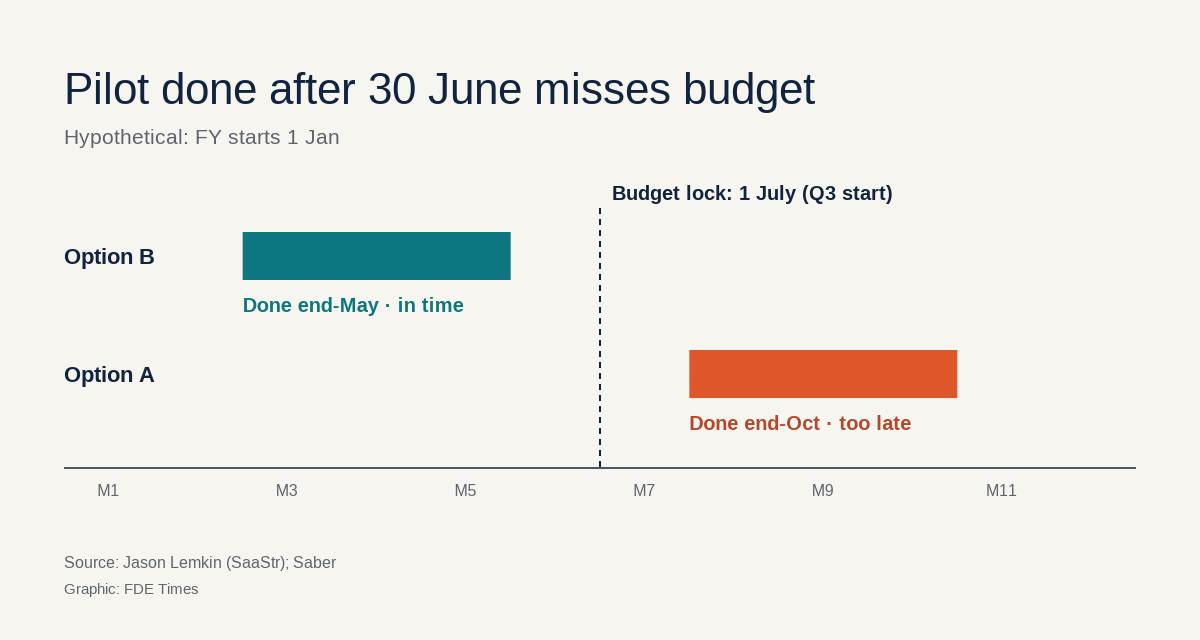
Under option A, the pilot starts in early August. The parallel run begins in early September, so reliable numbers only arrive around October, and the final report comes out at the end of October.
By then, on Lemkin’s estimate, the budget has been locked since Q3. On Saber’s estimate, the September-to-November planning period is also nearly over. Whichever deadline applies, the sponsor has to seek approval for a spend that is not in the plan.
Under option B, the pilot starts in early March. March goes to connecting data and building evals, April and May to the parallel run, so the first numbers arrive in April and the pilot ends in late May. The sponsor has June to put the results into the budget case before Q3 begins.
Both options use the same model, the same team and the same technical results. Only option B gets the expansion into next year’s budget in time, whether the client locks early as Lemkin describes or later as Saber does.
If you have already slipped into option A, there is still a way out. Lemkin says that after budgets lock, clients can still buy software for small amounts out of discretionary budget.
Saber gives the example of a small pilot that stays within the discretionary spending limit, using what is left of the current year’s budget to prepare for a larger rollout later. You can narrow the pilot’s scope to fit that limit, then use it as evidence for the next budget cycle.
| Milestone (calendar-year client) | What the FDE does |
|---|---|
| March | Agree scope and success metrics, connect data, build evals |
| April–May | Run in parallel, deliver first numbers to the sponsor |
| June | Finish the results report and the proposed expansion scope |
| Q3 (July–September) | Budget lock, on Lemkin’s estimate |
| September–November | Budget planning, on Saber’s estimate; the sponsor defends the spend |
| Q4, if the window was missed | Run a small pilot within the discretionary spending limit |
Which questions belong in the discovery meeting?
Add three questions to your usual discovery list, and ask them naturally: “What month does your fiscal year start?”, “When is next year’s budget usually finalized?” and “If the pilot succeeds, who will put the expansion into the plan?”
The third matters most. According to Madrona, the sponsor you need is at VP or C-level, accountable for both risk and budget, and focused on measurable results. The most enthusiastic user in the pilot is usually someone else, so your report has to be written for the person who holds the money.
Common FDE mistakes
The most common mistake is assuming that a successful pilot will naturally be funded. As Madrona and Anthropic point out, money for pilots and money for production systems usually come from different sources. The second is assuming the client runs on the calendar year without checking.
The third is letting the pilot simply run out. Madrona writes that in AI the renewal is the real sale, everything before it is a trial, and a successful pilot should never be allowed to quietly wind down. The last day of the pilot should therefore come with a concrete expansion proposal, not just a demo.
The final mistake lies in how you tell the story afterward. On your CV or in FDE interviews, give both the timeline and the person who approved the expansion money; that detail shows a hiring manager you understand how a pilot reaches production.
Good code gets you a good pilot. Whether that pilot gets money to scale depends largely on whether the numbers reach the sponsor before or after the client locks its budget.
Was this article useful?
Thanks for the feedback!
5 sources
- Customers Have Windows to Deploy New Apps. They May Buy Early — But Only Up to A Point. (SaaStr, Jason Lemkin)
- Budget Cycle: Definition, Timing & B2B Sales Strategies (Saber) · 2026-11-03
- Selling AI in 2026: Selling Is Easy. Staying In Is Everything (Madrona) · 2026-04-17
- What it takes to win enterprise AI deals (Foundation Capital) · 2026-11-24
- Deploying AI from pilot to production: a practical blueprint for CIOs and technical leaders (Claude) · 2026-09-14