Why an eval suite persuades clients better than a slick agent demo
A single pass rate can hide the very failure a client's risk team fears most, and splitting the score by case type brings it into view.
In brief
- The Microsoft Foundry team itself warns that early demos look impressive but edge cases pile up fast.
- An eval suite split by case type is what convinces clients, because an overall pass rate can hide the exact failure the risk team worries about most.
- Microsoft's FDE posting keeps you accountable after handover, so the eval suite must also serve as a regression suite once the agent is in production.
In its guide to evaluating agents, the Microsoft Foundry team puts it bluntly: early demos look impressive, but edge cases pile up fast. The same guide warns that without evals, regressions usually surface only when users hit them in production.
The way Microsoft writes its job postings for forward deployed roles points the same way. The posting for a Senior Forward Deployed Scientist in CoreAI, a role that runs parallel to the FDE, makes that person the lead technical adviser to clients evaluating Agents and Azure Direct Foundry models. To win adoption, they build pilots, prototypes and eval suites.
For anyone who wants to work forward deployed on Foundry, or on any agent platform, the eval suite is the skill to practice first. It follows you from the moment a client is weighing the decision to the moment the agent runs for real, and then becomes a signal sent back to the product team.
Two parallel roles, one shared skill
Microsoft’s FDE posting describes the engineer as a bridge between the client’s environment and Microsoft’s engineering teams. On the careers page, the other end is simply called “engineering teams”, with no mention of Foundry and none of evals.
The more telling line concerns what happens after handover. According to the posting, the FDE remains responsible for monitoring, tuning and driving adoption of what they have built. Pilots and eval suites appear in the Forward Deployed Scientist posting instead, alongside feeding client lessons back into the AI Foundry platform and building solution accelerators.
The postings do not say how the two roles coordinate or hand work to each other. Read side by side, they look like two complementary halves: one uses the eval suite to earn the client’s trust, the other has to keep the system running well after handover, and both need to know how to measure an agent.
On the platform side, a posting for the Foundry Agents team in CoreAI mentions observability for drawing insights from agent traces and evaluating agents continuously.
So even in Microsoft’s own description of the agent lifecycle, evaluation runs for as long as the agent operates rather than stopping at the sales stage.
An eval suite that tells the truth: a worked example
Take a hypothetical insurer evaluating an agent that answers questions about policies, running on Foundry. Its sales team wants fast answers; its risk team wants the agent to know when to hand over to a human. A good eval suite has to answer to both.
Foundry’s documentation describes its built-in agent evaluators as working like unit tests, returning Pass/Fail scores. It also separates system evaluation (the final outcome) from process evaluation (each execution step). Your eval suite should do both.
You write 40 test cases in three groups: 25 policy-clause lookups, 10 multi-step questions (which require a tool call to look up records) and 5 questions the agent must refuse or escalate. The runner can be as simple as this:
# eval_suite.py — a minimal eval suite for an agent pilot
import json

def call_agent(question: str) -> dict:
    """Replace with a call to the client's deployed agent."""
    raise NotImplementedError

def check(case: dict, answer: dict) -> bool:
    if case["type"] == "refuse":
        # pass if the agent refuses or hands over to a human
        return answer.get("escalated", False)
    text = answer["text"].lower()
    outcome_ok = all(k.lower() in text for k in case["must_include"])
    # score the process too: did the agent call the right tools
    expected = case.get("expected_tools", [])
    process_ok = all(t in answer.get("tools_called", []) for t in expected)
    return outcome_ok and process_ok

def run(path: str = "cases.jsonl") -> None:
    results: dict[str, list[bool]] = {}
    with open(path, encoding="utf-8") as f:
        for line in f:
            case = json.loads(line)
            ok = check(case, call_agent(case["question"]))
            results.setdefault(case["type"], []).append(ok)
    for kind, oks in results.items():
        print(f"{kind}: {sum(oks)}/{len(oks)}")
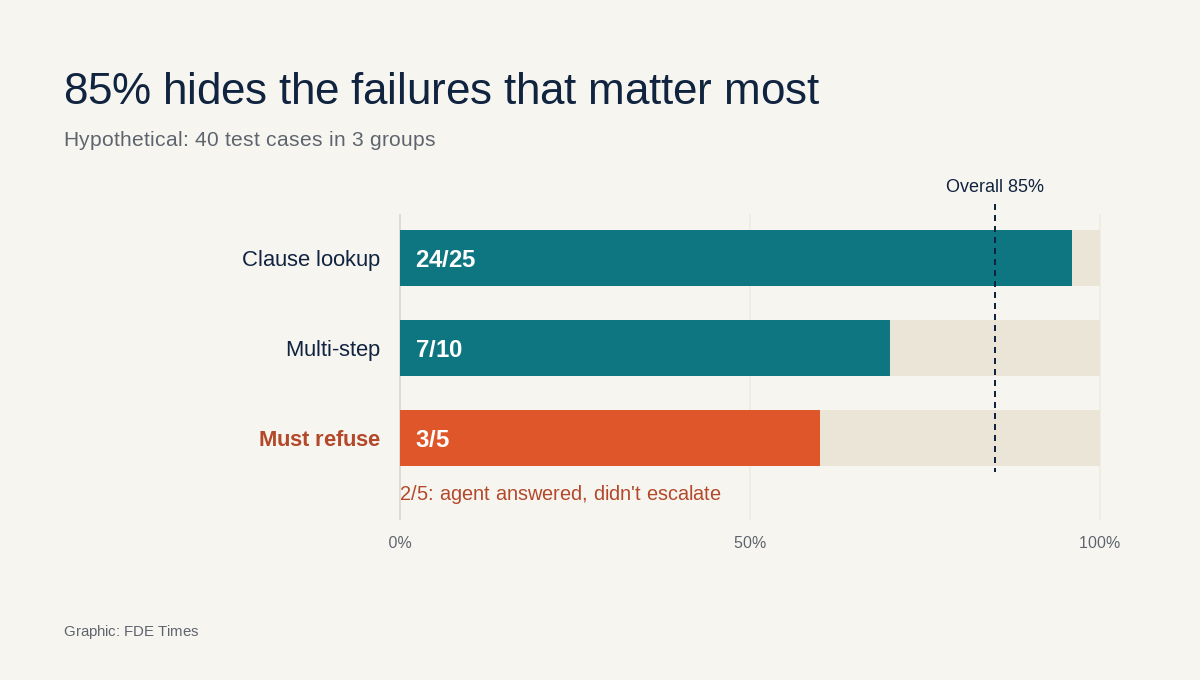
Suppose the results come back as 24/25 lookups, 7/10 multi-step questions and 3/5 must-refuse cases. That adds up to 34/40, or 85%, and a slide reading “85%” looks very good.
But in 2 of the 5 cases that should have gone to a human, the agent answered on its own: 40% of sensitive situations handled wrongly. That is the number the risk team will ask about. In the multi-step group, process scoring also tells you whether the agent failed because it answered badly or because it skipped the records lookup.
The client presentation should therefore open with the three-row table rather than a single headline number. Next comes the fix plan: add escalation rules, rerun, and keep these 40 cases as the regression suite. At that point the eval suite becomes a shared agreement between you and the client on what “good enough” means.
After handover, the eval suite becomes the regression suite
An approved pilot is where the hardest work begins. Because the FDE posting keeps you monitoring and tuning after handover, every change of prompt, model or tool means rerunning those same 40 cases before the client notices anything.
The pressure for speed is rising, too. When Accenture launched its forward deployed engineering practice for Microsoft in March 2026, it targeted the gap between pilot and production, promising to take AI from idea to production in days rather than months. Moving that fast is only safe with a regression suite that runs in minutes.
Go back to the insurance example. If eval_suite.py and its three-group split work for a second client, they should become a team template, in the spirit of the solution accelerators the Scientist posting mentions, instead of sitting forever in the first client’s repo.
How should a product feedback note be written?
Feeding lessons back to the platform sounds grand, but in practice it is a short document a platform team can read in two minutes. A workable template:
Client / industry: insurance, policy-lookup agent pilot
Problem: agent failed to hand over to a human in 2/5 sensitive cases
Workaround: added escalation rule in the prompt + regression case
Why the platform should care: every financial-services client will hit this
Proposal: a built-in "must escalate" check type in the eval tooling
The fourth line matters most. It turns one client’s complaint into a product signal, which is exactly the job of feeding client lessons into AI Foundry that the posting describes.
Common mistakes
The most common mistake is reporting the overall pass rate, like the 85% above. The second is scoring only the final answer, when the Foundry documentation stresses evaluating both the quality and the efficiency of each step in the workflow.
The third is writing test cases alone, without sitting down with the client’s business staff. The eval suite then measures only what engineers can guess and misses what the client actually runs into.
The fourth is treating the end of the pilot as the end of the job, even though the FDE posting spells out responsibility for monitoring and tuning after handover. The last is solving a problem without writing it down, so the next client hits the same issue and the team starts from scratch.
What do you need to show to get hired?
Job postings will not always spell this skill out; you have to bring it yourself. When reading postings at any company, look for two kinds of line: one saying you stay accountable after handover, and one mentioning pilots or eval suites for clients who are evaluating.
The strongest portfolio piece is a small agent with an eval suite split by case type, scoring both outcomes and individual steps, plus a README section recording what was fixed after the first eval run.
On a CV, do not write “built a RAG chatbot”. Use a structure instead: what problem the agent was built for, a 40-case eval in three groups, how far the escalation failures improved from 3/5, and how long it has run in production. Each clause answers a question a recruiter will ask.
The demo gets you the first meeting. The client’s trust comes later, when edge cases start piling up and the eval suite points to exactly where the agent is breaking.
Was this article useful?
Thanks for the feedback!
7 sources
- Forward Deployed Engineer (FDE) @ Microsoft | anitab.org Job Board · 2025-09-23
- Forward Deployed Engineer (Microsoft, via the AnitaB.org Job Board)
- Senior Forward Deployed Scientist - CoreAI (Microsoft, Jobright.ai listing)
- Senior Software Engineer, Foundry Agents - CoreAI @ Microsoft | anitab.org Job Board
- Agent Evaluators for Generative AI - Microsoft Foundry | Microsoft Learn · 2026-09-30
- Evaluating AI Agents: A Practical Guide with Microsoft Foundry · 2026-03-16
- Accenture Launches Microsoft Forward Deployed Engineering Practice to Help Organizations Scale AI Across the Enterprise · 2026-03-18