Saying yes to every client request is how FDEs lose the project
A well-timed "yes, but" protects the timeline and the client's trust, and stops daily requests from turning a forward deployed engineer into outsourced staff.
In brief
- Staff augmentation means working under the client's direction; an FDE is accountable for getting an outcome into production.
- Without a regularly restated mission, the client's daily pressure will redefine your role for you.
- Defer commitments, answer with a conditional yes, and route ticket-style work to support.
Umbrex’s playbook for forward deployed engineers contains a warning that anyone who has spent long stretches in a client’s office will recognize: if the mission is not restated again and again, the client organization will redefine your role through daily pressure.
Nobody calls a meeting to decide that the FDE should become outsourced staff. It simply happens, one morning Slack message at a time.
The signs are familiar. Today it is “could you export that report for me”, tomorrow “could you fix the filter on the dashboard”, the day after “add a column to the internal tool”. Each task is small and reasonable, and taking it on makes the client happy straight away.
The trouble is that you were sent there to do something else. This guide shows how to pull the role back where it belongs while keeping the client relationship intact.
Whoever directs the work defines the role
FullStack separates the two models with one neat test. Staff augmentation adds engineers to the client’s team, and those engineers work under the client’s direction: they do the tasks the client’s team assigns. A forward deployed engineer, by contrast, is accountable for getting an outcome into production.
That difference shapes how you answer every request. Someone working through tasks is measured by tasks completed and hours spent. Someone accountable for an outcome has to ask: does this bring the outcome closer to production?
FullStack also explains why clients need the FDE model: it fits when nobody yet knows exactly what has to be built. That is precisely when assigning work task by task, day by day, is most likely to fail, because the person handing out the tasks cannot see the destination either. When you accept daily tasks, you hand back to the client the very burden they hired you to carry.
PostHog’s handbook draws the line in the same spirit. The FDE owns the technical outcome of the engagement, while the commercial relationship belongs to sales and customer success. Recurring work, the repetitive ticket kind, belongs to support. Umbrex puts it more bluntly: by default, the FDE should not become the client’s implementation team.
What a week of drift looks like
Take a hypothetical case. You are deploying an agent that triages claims files for an insurance company, and the agreed outcome is the agent running on real data within six weeks. In one week the client sends five side requests, each costing about 90 minutes once context switching is included.
Five tasks at 90 minutes is 7.5 hours, nearly a full day of a five-day week. Over six weeks you lose about six days, more than a week of the engagement, and nobody records it. At the review the agent is late, and the client who thanked you for the quick report export is the one asking why the project slipped.
The wrong reflex at this point is a flat refusal. “That’s not in my scope” is contractually correct but damages the relationship. A three-step script works better.
A three-step script for ad hoc requests
Step one: do not commit on the spot. FDE Academy notes that experienced FDEs tend to reply along the lines of “let me check and get back to you”. That buys time to see whether the task is feasible and, more important, what kind of task it is.
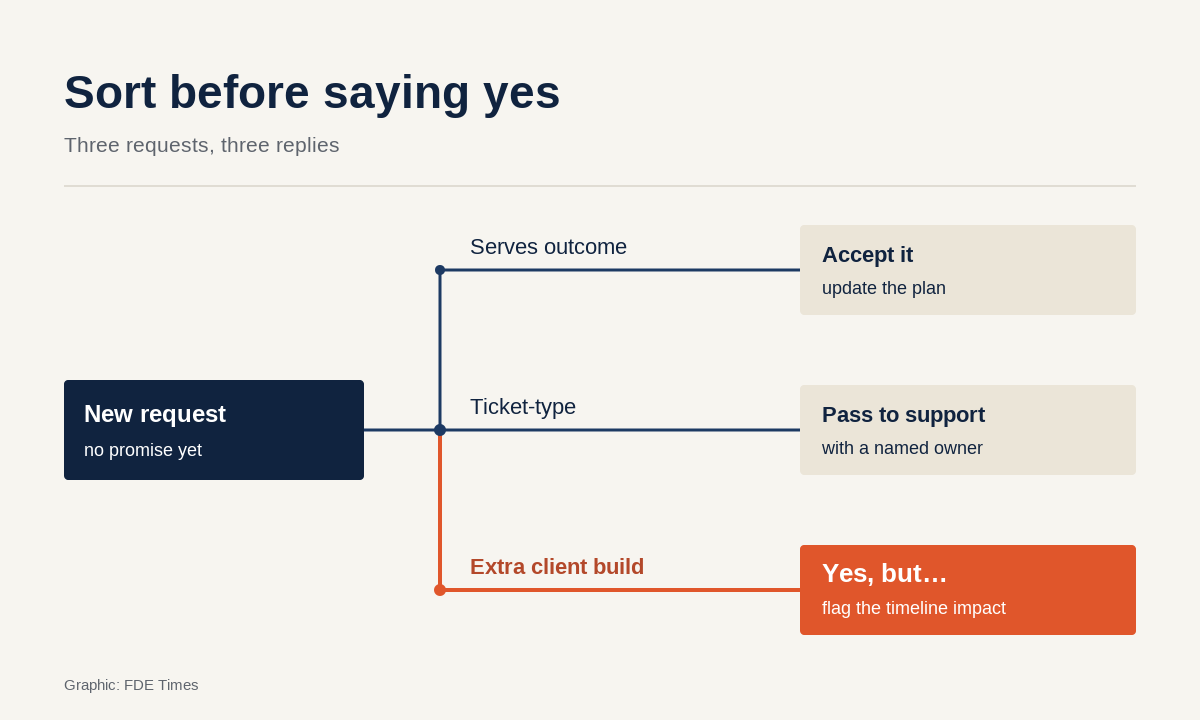
Step two: classify it. If it directly serves the outcome, it is yours. If it is recurring, ticket-style work, it should go to support. If it is extra building for the client’s team, it is a scope conversation that needs the account owner involved.
Step three: answer with a conditional yes. FDE Academy suggests saying something like: “Yes, but doing this will push the current timeline back as follows.” Applied to the example above, the reply might read:
“Lan, I’ve looked at it. Adding this column to the internal tool takes about a day. If I do it this week, the triage agent’s first run on real data moves from Friday to next Tuesday.
Which would you like to prioritize? As for the weekly report export, I’ll hand it to Minh in support so there’s a fixed process and you don’t have to wait on me.”
You do not say no. You spell out the cost and let the client choose, which is what someone accountable for an outcome should do.
| Request type | How to recognize it | How to respond | Who takes it |
|---|---|---|---|
| Serves the outcome | Without it the outcome cannot reach production | Accept, update the plan | FDE |
| Ticket-style | Recurring, small fixes, no end point | Hand off with a named contact | Support |
| Extra building for the client’s team | New feature outside the agreed outcome | Agree, with the impact on the timeline | FDE with the account owner |
Write the boundary into the deliverable itself
The script only treats one case at a time. For the boundary to hold, it has to be on paper. PostHog requires every deliverable to answer two questions: what did we assume, and what is out of scope? Those two sections help block scope creep in the next round.
For the insurance agent, the assumptions section might state that claims data comes from a single system. The out-of-scope section lists changes to the internal tool and recurring reports explicitly. The next time the client asks, you only need to point to the line in the deliverable, with no argument required.
The boundary also has an end point. When the technical work is done, PostHog has the FDE hand the relationship back to the account owner. If you stay on “just to be safe”, you become the client’s standing resource, the very thing to avoid from the start.
Why restate the mission every week?
If daily pressure can redefine the role, as Umbrex warns, then regular restatement is how you hold onto it. A three-line weekly note is enough: the outcome you are working toward, progress against the plan, and how ad hoc requests were handled.
That note is also the place to deliver bad news. FDE Academy stresses clear, honest and frequent communication, especially when something goes wrong. The credibility built up from telling the truth is what lets you renegotiate the boundary without the client feeling turned down.
Common mistakes
The most common mistake is agreeing unconditionally until the deadline slips, and only then telling the client about the seven hours a week that went missing. By then the explanation sounds like blame. The opposite mistake is a curt refusal: right about scope, but it costs you an ally on the client’s team.
The third is handing work to support without naming who will pick it up, which leaves the client feeling brushed off. The fourth is writing the out-of-scope section so vaguely, along the lines of “other tasks”, that it cannot be cited when needed.
For your career, this skill should show up on a CV as an outcome, for example “shipped a triage agent to production in six weeks, routing recurring requests to support”.
When interviewing for an FDE role, ask who will direct the day-to-day work. If the answer is the client’s team, then by FullStack’s definition the role is closer to staff augmentation.
This week, count the hours you spent on work that is not part of the agreed outcome. That number is the starting point for your next conversation with the client, and it is far easier to raise when you bring it early.
Was this article useful?
Thanks for the feedback!