What a CFO wants from an AI pilot is a page, not a model
Ninety days of operating data supply the baseline, the break-even scenario and the stop condition that make a 20% claim believable.
In brief
- The baseline must be measured before deployment, on the exact process being automated: cost, cycle time, error rate.
- Every percentage scenario needs one line of explanation that traces back to the data, and must show how saved hours become money.
- A good page has a break-even scenario and stop conditions, both fixed before the pilot runs.
Picture your third week at a distribution company. The head of operations sends you an export from the invoice reconciliation system covering exactly the last 90 days, with a one-line message: the CFO wants a single page by Friday, and if it is convincing, the pilot gets approved.
Most engineers would open a notebook and start trying models. That is the most comfortable task, but it is not the one that decides whether the project goes ahead. What decides it is a single page, and the person reading it does not care about prompts or OCR accuracy.
For an FDE, this skill sits between the code and the client. In the scenario above, you hold the data and you know what the system can and cannot do. That makes you the most sensible person to write the page.
Why only one page?
In Working Backwards, Colin Bryar and Bill Carr explain why Amazon limits the length of its documents: the constraint sharpens both thinking and communication. They put it bluntly: there are no awards for extra pages or more words.
One page does not mean less analysis. The business case template that Infinisynapse proposes for data AI projects uses one page as the executive summary, then attaches supporting analysis for each answer on that page. The first page is the promise; the appendix is the evidence.
The baseline is already in your hands
SoftwareSeni defines a baseline as performance data recorded before deployment, for the exact process about to be automated, over a minimum window of 90 days drawn from existing systems.
Beyond the degree of customer impact, the three core metrics are cost, cycle time and error rate. When AI replaces or augments a process that is already running, that process is the point of comparison.
The client’s 90 days of data is a ready-made baseline that costs nothing extra to measure. Suppose the file shows 27,000 invoices in the quarter, or 9,000 a month. Each invoice takes an average of 6 minutes to process by hand, so each month consumes 54,000 minutes, or 900 staff hours.
The error rate is 4%, which means 360 invoices a month must be reworked, at 20 minutes each, adding 120 hours. At an assumed rate of VND 150,000 per staff hour, you now have all three numbers: cost, cycle time and error rate.
Unframe stresses that the baseline must be locked before the pilot runs, so that when it ends you can show which improvements genuinely came from AI. Where feasible, keep a control group, such as one shift that still works by hand, to separate the effect of AI from seasonal swings.
Every percentage needs a line of explanation
The part of a business case most likely to be struck out is a sentence like “AI cuts processing time by 20%”. The CFO will ask where the 20% comes from. The answer has to trace back to data, not to a hunch.
Go back to the 90-day file. Suppose you group invoices by supplier and find that 60% come from 20 large suppliers using fixed templates. This is the portion AI can pre-fill, leaving staff only to check it. The remaining 40% are one-off formats, and you assume no savings there.
Base case: on the 60% of fixed-template invoices, time falls from 6 minutes to 4. The average saving is 2 minutes times 60%, which is 1.2 minutes out of 6, or 20%. Each month that is 5,400 invoices times 2 minutes, giving 180 hours.
Low case: in testing, extraction fails on half the fixed templates, so only 30% of invoices benefit. A saving of 2 minutes times 30% is 0.6 minutes, or 10%, equivalent to 90 hours a month.
High case: still 60% fixed-template invoices, but staff need only 3 minutes to check. A saving of 3 minutes times 60% is 1.8 minutes, or 30%, equivalent to 270 hours a month.
At this point, no percentage is a number chosen to look good. Each is tied to a specific assumption, and every assumption can be tested in the pilot.
Staff hours are not yet money
SoftwareSeni cites Deloitte’s State of AI in the Enterprise 2026 report: 66% of organisations achieved productivity gains, but only 20% increased revenue. Many business cases break precisely in that gap. Saving 180 hours only has value when the page states clearly where those hours go.
In this example, ask the head of operations before you write: do they plan to hire fewer temporary staff for the peak season, or move people onto overdue receivables? Their answer, not yours, is what becomes the P&L line.
Now convert to money. At VND 150,000 an hour, the gross monthly saving is VND 13.5m (low), VND 27m (base) and VND 40.5m (high). After an assumed operating cost of VND 4.5m a month, the net comes to VND 9m, VND 22.5m and VND 36m.
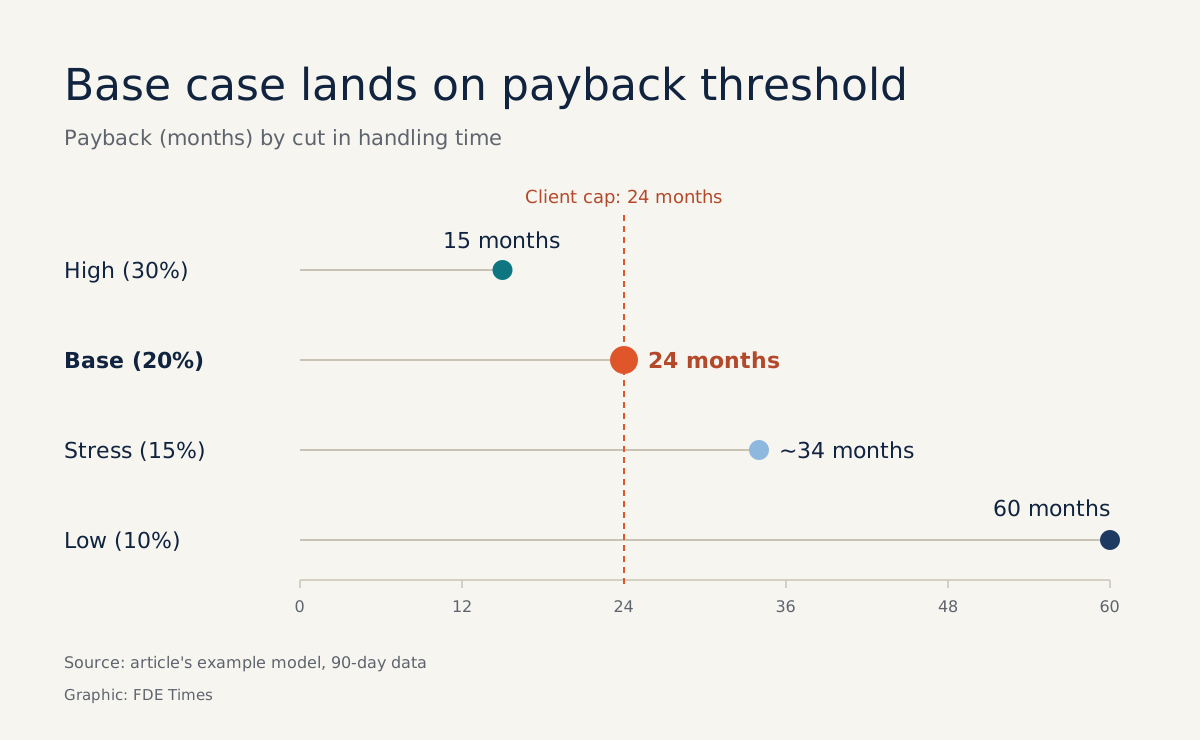
If the build cost is VND 540m, payback is 60 months, 24 months and 15 months respectively. Suppose the client sets a 24-month payback threshold: the minimum reduction needed to meet it is exactly 20%, which matches the base case.
That is the most valuable information on the page. This project is not a “sure win”. It sits right on the edge, and everything depends on whether the 2 minutes saved per fixed-template invoice materialise.
To see how close to the edge it sits, run a sensitivity check. If only 45% of invoices use fixed templates, the base case falls to a 15% reduction, or 135 hours a month, a net saving of VND 15.75m and a payback of about 34 months.
What does the finished page look like?
Infinisynapse recommends presenting uncertainty through low, base and high scenarios, a break-even case and the confidence level of the evidence, rather than a single number. Applied to the example, the core of the page might look like this:
| Scenario | Key assumption | Hours saved/month | Payback |
|---|---|---|---|
| Low (10%) | 30% of invoices benefit, 2 minutes saved | 90 | 60 months |
| Base (20%) | 60% of invoices benefit, 2 minutes saved | 180 | 24 months |
| High (30%) | 60% of invoices benefit, 3 minutes saved | 270 | 15 months |
The break-even scenario does not need its own row. A note directly beneath the table is enough: to meet the client’s 24-month payback threshold, the minimum reduction is 20%, exactly the base case.
The confidence line should clearly separate what has been measured from what is assumed. The 60% share of fixed-template invoices is measured from 90 days of data, so confidence is high. The 2-minute saving is an assumption, so confidence is low until the pilot tests it.
The three scenarios count processing time only; the 4% error rate is in the baseline, but nothing yet assumes AI will reduce errors. Record the 120 hours of monthly rework as a potential benefit not yet counted, because a conservative figure in which the CFO can see headroom for themselves is usually more persuasive than a greedy one.
Stop conditions must be written before the pilot
Infinisynapse suggests that a business case should state clearly the conditions under which the project must stop or be redesigned. Unframe adds that ROI metrics and reporting cadence must be defined before the pilot starts, and Educative advises locking the definition of success at this stage too.
In the example, the stop condition might read: after four weeks of pilot, if the time saved on fixed-template invoices is under 1 minute, the project stops or narrows its scope. Reporting is weekly, measuring the same three metrics as the baseline.
Writing stop conditions can feel like weakening your own proposal. In practice it does the opposite: it shows the CFO that the risk is bounded, and it protects you from a pilot that drags on with no end.
The timeline belongs on the page too. FDE Academy cites analysis by Perspective AI that sets a target of putting the system into production within 90 days of contract signature. Do not confuse this with the 90 days of baseline data above: one is a delivery schedule, the other a measurement window.
This milestone comes from firms that sell FDE services and does not come with a methodology or underlying data, so treat it as a reference only. The point it makes is sound, though: a business case needs a timeline, not just numbers.
Mistakes that get the page struck out
Do not take the baseline from staff’s verbal estimates: a baseline must be performance data recorded before deployment, so pull it from the system. Nor should you apply the savings percentage to the entire volume when AI touches only part of it, such as the 60% of fixed-template invoices above.
Another mistake is converting saved hours straight into money without asking where those hours will be used. The last is offering a single number, with no low case, no break-even scenario and no stop conditions.
When applying for FDE roles, check whether the job description mentions ROI, value realisation or working with finance stakeholders. If it does, a CV line such as “built a baseline from 90 days of data, 20% base case, 24-month payback, pilot measured X” says more than any adjective.
This week’s exercise: with a 45% fixed-template share, work out the low and high scenarios yourself, then redo the whole table. Then write exactly one sentence to the CFO explaining why the pilot should still go ahead, or why it should not.
Was this article useful?
Thanks for the feedback!
6 sources
- How to Build an AI Business Case That Survives CFO Scrutiny Before Budgets Are Set · 2026-04-27
- How to Measure the ROI of AI Pilot Projects | Unframe AI · 2026-04-30
- Business Case Template for AI Data Projects · 2026-07-23
- Developing the AI Business Case: Part 2
- What's it like to work at Amazon? (excerpt from Working Backwards)
- How Do Forward Deployed Engineers Improve AI ROI? · 2026-07-30