An EU client's AI board won't ask how accurate your model is
Under Article 9 of the AI Act it asks what risk remains and who accepted it, so the file must be a living argument, not a one-off PDF.

In brief
- Under Article 9, risk management is a continuous, iterative process, and the board will ask directly whether residual risk is acceptable.
- Annex IV requires you to explain why the chosen metrics are appropriate and to describe how performance is evaluated after deployment.
- The deadline extensions in the Omnibus package take legal effect only once published in the Official Journal, so check EUR-Lex yourself.
Go-live is two weeks away. The client’s AI board sends an email with a single question: “Is the residual risk of this system acceptable, and who decided that?”
You have a dashboard, an eval suite and a demo that runs smoothly. None of them answers that question.
For an FDE working with clients in Europe, this is the moment a project either moves forward or sits waiting for another quarter. The skill required is not knowing the law by heart. It is turning the technical work you have already done into an argument the board can read.
The board does not read code. It reads arguments
Article 9 of the EU AI Act requires high-risk AI systems to have a risk management system that is established, implemented, documented and maintained. The most important word is “maintained”.
The law states plainly that this process must be understood as a continuous, iterative one. Your file is therefore not a PDF submitted once and forgotten. It lives alongside the system.
Article 9 also sets the destination: the overall residual risk must be judged acceptable. That is exactly the question in the email. The board does not need zero risk. It needs to see that risk has been named, reduced, and that someone has signed for what remains.
Annex IV gives you the minimum content. It includes a detailed description of the risk management system under Article 9, an explanation of why the performance metrics are appropriate for the specific system, and a description of how performance is evaluated in the post-market phase.
When you customise, do you become the provider?
Before writing a single line, establish roles. Article 25 says a deployer or third party may be treated as a provider if it changes the intended purpose so that the system becomes high-risk, or makes a substantial modification.
Article 25 also applies when a party puts its own name or trademark on a high-risk system already on the market. Imagine your team takes a general-purpose model and writes prompts and tools so that it screens job applications.
If the client’s legal team classifies this new purpose as high-risk, Article 25 may pull your company into the provider role.
The practical advice is to record roles on the first page of the file: who is the provider, who is the deployer, and which of your team’s changes could shift those roles.
Legal needs this page because the role determines who carries the provider’s obligations, including establishing and maintaining the risk management system under Article 9. Until that is settled, nobody knows whose name belongs on every page that follows.
A worked example: a CV screening agent
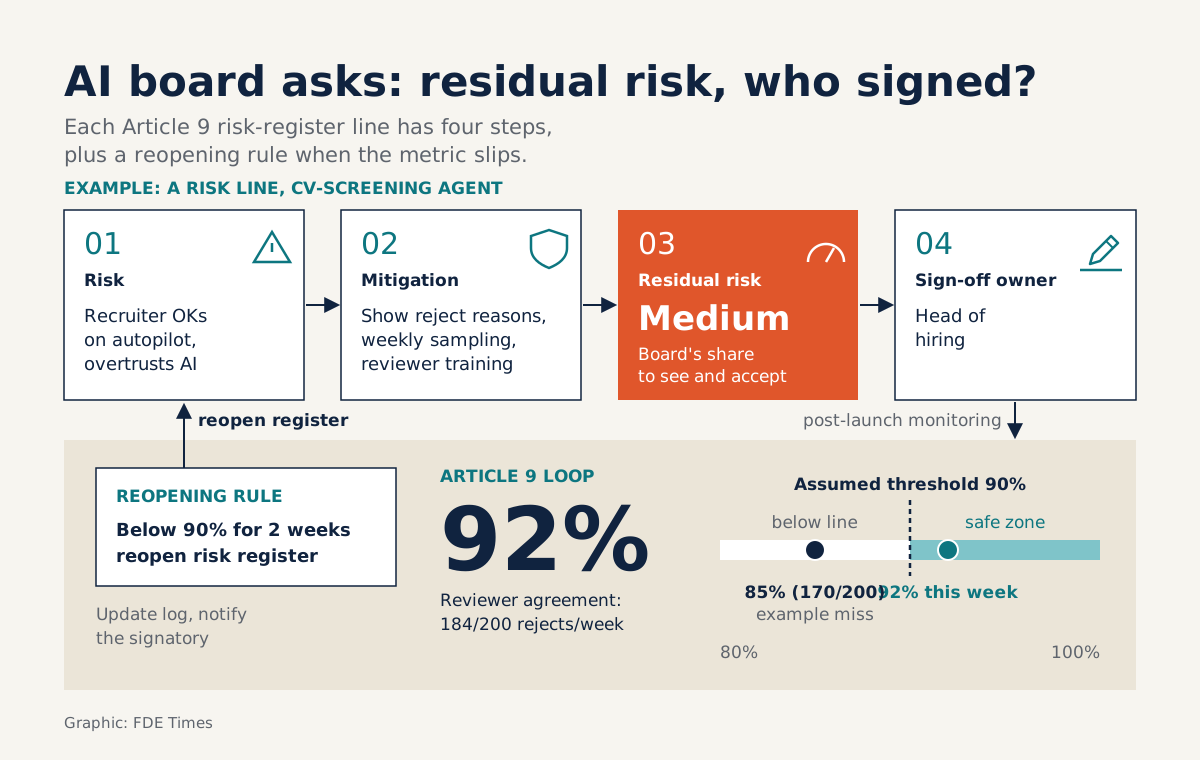
Imagine you deploy an agent that reads CVs and recommends rejecting or keeping candidates for a recruitment company in Germany. Assume the client’s legal team has classified the system as high-risk. The core of the file is a risk register like this one.
| Risk | Mitigation | Residual risk | Accepted by |
|---|---|---|---|
| Agent wrongly rejects a qualified candidate | Every rejection recommendation is reviewed by a recruiter | Low | Head of recruitment |
| Recruiters approve on autopilot, over-trusting the machine | Show rejection reasons, weekly sample checks, reviewer training | Medium | Head of recruitment |
| New CV formats cause the parser to misread | Log every run, alert when the error rate rises | Low | Engineering lead |
| System needs an emergency stop | Stop button routes everything back to the manual process | Low | Chief operating officer |
The second and fourth rows are not decoration. Article 14 requires that human overseers be able to interrupt the system through a “stop” button or a similar procedure, and that they remain aware of the risk of over-relying on the system’s output.
Next come the metrics. Annex IV does not just want numbers; it requires you to explain why the chosen metric is appropriate for this particular system. If you report only accuracy, expect the question: what does accuracy measure that the affected people care about?
For this agent, the thing worth measuring is reviewer agreement with rejection recommendations. Suppose each week you sample 200 rejection recommendations, recruiters re-read them and agree with 184. The agreement rate is 92%, meaning 16 candidates might have been wrongly rejected without a human reviewer.
That number also answers Annex IV’s post-market requirement. You record a hypothetical threshold, for example: if agreement falls below 90% for two consecutive weeks, reopen the risk register. That is the iterative process Article 9 describes, written as a rule anyone can check.
Five steps to do it yourself
- Establish roles under Article 25 and record them on the first page: who is the provider, who deploys, and which changes could alter those roles.
- List risks by the people affected, not by technical component. Every row needs a mitigation, a residual-risk level and the name of the person accepting it.
- Choose a primary metric and write a short paragraph explaining why it suits this system, as Annex IV requires.
- Design human oversight and logging together. Article 26 requires the client to assign oversight to people with the necessary competence, training and authority, and to keep the logs the system generates automatically.
- Write a post-deployment monitoring plan with concrete thresholds and actions when they are breached, then ask legal whether the client must carry out a fundamental rights impact assessment under Article 27.
Step 4 is where an FDE makes the difference. The client carries the Article 26 obligations, but can only meet them if your system logs enough and offers a clear review screen.
If the board is not yet fluent in the language of the EU AI Act, the NIST AI RMF is a voluntary framework that can serve as common ground. It helps both sides agree on how to talk about risk before getting into specific articles.
Mistakes that get a file sent back
The most common mistake is a risk register with no residual-risk column. You list mitigations in detail but never say how much risk remains, so the board has nothing to accept.
The next is treating the human reviewer as a mitigation that works automatically. Without measuring agreement and without training, “human in the loop” becomes a rubber stamp.
The last is misreading the timeline. The Omnibus package moves the deadline for standalone high-risk systems under Annex III to 2 December 2027, and for systems embedded in products under Annex I to 2 August 2028.
But the new dates take legal effect only once published in the Official Journal. As of iubenda’s update on 10 July 2026, publication had not been confirmed, and until then the law’s original timeline applies. Check EUR-Lex yourself rather than quoting commentary.
How this skill shows up on a CV and in interviews
When reading FDE job descriptions for European clients, look for phrases such as “AI governance”, “model risk” or “regulated industries”. When you see them, ask the recruiter directly whether FDEs present to clients’ AI boards. If they do, the example below is worth bringing along.
A strong CV line looks like this: “Designed a weekly process sampling 200 recommendations to measure reviewer agreement, with a threshold that automatically reopens the risk assessment.” It shows you can turn a compliance requirement into an operational metric.
Prepare for an interview question along these lines: “Agreement falls from 184/200 to 170/200 over two weeks. What do you do?” Note that 170/200 is 85%, already below the hypothetical 90% threshold above.
A good answer has three steps. Check the logs for changes in the input, temporarily route rejection recommendations back to manual review, then update the risk register and notify the person who signed off on the risk.
A good model risk file does not stop the board worrying. It tells them exactly what to worry about, and who takes the call when the number starts to slip.
Was this article useful?
Thanks for the feedback!
9 sources
- Article 9: Risk Management System | EU Artificial Intelligence Act
- Annex IV: Technical Documentation Referred to in Article 11(1) | EU Artificial Intelligence Act
- Article 25 | EU Artificial Intelligence Act
- Article 26: Obligations of Deployers of High-Risk AI Systems | EU Artificial Intelligence Act
- Article 14: Human Oversight | EU Artificial Intelligence Act
- Article 27: Fundamental Rights Impact Assessment | EU Artificial Intelligence Act
- EU AI Act Omnibus Agreement — Postponed High-Risk Deadlines and Other Key Changes
- AI Omnibus adopted: what still applies from August 2 · 2026-07-10
- AI Risk Management Framework | NIST