Forward Deployed Engineer interviews: the common questions and how to answer each type
The round that decides an FDE offer often involves no code at all, and candidates who are strong at algorithms still fail if they offer a solution before asking what the customer actually needs.

In brief
- The round that decides an FDE offer often has no code: interviewers grade how you work towards a solution, not whether you reach one particular answer.
- The most common reason candidates are rejected is jumping to a solution before defining scope, so spend the first ten minutes asking questions.
- A good behavioural answer has two results, the technical outcome and the impact on the customer, with numbers.
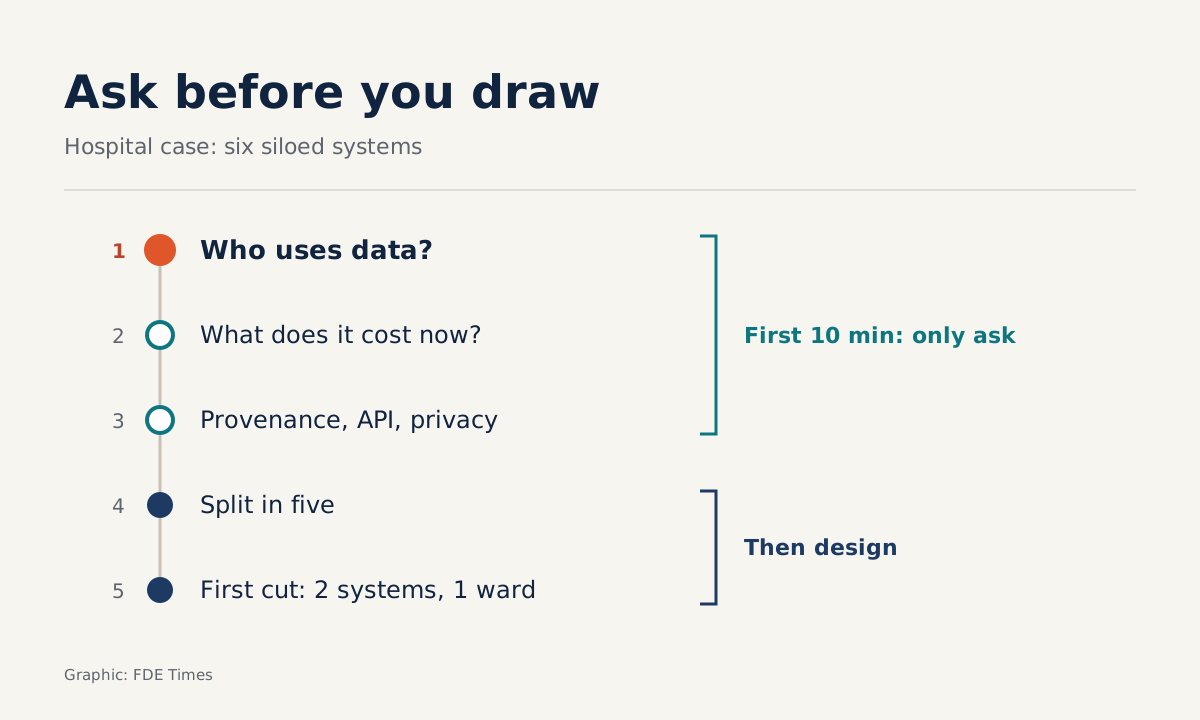
You walk into the final round for an FDE role with your editor open. The interviewer does not hand you an algorithm problem. Instead they say: a hospital keeps patient records in six systems that do not talk to each other. What would you do?
There are no test cases and no sample input. According to techinterview’s analysis of FDE hiring, the round that decides the offer often contains no code at all. The interview assesses three groups of skills with roughly equal weight, so do not spend all your preparation time on coding.
This is where many good engineers fail. fde.academy’s preparation guide names the most common reason candidates are rejected: jumping to a solution before defining scope. What follows covers each type of question you will meet and one approach that works for all of them.
The interview simulates the actual job
To predict the questions, look at what FDEs do every day. Google Cloud’s FDE job posting describes the work as deploying custom agentic solutions alongside customers, inside the customer’s own environment. It is looking for “high-agency engineers with a founder’s mindset”.
That is why the technical rounds differ from those for product engineers. According to fde.academy, the focus is not algorithmic optimisation but integration thinking: where data flows from and to, which system is the source of truth, and where things will break.
Aced’s guide to the decomposition round (Palantir-style) is more explicit: interviewers grade how you work towards a solution, not whether you reach one particular answer.
| Question type | Example prompt | What it tests | First move |
|---|---|---|---|
| Problem decomposition | Patient records spread across six disconnected systems | Defining scope, splitting into solvable parts | Ask who uses the output and for what |
| System design | A customer’s traffic grows 10x overnight; latency and cost must hold | Integration thinking, weighing trade-offs | Ask for the specific latency target and cost ceiling |
| Debugging | A system misbehaves in front of the interviewer | Method, not guesswork | Reproduce the bug, state a hypothesis |
| Customer simulation | An angry customer, scope creep, an unrealistic deadline | Communication, ownership | Acknowledge the problem, state the next step |
| Behavioural | Explain a complex concept to a non-specialist | Real impact, with evidence | Pick a story with numbers |
The first ten minutes decide the outcome
Techinterview describes strong candidates as those who spend the first ten minutes asking questions. Take the hospital prompt to see what those ten minutes look like. The exchange below is an illustrative script, not a transcript of a real interview.
The first question should be: “Who will use the merged data: doctors during consultations, or the finance team during reconciliation?” The second: “How much time does this cost them today, or what errors has it caused?” These two questions turn “merge six systems” from an unbounded project into a problem with someone who is paying for it.
Only then come the integration questions. Which system is the source of truth for patient identity? Does each system have an API, or can it only export files? What are the privacy constraints, and who is allowed to see what? After 90 days, what will make the customer say “this worked”?
Suppose the interviewer answers: emergency doctors need to see allergy history and prescriptions, and today they have to open three screens.
Now you split the problem into five parts: matching a single patient’s identity across systems, a connector that reads data from each system, a shared data model for allergies and medications, one screen for emergency doctors, and an access-control layer with an audit log.
Then pick the first slice: the two systems that hold allergies and prescriptions, one department, one screen. The other four systems come later, and you say why. Identity matching is the biggest risk, so you propose testing it on real data before building anything else.
Think aloud as you go. fde.academy advises narrating your reasoning while you design, because silence is read as being stuck. A sentence such as “I’m assuming these two systems have APIs; if not, the fallback is reading the nightly file export” shows the interviewer both your assumption and your way out.
Technical questions: ask about the goal before choosing tools
The system design prompt Aced records from OpenAI’s process is a good example: a customer’s traffic grows 10x overnight; how do you keep the system within its latency and cost targets? The wrong reflex is to list autoscaling, caching and queues straight away.
The right reflex is still to ask. Is this spike temporary or the new baseline? Is latency measured at p95 or p99, and for which endpoint? How much more is the customer willing to pay?
Each answer prunes a branch: a temporary spike can be handled with queues and rate limiting, while a new baseline forces you to revisit the architecture and the cost with the customer.
In the debugging round, discipline matters even more. Techinterview notes that changing lines at random to see what sticks is marked down. Reproduce the bug, read the logs, say your hypothesis out loud, then change one thing at a time to test it.
Some companies add a take-home. According to Aced, OpenAI’s FDE process includes an assignment of about a week, submitted as working code with a video walkthrough.
The sample prompt is to build semantic search over a product catalogue that ChatGPT can query, then explain the system. The video is where you show you know why you chose each component, so give it as much time as the code.
Customer scenarios: the pressure is the test
According to fde.academy, the customer simulation round tests communication and ownership. The prompts are built around real pressures: a frustrated customer, scope creep, an unrealistic deadline, a customer executive pushing hard while the system is down.
Picture the interviewer playing a head of operations, sharp-voiced because a pipeline has stopped in the middle of peak hours. A solid answer has four beats. Acknowledge the impact: “I understand your team can’t process orders.” Say what you know and what you don’t yet know. Say what you are doing right now. Commit to the next update at a specific time.
With scope creep, neither say “no” nor simply nod along. State the trade-off out loud: adding this feature pushes back the delivery date, or something else has to be dropped. The interviewer wants to see that you can protect the project while keeping the relationship intact.
Behavioural: two results and a number
fde.academy advises that every behavioural answer state both the technical result and the impact on the customer, using numbers where possible. This is where engineers often fall short: they describe the architecture in detail and then stop, without saying what the customer gained.
Take a question Aced records at OpenAI: tell me about a time you explained a complex technical concept to a customer or a non-specialist.
A template for the answer: the context is who they were and what decision they needed to make; you explained it using which analogy, and how you checked they understood; the technical result was [the system shipped, with what accuracy or latency]; the impact was [what they decided, how many hours or how much money they saved].
Fill the square brackets with your real numbers; do not estimate to make them look good.
The same template works for your CV. Each bullet should contain what you did, the technical result and the impact on users. When reading a job description, if you see phrases such as “customer’s environment” or “ship with customers”, prepare at least two stories in which you worked directly with end users.
The mistakes that sink strong candidates
The first mistake is rushing. Engineers used to well-defined problems start drawing architecture as soon as they see the prompt, while FDE prompts are deliberately vague. Aced describes the decomposition round as presenting a deliberately ambiguous real-world problem and asking you to break it down, with your reasoning.
The second is thinking in silence and then presenting a finished conclusion. Interviewers cannot grade a process they cannot hear. The third is treating the role-played customer as unreasonable: once you start arguing about who is right, you have forgotten that an FDE’s job is to get the project over the line with them.
The last mistake is in preparation: grinding another hundred algorithm problems without ever once practising thinking aloud. The deciding round often has no code and grades how you work towards a solution, which means it grades structured reasoning and how you communicate it. Both only improve when you practise out loud.
This week’s exercise: take the hospital prompt above, set a timer and record yourself. Play it back and count how many questions you asked before you first said the word “architecture”.
Was this article useful?
Thanks for the feedback!
5 sources
- What the forward deployed engineer interview really tests – techinterview · 2026-08-05
- Forward Deployed Engineer (FDE) Interview Questions: The Complete Prep Guide · 2026-04-09
- How to Answer Decomposition Interview Questions: The Definitive Guide (2026)
- OpenAI Forward Deployed Engineer (FDE) Interview Guide | Sample Questions (2026) - Aced (formerly Exponent)
- The Pulse: Forward deployed engineering heats up again · 2026-05-24