The one-page Forward Deployed Engineer CV: structure, deployment results and a template for each section
FDE recruiters do not start by asking which framework you used. They want to know which customer works differently because of you, and how much faster.

In brief
- Keep the CV to one page; use two only if you have eight or more years of experience.
- Open every bullet with a measurable outcome and the deployment scale, and put the technology last.
- Say plainly which users you worked with, and do not inflate prototypes or internal work.
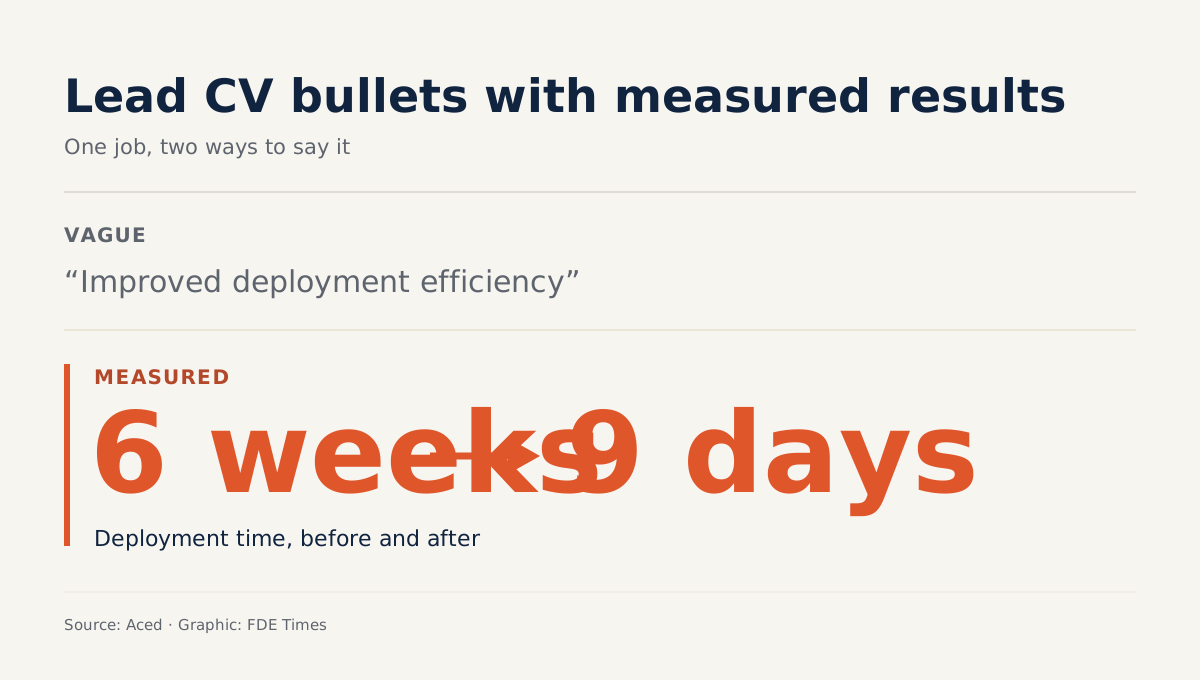
Compare two lines. The first reads “improved deployment efficiency”. The second reads “cut deployment time from 6 weeks to 9 days”. Aced’s guide to writing an FDE CV uses exactly this pair to show the difference between a generic description and a sentence that shows what you actually achieved.
For a Forward Deployed Engineer role, the gap between those two lines is worth fixing word by word. An FDE is the person who gets software running at the customer’s site, so your CV needs to prove that from its first lines.
This guide walks step by step through building a one-page FDE CV. You will end up with a plain-text file with the frame in place, three to five bullets rewritten with the outcome-first formula, and an honesty checklist to run before you send it.
What do you need before opening an editor?
You do not need a polished design template yet. What you need is raw material: a list of the projects you have worked on, who used them, and the before/after numbers you actually measured or can verify. If there is no number, say so plainly; do not estimate one to make the line look better.
A practical tip is to write the CV in plain text first, such as Markdown or a text file, and only then move it into its final format. That keeps your attention on the content rather than losing an evening to margins.
Step 1: Choose the length, and it is almost always one page
Aced advises keeping an FDE CV to one page, using two only if you have eight or more years of experience. For people with two to eight years, the rule forces you to be selective. That is the same skill an FDE needs when presenting to a customer.
Check after this step: print it or export a PDF. If it spills onto a second page and you do not yet have eight years, cut before you add anything.
Step 2: Build a three-part frame recruiters can scan
Final Round AI describes a one-page structure with a summary or objective, a skills section and a work experience section in bullet points. It recommends grouping skills by category so they are easy to scan. The minimum frame looks like this:
FULL NAME — email — GitHub/portfolio link

SUMMARY
[1-2 sentences: what kind of system you put into production for what kind of user]

SKILLS
Programming:          [languages you can write production code in]
Data/infrastructure:  [tools you have actually used]
Customer work:        [discovery, demos, user training...]

EXPERIENCE
Company — Role — Dates
- [outcome bullet]
- [outcome bullet]
There is a specific reason to group skills. Palantir’s FDSE job posting asks for a strong engineer with proven ability in languages such as Python, Java and C++. The reader should see the “Programming” line at once, not hunt for it among twenty tool names in no particular order.
Check: cover the whole CV except the summary and the skills groups. If a stranger reading that still cannot tell you have worked with customers, rewrite the summary.
Step 3: Write bullets outcome first, technology last
fde.academy lists a common mistake: opening a bullet with the technology rather than the outcome. Drafts written from the point of view of the person who built the system, rather than the person who uses it, fall into this easily.
Try an example. Suppose your draft reads:
- Built a Python pipeline to sync data between the customer's CRM and accounting system.The sentence is accurate but says nothing about value. The sample bullet fde.academy offers ends with a measurable outcome tied to scale: an 80% reduction in manual data-sync time across 20 customer accounts. Reverse the order and the draft above becomes:
- Cut manual data-sync time by 80% for 20 customer accounts
  with a Python pipeline connecting the CRM to the accounting system.
The formula has four parts, in order: business outcome, number, scale, and only then the method. Two of Final Round AI’s examples follow the same logic. One cut the time to produce a weekly compliance report from three days to under two hours. The other cut claims-processing errors by 35%.
What makes those examples worth studying is that the number is attached to the customer’s business, the compliance report and the claims files, not to your system. A metric such as “latency down 40ms” belongs on the CV only when you can say whom it helped do what.
Check: read the first three words of every bullet. If they name a language, framework or cloud, rewrite it.
Step 4: State plainly that you sat with users
Aced is direct: if you talked to users or stakeholders, write it down. Working directly with customers is a core part of the FDE role, and the reader will not infer it from a purely technical bullet.
Palantir’s posting adds what else you need to prove: working in small teams and owning the full execution and deployment of important projects. A good bullet ties both together:
- Interviewed [user group] at [type of customer] to pin down [problem];
  led it myself from design to go-live, result: [before → after number].
Check: every role in the experience section should have at least one bullet that names specific users or stakeholders and one that shows you owned the work end to end.
Step 5: Check your honesty before the interviewer does
Many people skip this step, and it is where a CV falls apart fastest. Aced warns against presenting a prototype as a production system, because interviewers will dig in and it comes out at once. fde.academy warns of a similar mistake: describing internal work as if it were a customer deployment.
fde.academy also notes that personal projects only count when they have run with real users. For a side project, that means either getting real people to use it first, or leaving it out of the experience section.
If you are a product engineer hoping to move into an FDE role, do not try to relabel internal work as “customer deployment”.
Call it what it is, for example “internal tool for [number] operations teams”, then say who the users were, how you worked with them and which number changed.
That is still evidence of working with users, and it holds up under follow-up questions.
| If the reality is | Don’t write | Write |
|---|---|---|
| A demo running on sample data | “Deployed a system” | “Built a prototype, validated with [whom]” |
| A tool for colleagues | “Deployed for customers” | “Internal tool for [team], [result]” |
| A side project nobody uses | Put it alongside work experience | Drop it, or get real people to use it first |
Check: for each bullet, ask yourself, “If asked three follow-up questions, could I answer with real detail?” Rewrite any bullet that fails.
Which mistakes still slip through?
The first is a number with no baseline. “Cut by 80%” only means something when the reader knows 80% of what and at what scale, which is why the fde.academy example includes “20 customer accounts”.
The second is a summary written as a statement of aspirations, such as “seeking to grow in a dynamic environment”. The summary should be spent on a deployment result. Picture a before and after, reusing the sample bullet from Step 3:
BEFORE:
Software engineer with [number] years of experience, seeking to grow
in a dynamic environment.

AFTER:
Software engineer working directly with customer operations teams;
most recently cut manual data-sync time by 80% for
20 customer accounts, leading the work from discovery to go-live.
The second version answers the question from Step 2: what kind of system you put into production, for whom, and with what result. The number must of course be your own, not the template’s.
The third mistake is harder to spot: listing every tool you have ever touched. A long skills line dilutes exactly what Palantir wants to see, proven programming ability. Keep only what you are ready to code with live in an interview.
How does this skill carry over to the customer site?
Writing a bullet in the order outcome, number, scale, method is exactly how an FDE writes a status email to a customer after each deployment. The customer does not care which library you swapped. They want to know how long the compliance report takes now and how far claims errors have fallen.
So once in the job, get into the habit of recording before/after numbers from the first day of every project. Manual sync time, errors per week and the number of real users are all worth logging. The next time you write a CV you will not have to guess, and your current customer will have a credible summary ready.
A good FDE CV is not a document you write only for job hunting. It is an honest record of what changed for users because you were there.
Was this article useful?
Thanks for the feedback!