The Scale AI FDE interview: two HackerRank rounds, a broken codebase and the skill that is really being graded
The Forward Deployed Engineer interview at Scale AI looks more like a week on a customer site than an algorithms exam, so preparing for it calls for a different approach.

In brief
- Two HackerRank rounds open the process. One is a 60-minute online assessment built around a project-style coding question.
- The onsite covers coding, system design, debugging an unfamiliar codebase and a behavioural round on ownership and speed.
- Communication has no round of its own but is graded throughout, so coding in silence is an easy way to lose points.
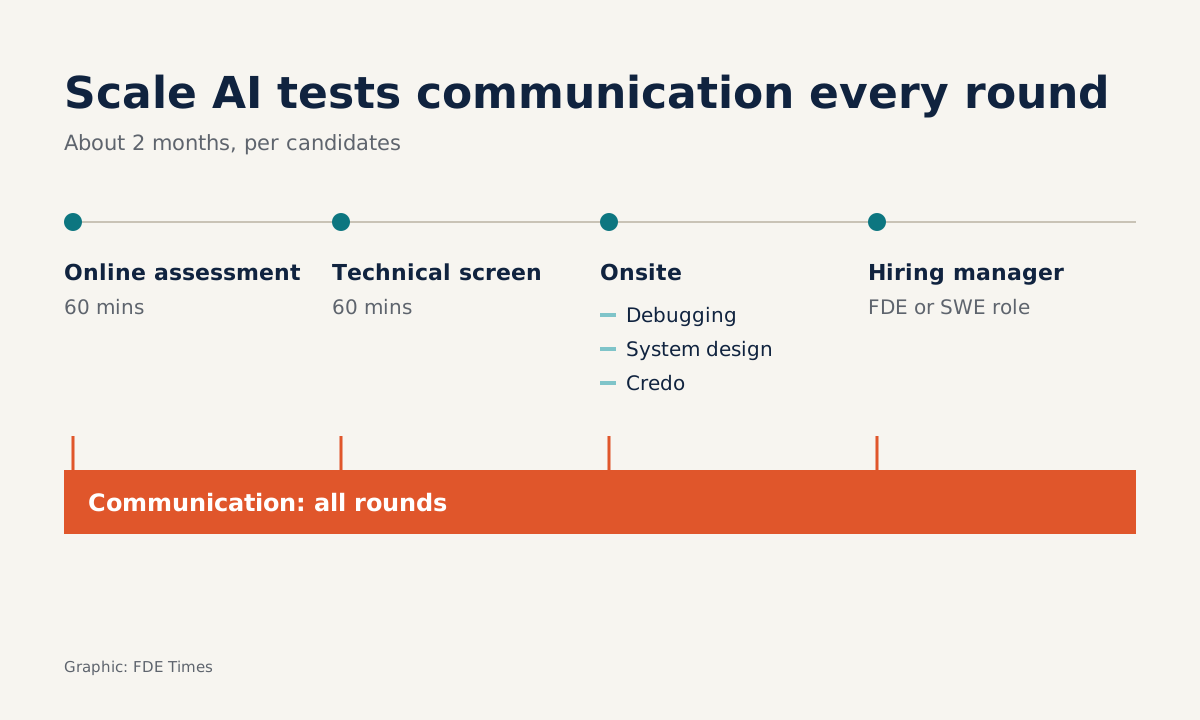
You open the HackerRank link, a 60-minute clock starts, and the task is not to invert a binary tree. It is a small project that has to run. According to a guide from Aced (formerly Exponent), that is the shape of the online assessment for the Forward Deployed Engineer role at Scale AI: a single project-style coding question, described as hard.
That is just one of two HackerRank rounds you have to pass before reaching the onsite. Final Round AI puts the assessment at 50 minutes and notes that not every candidate goes through the steps in the same order, so treat every description of timing and sequence as approximate.
Read the round descriptions closely and they track what an FDE does every week: take over a system someone else wrote, get it working, and explain to other people why it broke. Prepare for those tasks and you are also practising the job itself.
Each round simulates a day on a customer site
According to techinterview.org, the virtual onsite has four to five rounds: two coding, one system design, one debugging and one behavioural. In the debugging round you get a codebase you have never seen, along with a failing test or a described symptom, and about 45 minutes to find and fix the problem.
The hiring manager round, according to Aced, is behavioural and close in content to the credo round. Techinterview.org says the conversation leans heavily on Scale’s values of ownership and moving fast while everything around you keeps changing.
The job postings show why the rounds fit the work. Scale’s GenAI FDE posting asks for rapid experimentation, continuous iteration to meet customer needs, and the ability to explain complex technical concepts to both technical and non-technical audiences.
There is no communication round because every round is one
Aced states plainly that communication is assessed throughout the process and has no dedicated round. Another Aced page advises candidates to walk through their thinking and decisions during the technical rounds. Techinterview.org is blunter: debugging in silence looks like guessing.
Consider what follows. A candidate who silently fixes three bugs may make a weaker impression than one who fixes two but clearly explains where the third one is and how they would handle it. The second candidate is showing exactly what a customer needs to see when their system is broken.
Picture 45 minutes with an unfamiliar codebase
Suppose the debugging task is a script that computes the agreement rate between annotators, work that sits very close to labelled data. The snippet below is a made-up practice example, not a real interview question:
def agreement_rate(rows, labels_by_task={}):
    for r in rows:
        labels_by_task.setdefault(r["task_id"], []).append(r["label"])
    agreed = 0
    for task_id, labels in labels_by_task.items():
        if len(set(labels)) == 1:
            agreed += 1
    return agreed / len(rows)
Don’t read it line by line hunting for bugs. Build a three-row input instead: task A has two “cat” labels, task B has one “dog” label. The function returns 2/3, about 0.667. If the convention is to count only tasks with at least two annotators, the right answer is 1/1; if every task counts, it is 2/2. No reading of the spec gives 0.667.
That wrong number leads straight to three bugs. The denominator counts rows instead of tasks, and a task with a single label is counted as agreement. Most dangerous of all, labels_by_task={} is a mutable default: call the function a second time with different data and the previous call’s labels are still in the dict, skewing the result.
The order of fixes is itself part of the answer. The mutable default silently corrupts numbers across runs, so it comes first. The denominator comes next, and the single-label case is really a business question, so ask the interviewer for the convention rather than guessing.
As you work, think out loud in a steady rhythm: running a small input to reproduce, getting 0.667 when 1.0 is expected, suspecting the denominator, fixing it, running again.
If time runs out with a bug still unfixed, say where it is and which test you would add to catch it. That is how “didn’t finish everything” becomes evidence of ownership.
Where does the LLM sit in the infrastructure?
Scale’s GenAI FDE posting calls for rapid experimentation for customers and clear explanations for non-technical people. So when practising system design on your own, it makes sense to set problems that involve an LLM and to practise explaining the design to both kinds of listener.
The trap is to draw a box labelled “LLM” in the middle and stop. Sundeep Teki’s FDE interview guide argues that the most common mistake is jumping to a solution without asking a single clarifying question.
Take this problem: a customer wants to use an LLM to classify support tickets. Before drawing anything, ask whether tickets arrive in batches or as a stream, what a wrong label costs, and who will use the output. Only once those three things are clear do you start drawing.
Tickets go into a queue, workers call the model with retries and timeouts, and low-confidence answers are routed to a human reviewer. A small eval set with gold labels runs every time the prompt or model changes, in keeping with the rapid iteration the posting mentions.
Describe the fallback for when the model API goes down too, because that is the kind of incident an FDE working directly with customers will have to deal with.
How to practise over a few weeks
Final Round AI observes that the HackerRank assessment does not reward slow, careful solvers. So swap half your LeetCode time for project-style exercises with a 60-minute limit: read a CSV file, call a mock API, write the results out, and include tests.
Practise debugging on unfamiliar repositories, timing each session and recording yourself explaining what you are doing. Listening back shows you straight away where you went quiet for too long.
For the behavioural and hiring manager rounds, prepare stories about a time you took on the hard part of a job yourself and a time you had to move fast while requirements kept changing, each with a specific decision and a measurable result. Also prepare a clear answer to why you want to be an FDE.
Your CV should speak the same language. A line such as “took over another team’s data pipeline, found and fixed the bug that was corrupting reports, and explained the root cause to the customer” fits the job posting better than any list of frameworks. When you read an FDE job description anywhere, look for “strong coding” and “communication” listed side by side.
The traps that sink strong candidates
One easy trap is trying to fix every bug in the debugging round and running out of time midway without explaining anything. Another is answering system design as if the LLM were always right and always up, leaving out evals and fallbacks. Telling behavioural stories in terms of “the team did” rather than spelling out the part you owned also dilutes the answer.
The subtlest trap of all is treating the hiring manager round as a formality.
The Scale AI FDE interview is, in the end, a miniature week on a customer site. Prepare as if you were getting ready for that week, not for an exam hall.
Was this article useful?
Thanks for the feedback!
6 sources
- Scale AI Forward Deployed Engineer (FDE) Interview Guide | Sample Questions (2026) - Aced (formerly Exponent)
- Get a Job at Scale AI: Interview Process and Top Questions, Aced (formerly Exponent)
- Forward Deployed Engineer, GenAI @ Scale AI | Accel Job Board
- What the Scale AI interview looks like after the Meta deal · 2026-07-14
- Scale AI Interview Process: What to Expect in Each Round
- The Definitive Guide to Forward Deployed Engineer Interviews in 2026 · 2026-01-15