FDE skills across 1,000 job postings: Python leads at 66%. What comes next?
A single FDE job posting can list a dozen or more requirements. Count how often each one appears across 1,000 postings and you can tell which are the baseline, which are an edge, and which belong to one company only.

In brief
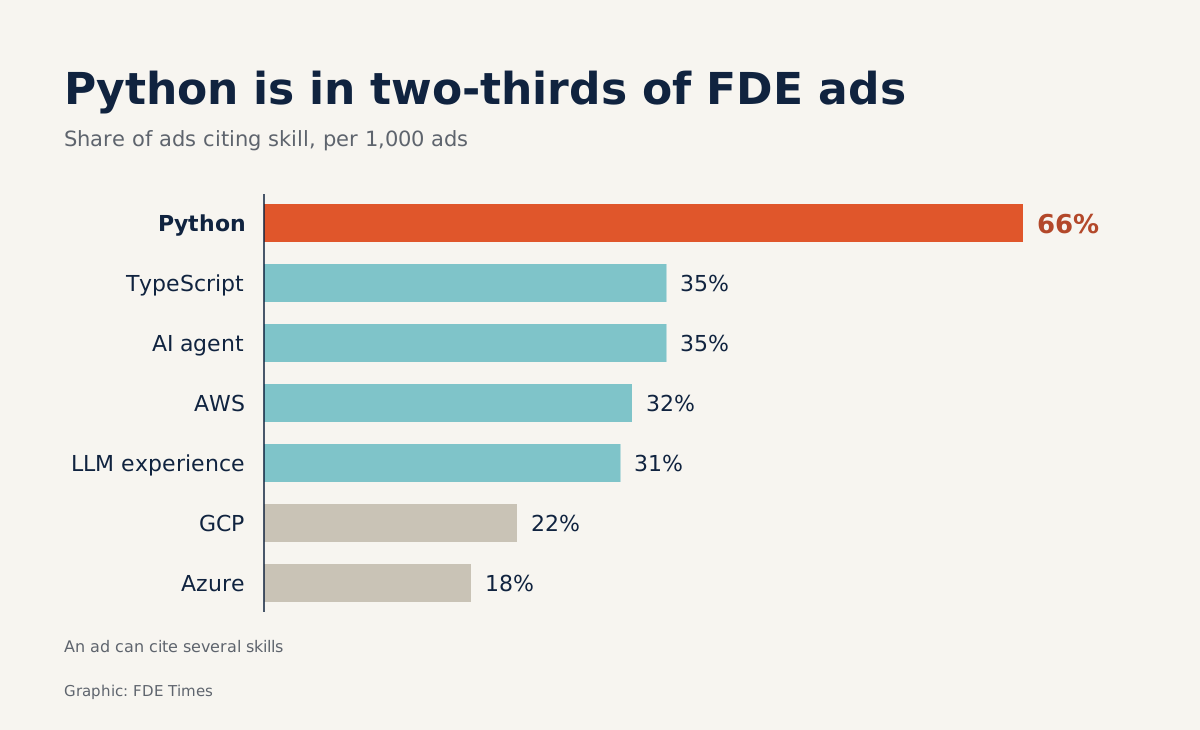
- Of the 1,000 FDE postings Bloomberry analysed, 66% mention Python. TypeScript and AI agents are tied at 35%, LLMs at 31% and AWS at 32%.
- The percentages overlap and cannot be added up. Learning one cloud in depth pays off more than skimming all three.
- According to Paraform, Python and JavaScript are only table stakes. What sets candidates apart is having shipped real LLM or agent systems and understanding customers.
You open a Forward Deployed Engineer job posting and count a dozen or more requirements: Python, TypeScript, a cloud platform, LLMs, agents, stakeholder communication, willingness to travel. At that point the question is no longer “am I qualified?” but “what should I learn first?”
Guessing by feel easily sends you in the wrong direction. Bloomberry analysed 1,000 FDE postings and counted how often each skill appears, which gives a better basis.
Once you know which skills show up in two-thirds of postings and which appear in fewer than one in five, you have an order of priority for both what you learn and how you write your CV.
Reading postings methodically is becoming more valuable. Paraform’s hiring data shows the number of FDE postings rose 350% between Q1 2025 and Q1 2026. More postings means more noise, and people who can filter out the core will apply in the right places.
Two-thirds of postings ask for the same language
Below are the technical skills in Bloomberry’s sample, ranked by frequency. The third column converts each percentage into a number of postings out of 1,000, to make the scale easier to picture.
| Skill | Share of postings mentioning it | Equivalent |
|---|---|---|
| Python | 66% | 660 postings |
| TypeScript | 35% | 350 postings |
| AI agents | 35% | 350 postings |
| AWS | 32% | 320 postings |
| LLM experience | 31% | 310 postings |
| GCP | 22% | 220 postings |
| Azure | 18% | 180 postings |
Python is far ahead of everything else: 66%, nearly double TypeScript in second place. Then comes a tight cluster at around one-third: TypeScript, agents, AWS and LLMs. In other words, Python is close to the entry ticket, and the second group is where candidates start to differ.
Beyond the technical skills, one more number is worth remembering: 68% of postings require travel to customer sites.
Why you cannot add the percentages
This is the most common mistake in reading the data. Adding AWS, GCP and Azure gives 72%, but you cannot conclude that 72% of postings require cloud. A posting can mention both AWS and GCP, so the same posting is counted twice.
Read each skill as a separate figure, calculated independently against the 1,000 postings. The right question is: if I learn only one more thing, which one opens up the most postings? For cloud, that is AWS, present in 320 postings against 220 for GCP.
This way of reading also keeps you from learning too broadly. An engineer who knows AWS well, who has deployed on their own, debugged IAM themselves and tracked costs, is more convincing than someone who has skimmed all three clouds. Once you understand one platform in depth, switching to another at a customer site goes much faster.
Breaking down a real posting: OpenAI in New York
Now apply the frequency table to OpenAI’s FDE posting in New York. It asks for 5+ years of technical or deployment experience, including some work directly with customers. Candidates need to write production code in Python or JavaScript and must have built or deployed systems powered by LLMs or generative models.
Compare each requirement with the table. Python is the most common skill (66%). JavaScript has no separate figure, because Bloomberry only counts TypeScript (35%), but Paraform places both Python and JavaScript among the “table stakes”, the price of entry. The LLM requirement (31%) is where this posting starts to be selective.
The next line is the easiest to skim past. OpenAI’s posting wants candidates who communicate clearly with engineers, product teams and customer stakeholders.
Paraform also argues that what separates candidates is having deployed real LLM or agent systems, plus soft skills such as understanding customers. OpenAI’s posting matches both points: it asks for someone who has built or deployed LLM systems, and for someone who communicates well with the customer side.
Palantir’s posting for a Forward Deployed Software Engineer in its US government business shows a different pattern. It wants someone who codes well in Python, Java or C++, and it requires Top Secret security clearance.
The clearance is tied to this posting’s government work, so it makes most sense to treat it as a company-specific barrier rather than a general market signal.
Palantir’s posting says one more useful thing: FDSEs work autonomously, make their own decisions and consult customers frequently. When you see a line like that, prepare an interview story about a time you had to decide on your own with no one to sign off for you.
From frequency table to learning plan
The table above sorts into three tiers. Tier one is production-grade Python: tested, packaged, with proper error handling.
Tier two is one or two skills from the one-third cluster: TypeScript if you often build interfaces for customers, agents and LLMs if you want to target AI companies.
Tier three is one cloud, and if you have no particular reason to choose otherwise, pick AWS.
Running through all three tiers is evidence that you have worked directly with customers. When 68% of postings require travel and OpenAI’s posting states that experience must include work with customers, recruiters most likely want to see that you have built something for real people to use, on their own premises.
When you get to the CV, compare two ways of writing it. The weak version: “Experience with LLMs, agents, AWS”. A stronger version, as a hypothetical: “Built an invoice-reading agent for a 12-person accounting team, running on AWS Lambda, cutting reconciliation time from two days to half a day”.
The second line answers exactly the three things a posting wants to know: what you built, who uses it, and whether it actually runs.
Three mistakes that make a skills list backfire
The most common mistake is trying to tick every box on the list. The frequency table is for choosing what to drop, not for collecting everything. A candidate who knows Python well, one cloud, and has shipped one agent project that actually runs will rank above someone with a passing knowledge of all seven skills.
Another mistake is treating years of experience as a wall. Bloomberry found that 60% of postings target mid-level candidates with 3 to 5 years, while entry-level accounts for only 12%, roughly 120 of the 1,000 postings.
If you have fewer than three years of experience, aim straight at that small group, and build up customer-facing work in your current job at the same time.
The last mistake is simply listing keywords. An automated screener may pick up “LLM” on your CV, but the interviewer will ask what you put into production, where it broke and how you fixed it. One prepared story with real numbers works better than ten keywords.
Exercise: count five postings yourself
Pick five FDE postings at companies you genuinely want to join. Copy each requirement into its own row in a spreadsheet, merge different phrasings of the same skill, then count. Compare the result with the table above: where it matches is a market signal; where it diverges is specific to the group of companies you are targeting.
Bloomberry’s table gives you the overall view of the market. The five postings you count yourself tell you what to learn next Monday.
Was this article useful?
Thanks for the feedback!