When the client asks who you are, answer on one page
A one-sentence role statement, a list of what you won't do and a written client sign-off can stop scope creep in the first weeks of an engagement.
In brief
- The FDE role overlaps with solutions architects, sales engineers and consultants, so client confusion is normal.
- The clearest positioning is to name the technical outcome you own and say that the commercial relationship sits with another team.
- Put the scope on one page and get the client to confirm it before you commit. When scope doubles, price it as a new quote.
In your second week at a client, the head of operations messages you to fix an old report. Someone in IT asks whether you are from support. Then the procurement lead asks you outright in the middle of a meeting: “What exactly is your role on this project?”
Answer “I’m the vendor’s engineer, just message me if you need anything,” and you have just signed up for every job nobody else wants. By week five your calendar is full of small requests, and the outcome you were sent to deliver is still unfinished.
The problem lies in the role itself. Wikipedia notes that FDE responsibilities overlap with those of solutions architects, sales engineers, integrators and consultants. Clients are confused because the role has many faces, and slowness on their part has nothing to do with it. If you do not define the role yourself, they will define it for you, each in their own way.
Define the role by the outcome you own
PostHog’s handbook has a sentence that works well: the FDE owns the technical outcome of an engagement, while the commercial relationship belongs to sales or customer success. That tells the client which questions to bring to you and which to take elsewhere.
Ramp’s FDE team is even more direct about accountability: they own the customer’s outcome, and if the product is not working for the customer, they are the ones who have to answer for it. A client who hears that understands you are someone accountable for a specific result, and that taking tickets is somebody else’s job.
A good role statement is therefore tied to a measurable outcome, for example: “I’m responsible for getting your ERP order sync into production.” Saying “I’m an FDE” tells the client nothing. The first sentence covers both the role and its limits.
Boundaries only work when they are written down
PostHog draws a clear line between FDE work and support: an FDE engagement is scoped, works more closely with the customer and leaves behind a lasting deliverable. A support ticket has none of those three traits.
When small requests that really belong to support keep coming back, the handbook advises saying so plainly to the customer and routing the request to the right place, rather than quietly doing the work yourself.
What is said in a meeting gets forgotten. PostHog writes the scope as a short brief and sends it to the customer for confirmation before committing. Spelling out assumptions and exclusions, they say, aligns expectations on both sides and heads off scope creep in the next iteration.
A template you can use next week
Back to the operations client above. This is the page you could send after the meeting, no longer than one screen:
ROLE AND SCOPE — Order sync project (version 1, awaiting confirmation)

1. Role
   FDE [name] owns the technical outcome: 3 integration flows
   ERP → platform running in production on real data.
   Contract, pricing, renewal: [AM/CS name].

2. Deliverables
   3 integration flows, operations runbook, handover session for the IT team.

3. Out of scope
   Fixing old reports outside the 3 flows; account and login issues (via support);
   warehouse system integration.

4. Assumptions
   IT grants read access to the ERP in week 1; sample data covers all 3 order types.

5. Request channels
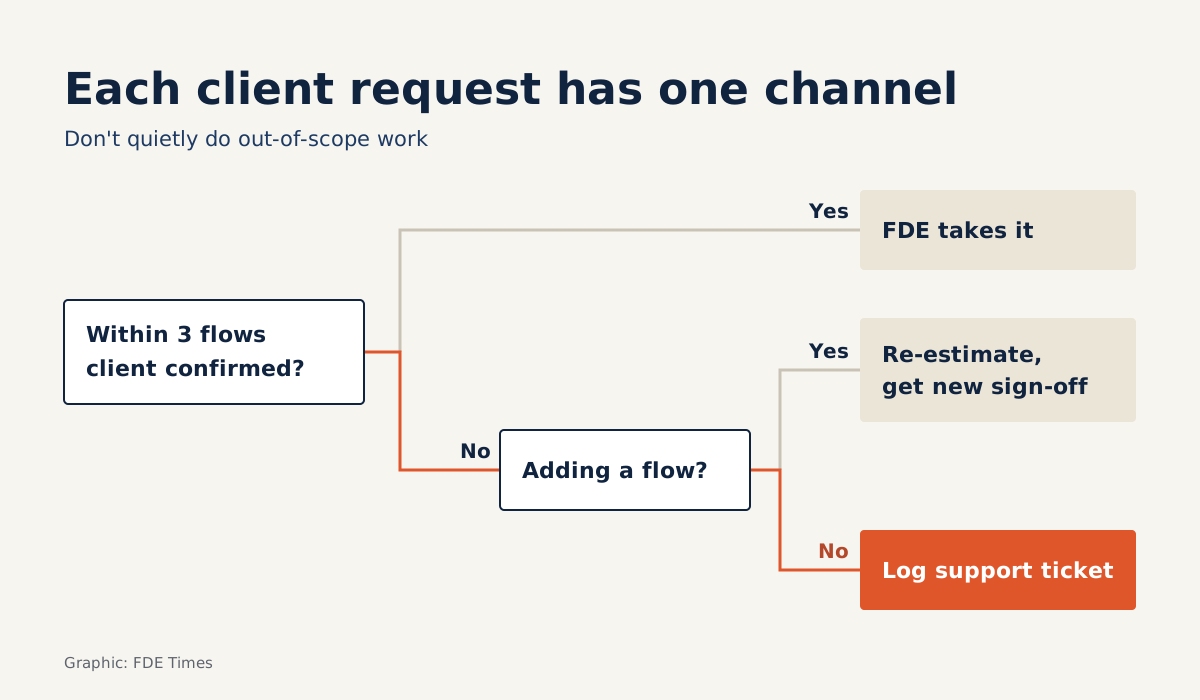
   Product bugs → support ticket. Work within the 3 flows → message the FDE.

6. When scope changes
   Additional flow = re-estimate, send a new confirmation.

Confirmed by: [name, date]
To see how section 6 works, take a concrete case. Say that three weeks later the client wants three more flows for the warehouse system. Three flows become six: the scope has doubled.
PostHog treats a deliverable that doubles in scope as a new quote, not a goodwill extension. With this page in hand, you only need to point to section 6, and the conversation moves to a commercial discussion with the AM.
The reason for keeping section 1 so narrow comes from the same handbook: lock in a small scope, because expanding a tight scope is far cheaper than unwinding a loose one.
Pushing back without giving offense
The page only works if you use it in conversation. A sample exchange:
Client: The old dashboard is loading really slowly. Could you take a look this afternoon?
FDE: That dashboard is outside the three flows we agreed, so I’ll open a support ticket for you right now so someone follows it through to the end. If it’s slow because of data from the order flow, that’s mine, and I’ll check that part before Friday.
The answer neither refuses nor takes everything on. It routes the request to the right channel, just as PostHog describes. Ramp adds a habit it calls “always be scoping”: when the customer asks for something, the team talks to them directly and questions every request. Asking “why is it slow?” is that habit in action.
Steps to do it yourself
Start with the role statement, written in the form “owns [outcome] on [the client’s system]”. Next, name the person who holds the commercial relationship, so every question about money has somewhere to go. Then list the three things the client is most likely to ask you for that fall outside your scope. You will know them from the first week’s messages.
After that, write down the assumptions that could delay the project, send the page to the decision-maker and wait for a written confirmation. Each time the scope changes, bump the version number and send it again for fresh confirmation.
The mistakes that make the page useless
The most common mistake is writing it like a five-page contract. Nobody reads it, so nobody remembers it. Another is writing it but never getting the client to confirm it, so when the moment comes, the page is merely your own opinion.
The hardest mistake to spot is quietly doing small out-of-scope jobs to stay in the client’s good books. Do it a few times and the client will treat that work as the new scope. Worse, each favor solves one client’s problem and feeds nothing back into the product.
A Substack analysis uses exactly this point to separate FDEs from consultants: if nothing generalizes into the product, the company is really running a services business, just with employees who carry engineering titles. Every quiet favor pulls you in that direction.
Turning the skill into an edge when job hunting
When reading FDE job postings, look for phrases close to how PostHog describes the role, such as “own the technical outcome” or “scope engagements”. When you see them, you can infer that the company expects you to set your own boundaries.
On your CV, avoid “supported customers”. Write instead that you drafted a client-confirmed scope document and used it to turn new requests into a fresh round of estimation.
In a case interview, if you are asked how you would handle a client requesting out-of-scope work, the exchange above is a complete answer.
The next time someone asks “what is your role on this project?”, do not treat it as small talk. It is the moment you decide whether you reach the end of the project with a deliverable you can hand over, or with an inbox full of other people’s work.
Was this article useful?
Thanks for the feedback!
5 sources
- Working with customers - Handbook (PostHog)
- How forward deployed engineers work - Handbook (PostHog)
- Forward Deployed Engineering (Ramp Builders)
- Forward deployed engineer (Wikipedia)
- The Difference Between a Forward Deployed Engineer and a Consultant With a Better Title Is One Design Decision · 2026-07-13