Forward deployed engineering for new graduates: the 12% of jobs that are open, and how to get in
Most FDE job ads ask for three to five years of experience. There is still a way in for newcomers, but getting through it means proving you have worked with a real customer, even on a small project.

In brief
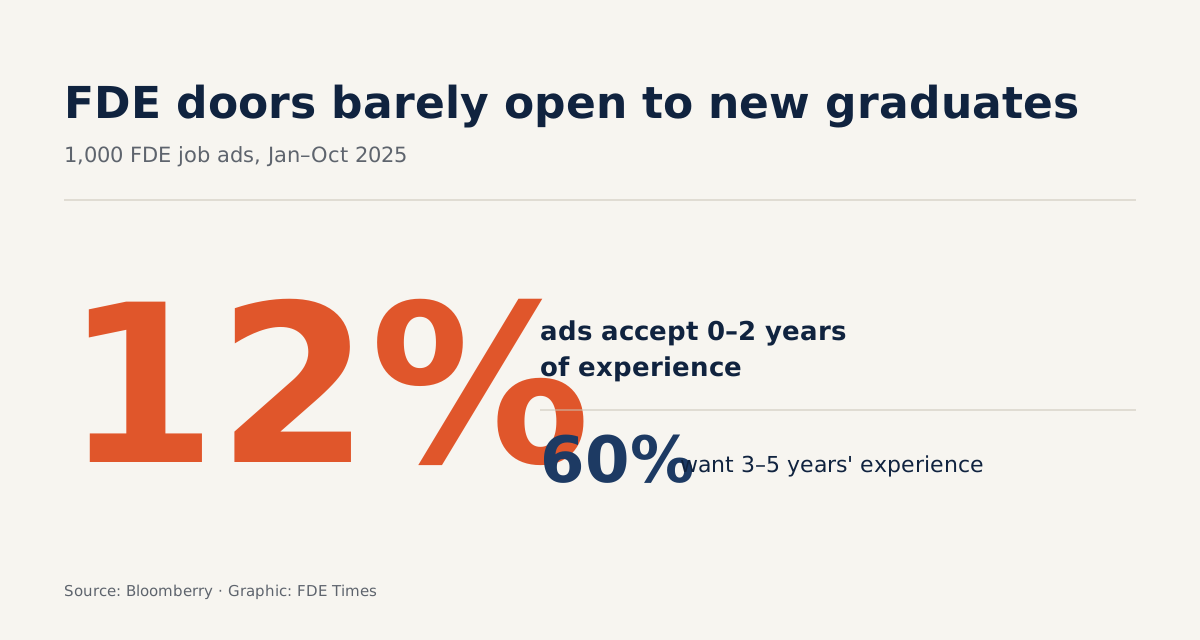
- Only 12% of FDE job ads accept people with 0–2 years of experience, while 60% ask for 3–5 years: the door for newcomers is real but narrow.
- Internship and new-grad postings, such as Palantir's, do not require work experience. What they require is the ability to build applications and LLM workflows that fit a customer's actual circumstances.
- There are three ways in: an internship in an FDE team, a SWE job at an AI company with a move after 12–18 months, or a role at an early-stage AI startup.
You are about to graduate. You type “Forward Deployed Engineer” into a job search, and almost every result asks for several years of experience. At this point most students make one of two mistakes: they apply indiscriminately to everything, or they give up on the idea altogether.
Both responses miss something. The numbers are harsh, but they also show where the door is. This article explains how to read those numbers, how to read a posting aimed at newcomers, and how to produce the kind of evidence FDE recruiters actually need to see.
How narrow is the door?
Bloomberry analysed 1,000 FDE job ads posted between January and October 2025. Only 12% accepted 0–2 years of experience. Ads asking for 3–5 years made up 60%, 6–8 years 20%, and nine years or more 8%.
Put more simply: for every 100 ads that state an experience requirement, 12 are for you, while 60 target people who have already worked for a few years. Bloomberry concluded that FDEs are usually hired at mid-to-senior level. Entry-level positions are rare, and appear mainly at companies that are building an FDE programme.
That last detail is the valuable one. A reasonable reading is that these companies are building teams from scratch, so they may be willing to take on newcomers and train them. So do not spread your CV evenly across every company. Concentrate on the ones that already have an intern or new-grad track for FDEs.
Is the wind changing?
There are signs that it is. The Pragmatic Engineer reported that Ramp prefers candidates with five or more years of experience for Senior FDE roles, but still hires some outstanding new grads into FDE positions. According to the same source, Palantir takes people with only about a year of work after university.
In May 2026, The Pragmatic Engineer argued that new FDE roles could be a good opportunity for young engineers: as product companies hire fewer new grads, recent graduates will increasingly find openings in FDE work.
The same analysis noted that Google’s FDE interview process could consist of just two rounds over two days.
A short process cuts both ways. It shows employers need people urgently. But it also means you have very little time to prove yourself, so your evidence must be ready before you apply, not prepared once the interviews begin.
Read an internship posting the way a recruiter does
Take Palantir’s Forward Deployed Software Engineer internship (Commercial) as an example. It is aimed at students graduating in December 2027 or spring 2028. On the technical side it asks only for proficiency in at least one common language such as Python, Java, C++ or TypeScript/JavaScript, and it does not require work experience.
The job description, however, is far heavier than the requirements. Interns build custom applications, LLM workflows and production solutions for the actual circumstances of a specific customer, and travel 25 to 50% of the time.
The new-grad posting in the same line of business, based in Chicago and New York, prefers a degree in Computer Science or Electrical and Computer Engineering. The work there is to collaborate closely with customers to design and build end-to-end, production-grade software.
The gap between those two sections tells you what is really being tested. A programming language is only the minimum. The deciding question is: have you ever built something for a user with a real problem, in genuinely messy conditions?
A project that simulates a customer deployment
Imagine you pick a small dental clinic near home as your “customer”. Do not start by choosing a framework.
Sit with the receptionist for 30 minutes and ask four questions: which task is repeated most during the day; where the data lives (a paper book, Excel or software); when that task last went wrong and what happened as a result; and if a new tool worked well, what would she notice was different by the end of the week.
Suppose the answer is that every day she replies by hand to dozens of messages asking about free slots, and the schedule lives in a spreadsheet. Now you have a scope: an LLM workflow that reads messages, checks the schedule file and drafts a reply for the receptionist to approve with one click, rather than sending it automatically.
The most important part is dealing with the “customer’s reality”, the very phrase in Palantir’s posting. The schedule file has rows with badly formatted dates. Some patients use abbreviations; some ask two things in one message.
Record every such case, write tests for them, then run a one-week trial with the receptionist and count how many replies she has to correct.
Finally, write a one-page handover guide: how to start it, where it tends to break, and whom to call when it does. A project like this contains everything FDE work demands: discovery, scoping, building, handling dirty data, measuring results and handing over.
Three ways in, and which to choose
FDE Academy, a commercial training provider, also says most FDE ads require 2–5 years of experience. It suggests three ways in for students, each with its own strengths:
| Way in | Strength | What to prepare |
|---|---|---|
| Internship in an FDE team | Straight into the role while still studying | Start applying early, a full year before graduating |
| SWE at an AI company, switching after 12–18 months | Builds production experience, exactly what mid-level ads ask for | Actively ask for customer-facing work inside the company |
| Seed/Series A AI startup | Blurred role boundaries let you work with customers early | Tolerance for chaos and a lot of self-teaching |
If you are more than a year from graduating, prioritise the internship route: Palantir’s posting shows that graduation dates are planned well in advance. If you have already graduated, the SWE-then-switch route is safer. After 12–18 months you will have real production experience and real stories to tell, enough to clear the roughly one-year threshold Palantir accepts.
The mistakes that get newcomers rejected
The most common mistake is a portfolio full of demos: chatbots running on sample data, with no users and no numbers. An FDE interviewer will ask “who uses it?”, and an empty answer ends the conversation.
The second is ignoring conditions that sit outside the technical section. Travelling 25–50% of the time is a real commitment, and you should have an answer ready. The third is writing your CV around technologies (“used LangChain, FastAPI”) rather than results.
A better line looks like this: “Interviewed a clinic receptionist and built an LLM workflow that drafts appointment replies; after a one-week trial, the share of replies needing correction fell from X to Y.” You must measure X and Y yourself.
The last mistake is waiting until you have “three years” before starting. By then your classmates will have three years of customer stories to tell. That 12% door is far wider for someone who has already walked into a real user’s office, listened to them and fixed the software based on what they said.
Was this article useful?
Thanks for the feedback!
6 sources
- I analyzed 1,000 forward deployed engineer jobs (Bloomberry) · 2025-11-18
- Forward Deployed Software Engineer, Internship - Commercial (Palantir)
- Forward Deployed Software Engineer, New Grad - Commercial (Palantir, Built In NYC)
- What are Forward Deployed Engineers, and why are they so in demand? (The Pragmatic Engineer) · 2025-08-12
- The Pulse: Forward deployed engineering heats up again (The Pragmatic Engineer) · 2026-05-21
- Can a fresher become a forward deployed engineer? (FDE Academy) · 2026-08-03