For data engineers turned FDEs, the schema belongs to someone else
Job ads from Valdera, Rowspace and Vori show that the first task is finding the data, spread across a client's SAP exports, Excel files and scanned PDFs.
In brief
- Client data does not follow your rules, so the first job is to find out where it lives and which rules it runs on.
- A client pipeline needs validation, retries and the ability to keep going when part of the data is broken: load the good rows, quarantine the bad ones, with reasons.
- Mapping and reconciliation are ongoing operations work, and the best thing you build for one client should become a feature for every client.
In your first week at a client, you need to load vendor invoice data, and you get three things at once: an export from SAP, an Excel file the finance team maintains by hand, and a folder of scanned PDFs. Nobody owns the schema, there is no data contract, and the demo for the leadership team is already on the calendar.
For a data engineer used to internal pipelines, this is a real shock. At your old company you controlled the source and the format, and if the data was wrong you filed a ticket with the upstream team. Here there is no upstream to blame, because upstream is the client.
The good news is that most of your skills still apply. What changes is the order of priorities, and FDE job ads describe that shift with surprising clarity.
The first job is finding the data, not writing the pipeline
Valdera’s FDE job ad says every client is different: the data sits in different systems, takes different shapes and follows different rules. The systems to integrate are the client’s ERP, procurement and finance platforms, such as SAP, Oracle, Coupa and Ariba. None of them is a data lake your team manages.
Rowspace goes further. Its FDEs work after the contract is signed, sitting with the client and building integrations and pipelines directly on the client’s data, inside the client’s environment.
The company wants people who are not put off by PDFs, Excel models and inconsistent formats. Vori, hiring a Forward Deployed Data Engineer, lists inputs ranging from CSV and EDI to PDFs and even scanned paper.
So the first question is not “Airflow or dbt?” You need to know where the data lives, who edits it, and which business rules nobody has written down. The vendor codes in the Excel file, for instance, may be old codes from before the SAP migration.
Internal pipeline
- You define the schema
- Bad data stops the job and opens a ticket
- Design carefully first, run later
- The migration finishes and you are done
Client data
- The schema already exists and often disagrees with itself
- Load the good part, quarantine the broken part, report why
- Prototype fast, harden what actually gets used
- Mapping and reconciliation need constant upkeep
Bad data must not bring down the whole run
Valdera spells out what FDEs have to handle: messy formats, mismatched schemas, and everything needing validation, retries and graceful degradation. Those three terms are the biggest break from internal habits.
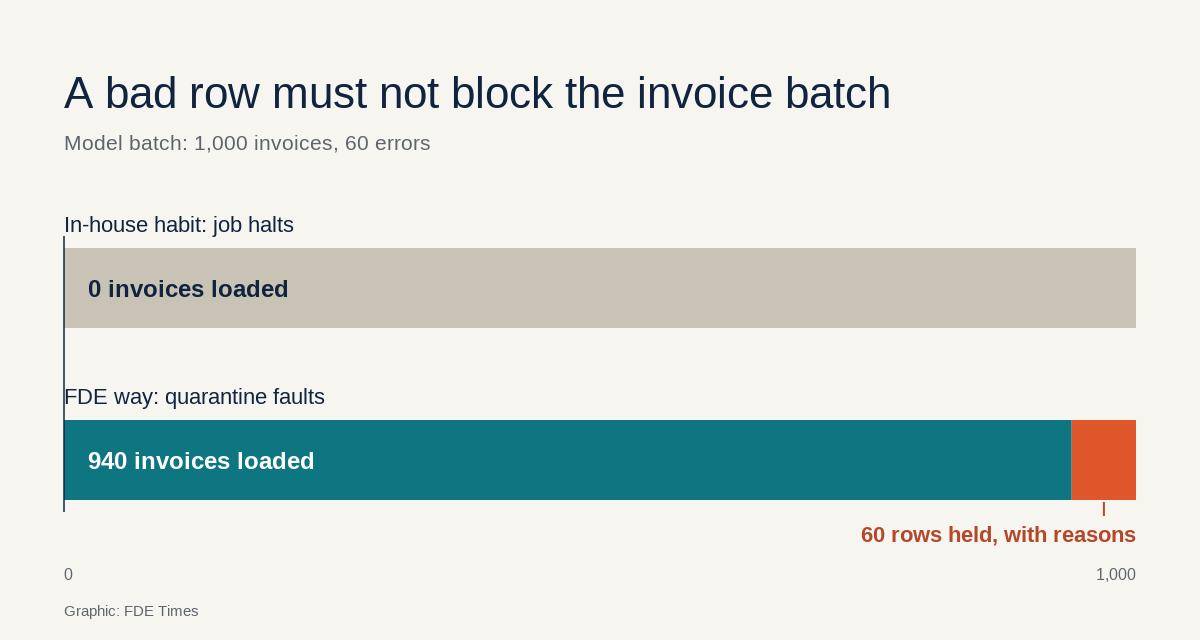
Run the numbers. Say the first batch has 1,000 invoices, and 60 rows are missing a vendor code or record the amount as “1.250,00” instead of “1250.00”.
By internal habit, an assertion fails, the job stops and zero invoices are loaded. The demo has nothing to show. The FDE way, 940 rows are loaded and 60 go to quarantine, each with a specific reason that can be sent to the finance team.
The code below is a minimal skeleton for the two tabular sources in that scenario, the SAP export and the finance team’s Excel file, once they have been read into rows. Each source has its own mapping, held in configuration rather than hard-coded. That is also the part you will change most in the first few weeks.
REQUIRED = ["vendor_id", "invoice_no", "amount", "currency"]

# One mapping per source; this is config, not code
SAP_MAPPING = {"vendor_id": "LIFNR", "invoice_no": "BELNR",
               "amount": "WRBTR", "currency": "WAERS"}

# Finance team's Excel: same targets, different column names
EXCEL_MAPPING = {"vendor_id": "Supplier Code", "invoice_no": "Invoice #",
                 "amount": "Total", "currency": "Curr"}

def normalize(row: dict, mapping: dict) -> dict:
    out = {target: row.get(src) for target, src in mapping.items()}
    amt = out.get("amount")
    if isinstance(amt, str):
        amt = amt.strip()
        if "," in amt and amt.rfind(",") > amt.rfind("."):
            amt = amt.replace(".", "").replace(",", ".")  # 1.250,00 -> 1250.00
        out["amount"] = amt.replace(",", "")
    return out

def validate(row: dict) -> list[str]:
    errors = [f"missing {f}" for f in REQUIRED if not row.get(f)]
    try:
        float(row.get("amount") or "x")
    except ValueError:
        errors.append(f"amount not numeric: {row.get('amount')!r}")
    return errors

def ingest(rows, mapping):
    good, quarantine = [], []
    for raw in rows:
        row = normalize(raw, mapping)
        errs = validate(row)
        if errs:
            quarantine.append({"raw": raw, "errors": errs})
        else:
            good.append(row)
    return good, quarantine

# Same function, two sources
sap_good, sap_bad = ingest(sap_rows, SAP_MAPPING)
xls_good, xls_bad = ingest(excel_rows, EXCEL_MAPPING)
The folder of scanned PDFs is outside this skeleton. It needs its own extraction step to turn pages into rows first, which then pass through the same ingest function with a third mapping. What matters is the shared entry point: every source goes through the same validation and quarantine layer.
Retries belong to the system-call layer, for example when the ERP’s API occasionally times out. You wrap that call in backoff with a cap on attempts. Quarantine belongs to the data layer. Keep the two apart: retrying a malformed row ten times will not make it correct.
Prototype first, harden later, reconcile forever
Valdera describes the rhythm as prototyping very quickly, then hardening whatever actually gets used into a solution robust enough for production. Paraform lists building custom integrations and pipelines on timelines set by the deployment among an FDE’s core responsibilities.
To someone used to designing thoroughly before running anything, this rhythm can feel sloppy at first. In fact it only reverses the order: you learn the data’s rules by running against real data.
The reason is that demos do not reflect reality. A guide from Stackmatix argues that client data is messy and that real pipelines are full of edge cases no demo reveals. The same guide says evaluation happens in production: until it runs on the real system, nothing has been proven.
Hardening does not end the work either. Vori treats configuring and maintaining data mappings and reconciliation as part of the operations team’s work, not a one-off migration project. The client changes vendor codes, finance adds a column to the spreadsheet, and your mapping has to keep up.
Rowspace adds one more loop: the best thing you build for one client should become a feature for all of them. The config-driven normalize function above is the seed of such a feature.
Five steps for a new data source
When you meet an unfamiliar data source, work through these steps in order.
Step 1: Discovery. Write one page setting out which system holds the data, who owns it, what format it is in, and the business rules users only mention out loud.
Step 2: Measure before you transform. Take a real sample and count the bad rows by error type before writing any transform.
Step 3: Prototype with quarantine. Build a prototype that separates valid and quarantined rows from the start, so you have something to show the client within days.
Step 4: Hand the quarantine list to the business owner. They can fix at the source errors you would never have guessed.
Step 5: Harden and package the mapping. Harden only the paths the client actually uses, and move the mapping into configuration so it can be reused next time.
Mistakes career-switchers often make
The most common mistake is treating one broken row as a failure of the whole job, the way quality was enforced at the old company. The second is guessing business rules instead of asking. A blank “status” column may mean “paid” in one department’s own process.
The third is pouring effort into an elegant architecture before touching real data. The fourth is about people. Vori’s requirements state that candidates need empathy for customers and the ability to stay calm while handling incidents in messy, high-pressure environments.
Palantir, the company that created the role, describes FDEs as often working directly on site with clients. There, how you explain the 60 quarantined rows matters as much as the code that separated them.
Turning past experience into an FDE profile
Palantir includes processing data at very large scale in its description of an FDE’s working day. A data engineering background is a genuine advantage, not something to hide. Paraform cites a Financial Times report that FDE job postings rose more than 800% between January and September 2025, so demand for exactly this skill set exists.
But the CV has to speak the role’s language. Instead of “built a Spark pipeline processing 2 TB/day”, describe a time you integrated a data source you did not control, how you quarantined errors and who you sat down with to pin down the business rules.
Take the 1,000-invoice scenario above as a hypothetical example. The old-style CV line would read: “Built an ETL pipeline loading invoice data into the data warehouse.” It is accurate, but an FDE recruiter sees no client, no dirty data and no outcome.
Rewritten in FDE terms: “Integrated invoice data from SAP and an Excel file managed by the client’s finance team; designed a quarantine layer that loaded 940/1,000 rows on the first run and sent the 60 failing rows, with reasons, to finance for correction at source; packaged the mapping as reusable configuration for a second source.”
The second line carries all three signals: data you did not control, graceful degradation with numbers, and something reusable. Write your own real projects in that shape, with real figures. When reading job ads, look for phrases such as “messy data”, “reconciliation”, “post-sale” and “on site”: they tell you how much time you will spend with clients.
Internal pipelines teach you to make data correct. Client data teaches you to keep a system useful while the data is still wrong, and that is the skill companies pay to send on site.
Was this article useful?
Thanks for the feedback!
6 sources
- Valdera - Forward Deployed Engineer
- Forward Deployed Engineer (Rowspace)
- Forward Deployed Data Engineer (Vori, San Francisco, CA)
- Palantir Technologies - Forward Deployed Software Engineer
- What Is a Forward Deployed Engineer? GTM Guide for Startups · 2026-09-03
- What is a forward deployed engineer? A complete guide · 2026-09-03