From backend engineer to FDE: what you bring, what you need to learn and how to tell your story
Two years of writing production code gives you most of what you need. Many candidates still fail because of a backend habit: drawing the architecture before asking the customer what "done" means.

In brief
- Two or more years of production backend work gives you most of the skills an FDE needs, and debugging and observability are the most reusable.
- The three main gaps are customer communication, understanding how AI systems behave, and scoping. Many candidates fail because they cannot run technical discovery, not because their code is weak.
- Tell your experience in terms of customer outcomes: move from 'I built X' to 'I deployed X and solved Y for customer Z'.
Picture an FDE interview. The interviewer sets the problem: a logistics company wants to use AI to handle customer complaint emails. If you work in backend, your first reflex is probably to pick up a pen, draw a queue, choose a database and sketch an API.
That is exactly where many candidates fail. fde.academy’s career-switch guide observes that backend engineers often fail this round because they jump into architecture before clarifying the success criteria. The irony is that the same guide states that anyone with two or more years of production backend experience already has most of what an FDE needs.
The gap between the two roles is narrower than many people think, but it sits precisely in the area backend engineers practise least. This is also a good time to close it: The Pragmatic Engineer reports very strong demand for FDE hires at Google, OpenAI and Anthropic.
You bring more than you think
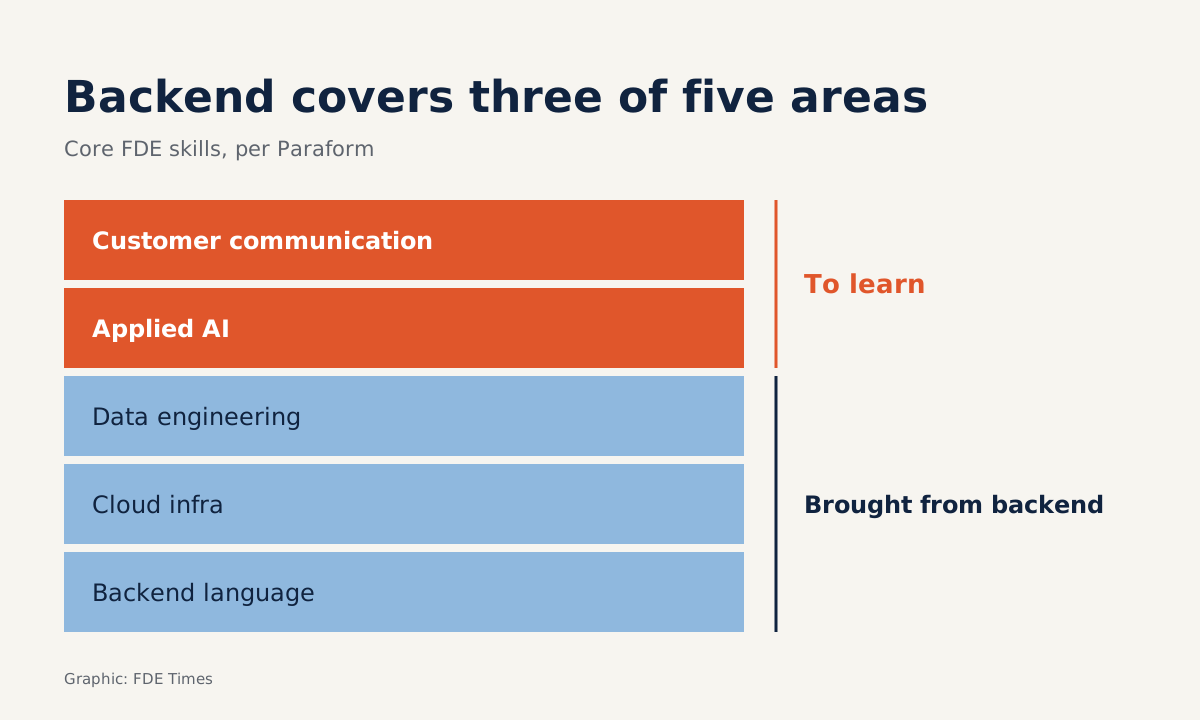
Paraform describes the FDE core skill set as five areas: a backend language, cloud infrastructure, data engineering, applied AI and customer communication. Someone with a few years of backend work has usually got the first three down, at least well enough to be useful.
According to fde.academy, the most reusable skills are observability and debugging. At a customer site you have to debug a system someone else built, with missing logs and restricted access, while everyone waits for your answer.
Those midnight on-call shifts are practice for exactly that situation.
Read job postings from Palantir and Anthropic and you will see the same demand. Palantir wants FDSEs to own high-stakes projects end to end.
Anthropic’s posting for an Applied AI FDE asks candidates to work inside customers’ systems to build production applications on Claude models. Both want someone who can ship code that runs for real in an environment that is not their own, which is what backend engineers do every day.
Three gaps to close
fde.academy identifies three gaps: customer communication, understanding of AI/ML systems, and scoping a deployment, meaning agreeing the success criteria before thinking about architecture. Scaler’s guide is blunter: most engineers fail to move into FDE work because they cannot do technical discovery, not because their code is weak.
The AI gap is only really large if you have mostly built CRUD services. In that case, says fde.academy, you need to grasp how AI systems behave differently.
With a CRUD API, the same input gives the same output and errors come with a stack trace. An LLM application can be fluently wrong, so you need an eval suite; unit tests alone are not enough.
Beyond those three gaps, job postings name one more requirement worth noting. Anthropic asks for high agency and the ability to navigate ambiguity in complex organisations. At a product company, a ticket reaches you after someone has already clarified the requirements. At a customer site, that clarifying is your job.
One project, two ways to tell it
fde.academy advises rewriting your CV around outcomes rather than features. Scaler suggests a storytelling frame for interviews: move from “I built X” to “I deployed X, solving Y for customer Z”. Try it on a familiar hypothetical project: a service that syncs orders with a partner’s system.
| Element | Builder version | FDE version |
|---|---|---|
| Opening line | Built an order-sync service in Go, Kafka, Postgres | The operations team had to enter orders from the partner’s system by hand, and the numbers often drifted apart |
| Definition of done | Not mentioned | Agreed with the operations lead: no order should need manual entry |
| The hard part | Retries and idempotency | The partner’s API returned duplicate events. Added tracing to prove the fault was on their side |
| Outcome | Service runs reliably | [your real figures: manual-entry hours saved, order mismatch rate before and after] |
The technology still appears in the right-hand column, but it serves the customer’s problem. Do not invent numbers. If you never measured, ask your former team or say clearly that it is an estimate.
Never had an external customer? An internal team that uses your system is a customer too. Operations, finance or data teams all count. What hiring managers want to hear is that you asked them what they needed and measured whether they got it.
The first ten minutes decide the decomposition round
According to techinterview.org, a strong candidate in the decomposition round spends the first ten minutes asking questions about the users and about what “done” means.
The round assesses structured problem breakdown, user empathy, reasoning with data and scoping. The article warns that if you only practise algorithms, you are revising the least important part of the exam.
Back to the complaint-email problem. Instead of drawing architecture, you could open with a few questions like these:
“Who reads these emails today, and how long do they spend on each one? Roughly how many arrive a month, and what kinds of complaint are they? If the project succeeds six weeks from now, which number will you look at to know?
What happens when the AI misclassifies a serious complaint? Which system holds the emails, and how far are we allowed to move the data outside it?”
Each question opens a later technical decision. The cost of a misclassification tells you whether a human reviewer is needed. Where the data lives tells you where the model can run. Only once you have the answers do you draw the architecture, and then every box in your diagram has a reason.
Common mistakes when switching
The first mistake is a CV full of technology names. A list of Kafka, Kubernetes and gRPC shows you know the tools, but not whose problem you solved.
The second is hiding incidents. The story of how you traced the cause of an outage is the best evidence of debugging skill, exactly what fde.academy rates as most reusable. Tell it along with the users who were affected and how you communicated with them.
The third is inflating your AI experience. If you have only built CRUD, build a small project with a proper eval and talk about it honestly. A probing question about unstable outputs quickly exposes anyone who has never done it.
When you read job postings, look for phrases such as “end-to-end”, “customer systems” or “ambiguity”. For each one, have a real story of your own ready.
Coding skill gets you to the interview table. What convinces people you can stand in front of a customer is knowing to ask “what does done mean?” before you start building.
Was this article useful?
Thanks for the feedback!
7 sources
- Backend Engineer to Forward Deployed Engineer: A Complete Transition Guide · 2026-06-02
- How to Transition from Software Engineer to Forward Deployed Engineer · 2026-08-24
- What the forward deployed engineer interview really tests · 2026-08-05
- What is a forward deployed engineer? A complete guide · 2026-09-03
- Forward Deployed Software Engineer (Palantir)
- Forward Deployed Engineer, Applied AI (Anthropic)
- The Pulse: Forward deployed engineering heats up again · 2026-05-14