The real gap between SE and FDE is who wakes up at 2am
Solutions engineers prove a product can work during the sale; FDEs carry it in production, and the messy middle between the two calls for a different mindset.
In brief
- An SE proves the product can work during the sales cycle; the FDE picks up where the SE stops and makes sure it actually runs in production.
- Demos come together quickly because they dodge the hard assumptions. The FDE's job is to drag each of those assumptions into the open, starting at the handoff, and give it an owner.
- Before switching, ask yourself whether you want to write customer-specific production code for months on end.
The contract has just been signed. The demo built during the sales cycle won the customer over, and now they want it running for real, on real data, for real users. Three months from now, if the system goes down at 2am, who gets out of bed to fix it?
A comparison of the two roles on Scaler gives a blunt answer: the FDE. Almost the entire difference between solutions engineering (SE) and forward deployed engineering sits inside that answer.
An SE works within the sales cycle to prove the product can work for the customer. An FDE is sent straight into the customer’s problem to make sure the product does work in production.
If you are an SE who wants to become an FDE, most of your skills carry over: understanding customers, talking technical, building fast. What you have to learn is a very different way of thinking. The job is no longer to win the customer’s belief but to live with the consequences when the demo meets the real world.
The difference between “can” and “does”
Paraform describes the division of labor neatly: the SE sells the vision, the FDE builds it, the customer engineer maintains it. SEs work mostly before the sale, and the FDE picks up exactly where the SE stops. The two roles follow one another on the same account, yet they measure success in completely different ways.
Hapy writes that a demo chatbot can be built in a week. The hard part is making that workflow run reliably inside a real organization. Kunal Ganglani calls the gap between “the demo works” and “deployed to production at the customer” enormous, and Hapy gives the zone in between a name: the FDE owns that “messy middle”.
One more detail SEs tend to miss: FDEs write production code, though not for the core product. Your code is customer-specific (connectors, pipelines, business logic) and runs in the customer’s environment. That demands enough engineering discipline for it to last, without letting it turn into a fork of the product.
Taking a demo all the way to production
Take a hypothetical example. You once demoed a chatbot to a retail chain that answered questions about its returns policy. The demo used a CSV file exported by hand from the order system, twenty pre-written questions, and ran on your laptop. The customer said yes, and now you are the FDE on the project.
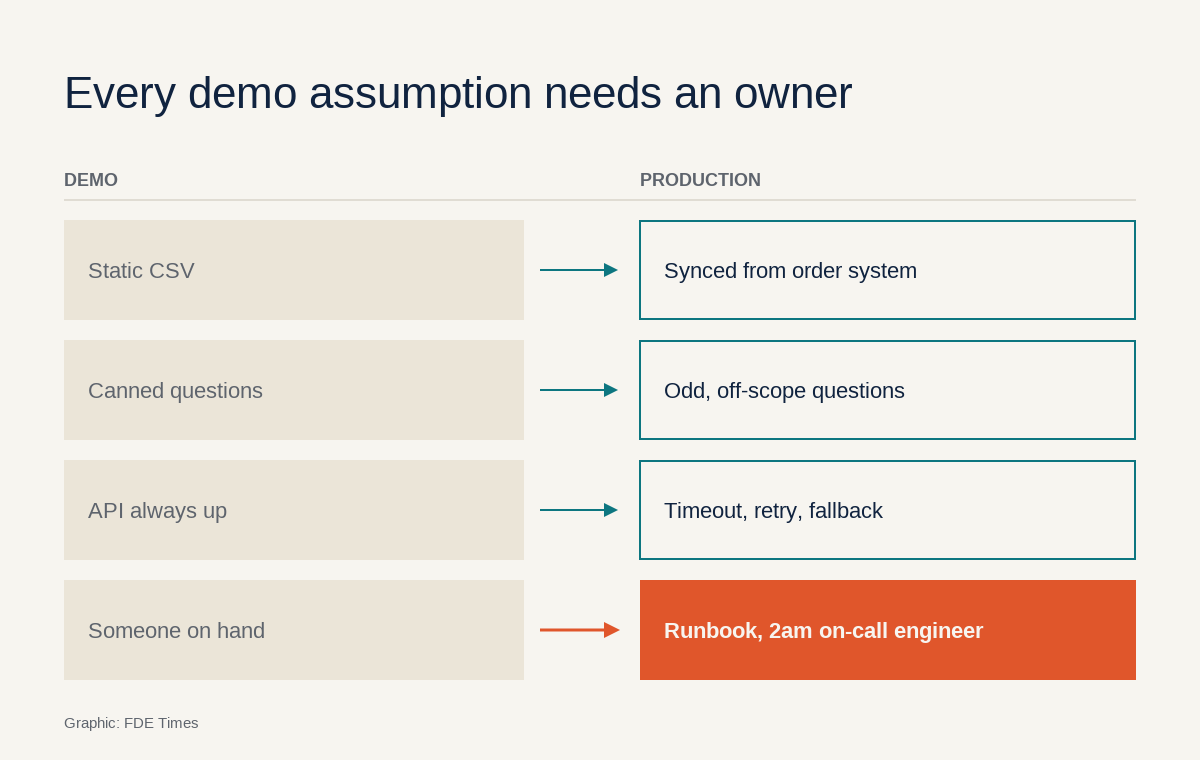
The first step involves no code at all. You sit down and write out everything the demo quietly assumed, and for each assumption note what production requires and who owns it. The table below is part of that list.
| What the demo assumed | What production requires | Who owns it |
|---|---|---|
| Data is a static CSV file | Read directly from the order system, with a sync schedule and alerts when data goes stale | FDE, with the customer’s IT team |
| Questions are pre-written | Unfamiliar questions, typos, out-of-scope questions, plus a way to answer “I don’t know” | FDE, with the business owner |
| The API always responds | Timeouts, retries and a fallback when the service is slow or down | FDE |
| The only user is you | Access control, audit logs, customer data never leaving their environment | FDE, with the security team |
| Someone sits beside it fixing errors | Runbook, alerts, someone on call when the system fails at 2am | FDE |
The last column is where the career shift shows. In a demo it stays empty because there is nothing to own. In production, every empty cell is an incident waiting to happen.
Look at the third row as code. The demo version is usually a single line calling the API directly. The production version has to answer a question: when the backend is slow or dead, what does the user see and what can the on-call engineer read?
import logging, time
import requests

log = logging.getLogger("returns_bot")
MAX_ATTEMPTS = 3

def get_order(order_id: str) -> dict | None:
    # Demo version: return requests.get(f"{API}/orders/{order_id}").json()
    for attempt in range(MAX_ATTEMPTS):
        try:
            r = requests.get(f"{API}/orders/{order_id}", timeout=5)
            r.raise_for_status()
            return r.json()
        except requests.RequestException as e:
            log.warning("order_api_fail order=%s attempt=%d err=%s", order_id, attempt, e)
            if attempt < MAX_ATTEMPTS - 1:  # don't wait again after the final attempt
                time.sleep(2 ** attempt)
    log.error("order_api_down order=%s", order_id)
    return None  # The layer above replies: "The order system is busy, please try again later"
There is nothing clever about this code. What changes is the mindset: every log line is written for someone who will read it at midnight, and that someone may well be you.
Assumptions hide in the handoff
The assumptions table is easy to write when you built the demo yourself. If you are an FDE inheriting the project from another SE, many assumptions will not be in any slide deck or repo. They live in the memory of whoever ran the demo, and a smooth handoff is often a sign they have not been spoken aloud.
A practical tip: do not let the SE walk through the demo again, because they will replay the happiest path. Ask questions that force them to describe what happened backstage. Which data was cleaned by hand before the demo? Which customer questions did the demo get wrong? Was anything promised verbally that is not in the contract?
A hesitant answer, or something like “that should just work”, is the next row in your assumptions table. Writing it down during the handoff is far cheaper than discovering it in the first incident.
Steps to apply this to your own project
Start with an assumptions list like the one above, written in the first week after signing and reviewed with the customer. Next, run the demo against a sample of the customer’s real data and real questions, and record where it breaks before promising any timeline. That list of breakages is your first backlog.
Then write the runbook before go-live, well ahead of the first incident. A runbook answers three questions: which alert goes to whom, what to check first, and how to switch the feature off without breaking everything else. If you cannot write the runbook, the system is not ready.
The last step is the one most often forgotten. Hapy treats feeding patterns back to the product team, so that one-off work for one customer becomes reusable capability, as a core FDE responsibility. Whenever you write the same connector a second time for a second customer, open a ticket for the product team.
Mistakes SEs make in their first year
The first is the demo instinct: hiding the hard corners so the presentation runs smoothly. As an FDE, hard corners have to surface as early as possible, because hiding them only pushes the incident to a more expensive moment. You will find yourself telling customers “this part doesn’t work yet” far more often than you did as an SE.
The second is patching the core product directly to save time, or the opposite, writing sloppy customer-specific code because it is “just an integration”. Customer-specific code is still production code and still needs tests, logging and review. The scope is narrower; the standard is the same.
The third runs deeper and sits with you. Paraform warns that an excellent demo SE may have no desire at all to write production code for six months straight. Demo skills prove nothing about your appetite for that work, so try it before you apply.
Proving the skill when job hunting
Palantir’s posting for a Forward Deployed Software Engineer describes the work as engaging directly with customers to quickly understand their biggest problems, then designing and implementing solutions. It also stresses working in small teams with little oversight and owning high-stakes projects end to end.
When you read FDE job postings, look for words such as “own”, “end-to-end” and “implement”: they signal that the company needs someone to carry production, beyond someone who presents. On your CV, do not stop at “built demos that helped close deals”.
Write about a system you remained responsible for after handoff: what data it ran on, which incidents you handled, which patterns you fed back to the product team.
In interviews, ask who gets paged when the customer’s system fails. The answer will tell you whether the role is a real FDE position or an SE job with a new title.
Exercise: put your latest demo on the operating table
Take the most recent demo you presented and build an assumptions table like the one above, with at least ten rows and no empty cells in the “who owns it” column. Then pick the hardest cell and write the code or runbook for it. If you finish and find it more engaging than building the demo, you have your answer to the career question.
Was this article useful?
Thanks for the feedback!
5 sources
- Forward Deployed Engineer vs Solutions Engineer: What's the Difference? · 2026-08-24
- Forward-Deployed Engineer vs. Solutions Engineer vs. Customer Engineer: What Startups Actually Need in April 2026 · 2026-04-22
- Forward Deployed Software Engineer
- How Forward Deployed Engineers Turn AI Demos Into Production · 2026-05-20
- Forward Deployed Engineer: The Hottest Role in AI-First Tech and Why It Pays So Well [2026] · 2026-05-09