Why an FDE's first week at a client should not start with code
Settle who signs off, who grants access and what failure looks like, or the out-of-scope requests of week five will decide for you.
In brief
- An FDE's first two weeks usually go on internal work and access requests. Use that time to prepare the kickoff.
- The kickoff must settle three things: who signs, what counts as success and as failure, and who decides when the parties disagree.
- Every milestone and every access request is tied to a named person. When nobody clearly owns something, the owner is you.
Picture your first Monday morning at a client’s office, after two weeks of settling in internally. The repo is cloned and the notebook is open, but you have no VPN, you cannot read the staging database, and nobody in the meeting room can say for certain who will sign off the demo.
The temptation is to start writing code so the time is not wasted. That is usually the wrong move. Code written before you know who approves, who grants access and what the client expects tends to be rewritten, because it solves a problem nobody in the client’s organisation has actually posed.
For an FDE, the kickoff and the first week are not a formality before the real work. They are the project’s first piece of work: you establish who you will work with on the client side, who will give you what, and who has the authority to say “yes”.
On the blog of Rocketlane, a customer onboarding software company, Irit Eizips of CSM Practice says bluntly that misaligned expectations can quickly derail the whole onboarding. According to the piece, that misalignment often stems from unrealistic commitments made during the sale.
Two internal weeks are for preparing the kickoff
A good kickoff is prepared before you meet the client. According to FDE Academy, an FDE’s first two weeks are usually internal: learning how the company typically deploys for clients, and requesting access to the tools and systems you will actually use.
PostHog’s FDE handbook also treats week two as the point at which work with clients begins.
Do not treat this period as waiting. It is a rehearsal for exactly what you will do at the client: every piece of access has a named person who grants it.
At PostHog, access to the tools used on client calls has to be requested from a specific person. Get into the habit of writing down the grantor’s name internally, because on the client side the list will be longer and the grantors harder to find.
That comes with an attitude: do not wait to be assigned work. The PostHog handbook treats onboarding as self-directed, and when it is unclear who owns a task, that person is almost certainly you.
Those two weeks are also the time to clarify expectations on your own side. FDE Academy advises asking your manager directly, as early as possible, what doing well in the first 90 days looks like to them.
Next, find the channel where FDEs meet the people who own client relationships; PostHog has a dedicated cross-team channel for Sales, CS and Support. That is where you ask what sales promised the client before the client tells you themselves.
Three things the kickoff must settle
The first is the approver. Rocketlane advises identifying, as early as the introductory call before kickoff, every stakeholder involved in the implementation, not only those who made the buying decision.
AmpUp’s stakeholder mapping template separates the economic buyer, who holds or approves the budget, from the delegated approver. A vice-president who says “let me pass this to procurement” is usually just a delegate.
The same template warns about blockers: anyone who can slow or stop the deal entirely without ever appearing on a call, such as a chief security officer nobody has met who raises data-residency concerns in the final round of approval.
For an FDE, check in the first week whether the person who approves data access is that kind of blocker.
The second is expectations. Rocketlane suggests that the introductions at the start of the session clarify each stakeholder’s role, expectations and desired business outcomes.
Read AI’s agenda template goes a step further: define measurable success and state clearly what failure looks like. The failure question is harder to raise, so few people ask it, but it will save you when a demo turns into an argument.
The third is decision rights. Read AI advises assigning each milestone to a specific person, not a team, and making clear who decides when the parties disagree. When two departments want two different things, that answer determines whether you lose an afternoon or two weeks.
A sample kickoff, from questions to record
Imagine you are an FDE deploying a support-ticket triage agent for a logistics company. In the room are the head of customer service, an IT engineer and the deputy director of operations. Sales has introduced her as the decision-maker.
You open with a question about success: “Six weeks after the agent goes live, what will you look at to know the project worked?” The head of customer service replies: “More tickets routed to the right team.” That is a wish, not yet an acceptance criterion.
You follow up: “How accurate does it need to be before you would drop manual triage? And what situation would you count as a failure, even if the overall number looks good?”
He answers: “If compensation-claim tickets get routed to the order-lookup team, even just a few, that’s a failure.” That is the real spec: complaint tickets need their own threshold, not just a single overall accuracy figure.
Then comes the approver question: “At the demo in week three, who says ‘yes, ship it to production’? If customer service and IT disagree, who decides?” Suppose the deputy director says “let me check with my boss”: you have just learned she is a delegate, not the signer. Ask for 15 minutes with the real signer before locking scope.
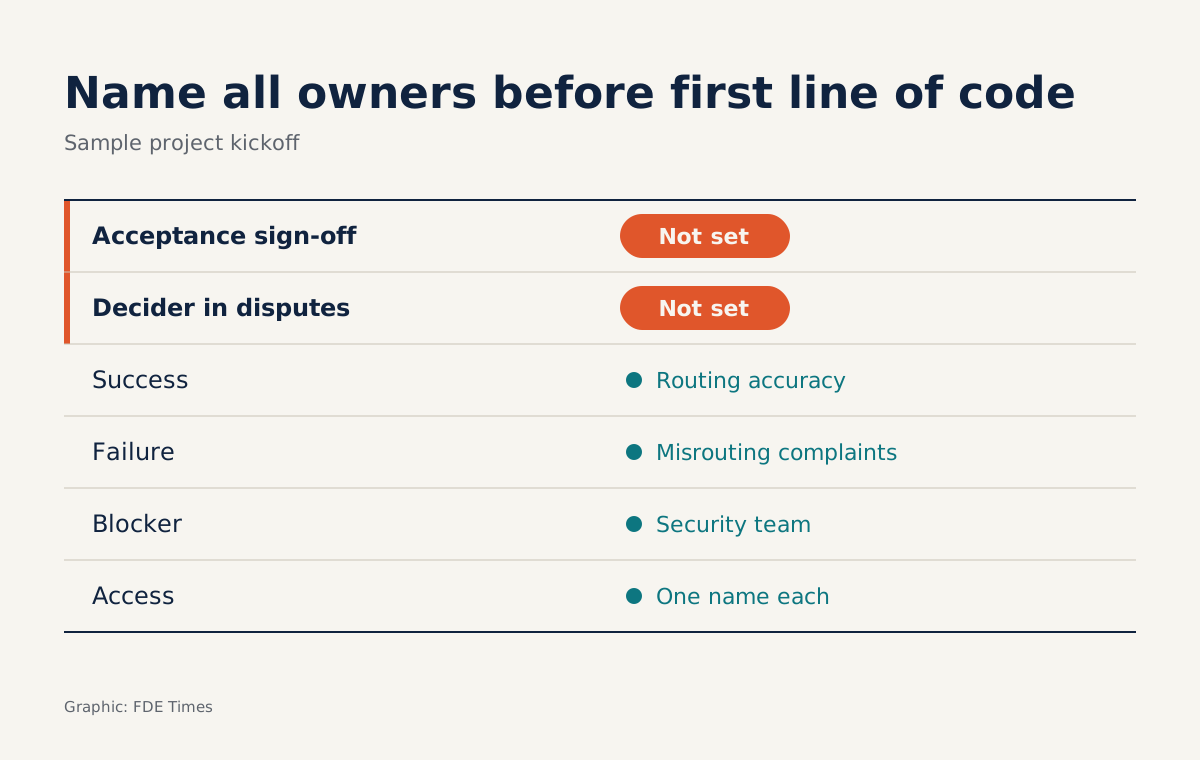
Finally, the blocker question: “For the agent to read tickets containing customers’ phone numbers, which department has to approve? Are they here today?” This often surfaces a security team nobody invited. Straight after the meeting, write everything into a one-page record:
| Item | What to record | Example from the sample project |
|---|---|---|
| Acceptance signer | One name, not a department | Not settled: the deputy director of operations may only be a delegate; meeting requested with her superior |
| Tie-breaker | Who has the final word between parties | Not settled: to be asked at the meeting with the real signer |
| Success | A number and how it is measured | Correct-routing rate, measured on a set of tickets the client has labelled |
| Failure | Unacceptable situations | Complaint tickets routed to the order-lookup team |
| Blocker | Who can block without attending | The security team, because tickets contain phone numbers |
| Access | System, grantor, expected date | VPN, ticket database, ticketing tool: a named person for each |
How to do it this week
Before the kickoff, read the sales handover notes, ask in the internal channel what was promised, and prepare the three groups of questions above. In the meeting, prioritise the failure question and the decision-maker question, because those are the two things clients rarely volunteer.
Within 24 hours, send the record to everyone who attended and ask them to correct anything wrong. A record the client has corrected is worth more than one nobody has read. After that, check the access list every morning: for any line past its expected date, message the named person on that line directly rather than waiting for someone else to chase.
The mistakes that turn weeks five and six into a wall
FDE Academy describes how, around week five or six, new FDEs hit their first wall: a client request that does not match the agreed scope, or a technical problem that refuses to yield to the usual approach. At that point, if there has been no clear decision-maker since week one, every extra request starts to look mandatory.
The first mistake is working only with the people who made the buying decision. Next is treating a delegate as the signer, then discovering on demo day that someone more senior has never seen the work. The third is forgetting blockers, so that only when you request access to real data do you learn the security team needs two weeks to approve.
The remaining two are harder to spot. One is defining success without defining failure, so every acceptance meeting becomes an argument about feelings. The other is waiting for someone else to grant access, when the spirit of the PostHog handbook is plain: if nobody owns a task, it is yours.
Perspective AI’s piece on the Palantir style of FDE work stresses sitting on site with the client and shipping working software early. That advice does not contradict anything above. Shipping early only has value when you know who you are shipping to and how they measure the result.
Turning this skill into an edge when job hunting
When reading FDE job descriptions, look for phrases such as customer onboarding, stakeholder management or “own the customer relationship”. They signal that the company expects you to lead the kickoff yourself, not just pick up tickets. In interviews, describing a time you uncovered the real signer or a hidden blocker is more persuasive than any claim to be “a good communicator”.
On your CV, replace “worked with clients” with something more specific, for example: led the kickoff, settled acceptance criteria including failure cases, secured all data access before week two. Internal projects, integrations for other departments and system handovers all give you a chance to practise this skill now.
The first line of code at a client should be written once the record has a name in every row. Then you know exactly who you are writing it for.
Was this article useful?
Thanks for the feedback!
6 sources
- New starter onboarding (PostHog Handbook, Forward Deployed Engineering)
- Forward Deployed Engineer First 90 Days: What Actually Happens on the Job · 2026-08-06
- How to set your kickoff meeting up for success · 2023-04-24
- Project Kickoff Meeting: Template & Agenda (Read AI)
- Stakeholder Mapping in Enterprise Deals: A Practical Template (AmpUp) · 2026-06-30
- Palantir's Forward-Deployed Engineering Playbook (Perspective AI) · 2026-05-14