Accenture's FDEs leave work behind; Palantir's feed the product
Confusing the two means training the wrong skills and telling the wrong interview story, yet a careful read of the job ad usually shows which one is on offer.
In brief
- Palantir created the FDE role because its software was too complex for clients to plug in and use on their own. There, services are a means of getting clients onto the product. Accenture uses the title for its services business.
- Both put engineers right next to the client. The difference is where your work ends up: as a shared platform serving more clients, or as assets left behind for one client to own.
- Before accepting an offer, ask exactly what the post-engagement handover includes, and what share of your time goes to writing production code.
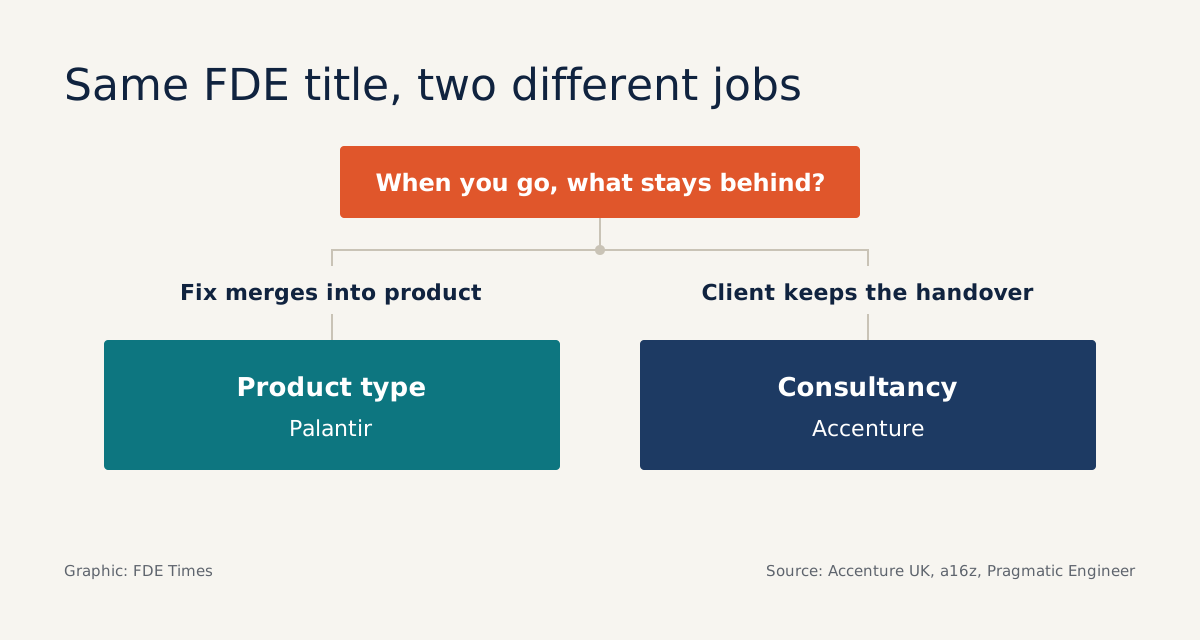
Accenture’s job ad for a Forward Deployed Engineer in the UK asks candidates to build patterns, playbooks and accelerators that the client will own after you leave. Palantir is where the role was born. According to a16z, at Palantir services are merely a means of getting clients to use the product, and the main revenue does not come from services.
So these are two different jobs sharing one name. You may be weighing an offer from a consultancy against one from a product company, or reworking your CV to move into FDE work.
Confuse the two and you will train the wrong skills, tell the wrong story in interviews and head in the wrong direction for the next few years. The good news is that a careful reading of the job ad tells you fairly clearly which kind you are applying for, well before you sign anything.
The role was born at a product company
The Forward Deployed Software Engineer role appeared at Palantir in the early 2010s, when it was known as Delta. Paraform explains why: Palantir’s software was too complex for clients to plug in and run on their own, so the company had to send engineers on site.
The Pragmatic Engineer defines an FDE as a software engineer who rotates between two places: sitting with the client’s team, then returning to the core product engineering team. The Pragmatic Engineer also notes that FDEs are often mistaken for consultants. In practice, an FDE stays with the client for the long term and contributes to the very product the company sells.
a16z points out why the model worked at Palantir: underneath the bespoke work for each client sat a real platform. In the original model, then, the work you do at the client gets that platform used, and what you learn there flows back to the product team.
What do consultancies use the title for?
Accenture UK’s job ad puts the weight somewhere else. Engineers work inside the client’s organization. What remains when the engagement ends is a set of patterns, playbooks and accelerators the client keeps after you have gone.
Accenture also wants its FDEs to measure the impact of each deployment in numbers a CFO can grasp at a glance and act on. FDEs must present results to the client’s CTO, CFO and CISO. The people you ultimately have to convince are the client’s leadership.
At first glance the two descriptions sound very alike, since both put engineers right next to the client’s team. That is the trap. The real difference is where your work ends up.
One design decision splits FDEs into two kinds
A post on Substack argues that a genuine FDE differs from expensive consulting in a new job title on exactly one internal design decision: keeping the product separate from services work.
In the post’s account, the product team’s job is to build things that serve many clients at once, what the author calls the “paved road.” A company that holds that line is running a product business when it sends engineers to clients. A company that drops it is, in essence, selling labor.
a16z gives the same warning. Companies that copy only the on-site engineering half of Palantir end up saddled with thousands of one-off deployments they cannot maintain or upgrade.
Same incident, two right answers
Take a hypothetical case to see how this decision plays out day to day. You are deploying at a bank and discover that the data connector cannot read its legacy transaction format.
At a product company, you fix it so the client can run, but the job is not finished. You also have to ask whether the fix belongs on the paved road. If other banks use the same legacy format, take the fix back to the core product team rather than leaving behind a branch of code only this bank uses.
At a consultancy, the right move is to build a clean, fully documented module that runs on the bank’s own infrastructure, so its team can maintain it after you leave. You also need to say how much the module saves or earns the bank, in terms its CFO understands.
Both are good engineering, measured differently. One side measures by whether the platform can serve more clients. The other measures by whether the client can run things without you.
Decoding a job ad in five minutes
You need not wait for the interview, because the way a company describes the role already gives a strong hint.
| Phrase (source) | What it means | Question to ask the recruiter |
|---|---|---|
| “rotates between the client’s team and the core product team” (The Pragmatic Engineer’s definition) | Product model: client work flows back into the product | Where does a fix you write at a client go, and who decides whether it enters the product? |
| “services are a means of getting clients to use the product” (a16z on Palantir) | Main revenue comes from the product | Are FDE hours billed to the client separately? |
| “what the client owns after you leave” (Accenture job ad) | Services model: the handover is the product | What does a typical handover package include? |
| “measure impact in terms a CFO understands” (Accenture job ad) | You report to the client’s leadership | Who on the client side signs off on your results? |
Beyond the table, the question most worth asking of either kind is what share of your time goes to writing production code. If the build work is handed entirely to others, the skills you accumulate will tilt heavily toward consulting.
In practice: read the job ad and underline every phrase about ownership, such as the company’s product or the client’s assets, and every verb about handover. Then use the table to classify the ad, and bring exactly those questions to your recruiter call.
Common mistakes when choosing between them
The most common mistake is treating the title as evidence. The letters “FDE” on an Accenture offer and on a Palantir offer tell you nothing about what your working day will look like. Product companies differ among themselves, too: Paraform notes that at AI startups such as Greptile the problems are narrower but the pace is faster.
The next mistake is telling the wrong story. When interviewing at a product company, describe a time you solved a client’s problem and then carried the lesson back into the product. When interviewing at a consultancy, describe the assets you left behind that the client’s team could run on its own, with impact measured in numbers.
The last mistake is thinking one kind is more senior than the other. The consulting model trains handover and the ability to talk to leadership. The product model trains the ability to turn work for one client into something many clients can use. Choose by the skills you want to be good at three years from now.
This week’s exercise
Take the most recent technical incident you dealt with for a client, or for an internal team if you are not yet an FDE. Write up two responses in the style of the bank connector example: one the product-company way, one the consultancy way.
Whichever version you enjoyed writing more is a fair hint about which kind of role to aim for.
The FDE title will keep spreading to more companies, and the more it spreads, the less the name itself tells you. To learn the truth, read the line that describes what you leave behind when you walk away from the client.
Was this article useful?
Thanks for the feedback!
5 sources
- The Difference Between a Forward Deployed Engineer and a Consultant With a Better Title Is One Design Decision · 2026-07-13
- What are Forward Deployed Engineers, and why are they so in demand? · 2025-08-12
- Forward Deployed Engineer Role: Palantir, Runway, and Greptile · 2026-04-22
- Forward Deployed Engineer (Accenture UK, listed on Flexa)
- The Palantirization of everything · 2026-01-16