Agreeing to ‘no mistakes’ is how AI projects fail sign-off
How often a model may be wrong is a product decision, so settle with the client which errors are acceptable, and on what data, before any code.
In brief
- LLM evals do not need to hit 100%. The right pass rate is a product decision that depends on which errors the client can live with.
- Good criteria are specific, measurable, achievable with current models, and set across several dimensions at once, including error severity.
- Write tests for the failure modes you have seen in real data, then rerun the evals after every change.
“Classification has to be right every time. Mistakes are not acceptable.” That is how the head of operations at a logistics company might sum up the brief in a second meeting about using an LLM to sort customer complaint emails automatically. The example is hypothetical, but the sentence will be familiar to most forward deployed engineers.
Nod and go back to your editor, and the project has probably already been lost. Three months later, at the acceptance review, a single misfiled email is enough for the client to declare that the system has failed, and there is nothing in writing to show otherwise.
For an FDE, the hardest part of an AI project is rarely the prompt or the pipeline. It is agreeing with the client what “success” means for a system that will certainly be wrong some of the time. This guide covers how to do that before the first line of code.
Why “always right” is not a criterion
Software engineers are used to unit tests: a red test means a bug, and every bug gets fixed. Hamel Husain, who advises companies on evals for LLM products, points out that LLM evals work differently: an eval suite does not have to pass at 100%. OpenAI’s guide to evals likewise says evals exist precisely because AI systems are nondeterministic.
Husain’s more important point is that the pass rate you need is a product decision, and it depends on which failures you are willing to accept. So when a client says “no mistakes”, answering “impossible” gets you nowhere. Ask the follow-up instead: which kinds of mistake are unacceptable, and which can the business live with?
Anthropic’s documentation on success criteria sets four requirements: criteria should be specific, measurable, achievable and relevant. Its example is brief: do not write “good performance”, write “accurate sentiment classification”.
“Always right” fails two of those four tests. Nobody can measure it on a finite sample, and no model can achieve it.
Read real errors before choosing metrics
The usual reflex is to open a list of standard metrics and pick accuracy, F1, perhaps a “helpfulness” score. Husain warns that this top-down approach tends to end in measuring whatever is easy to measure, while what users actually care about goes unmeasured.
He recommends working the other way: analyze errors on real data first, then write tests for the specific failure modes you have observed. On scale, he suggests starting with about 100 traces to find errors. When you need to validate an LLM judge, label 100 to 200 examples per failure mode.
Applied to the logistics company, that means asking for 100 real complaint emails with personal data removed, running the prototype on them and reading the results with a customer service agent. Say the two of you find three failure modes.
In the first, a “late delivery” email is filed as “information request”. In the second, a claim for compensation over broken goods is filed as “late delivery”. In the third, an email threatening legal action is not escalated to a manager.
These three failures differ sharply in severity. Mixing up “late delivery” and “information request” costs an agent a few minutes moving the ticket to another queue. Missing a legal threat can become a legal incident. A single accuracy figure hides exactly this information.
A complete set of acceptance criteria
Anthropic advises setting criteria on several dimensions at once. One is error severity, with the example “90% of errors are inconveniences, not egregious errors”.
Latency is on the list too. For safety, it gives a criterion with a clear number: fewer than 0.1% of outputs flagged as toxic by a content filter, measured over 10,000 runs.
Note how that criterion is written. It has a threshold, a sample size and a measuring tool. The criteria for the email project should follow the same template. The figures in the table below are illustrative only; replace them with the numbers agreed with the real client:
| Dimension | Criterion | Measured on |
|---|---|---|
| Overall classification | At least 92% of emails filed in the correct category | 500 emails with client-confirmed labels |
| Severity | At least 90% of errors are only “wrong queue” errors | The errors in the same 500 emails |
| Legal threats | No legal-threat email in the test set is missed | 150 labeled legal-threat emails |
| Latency | Classification finishes before the email enters the queue | Staging environment logs |
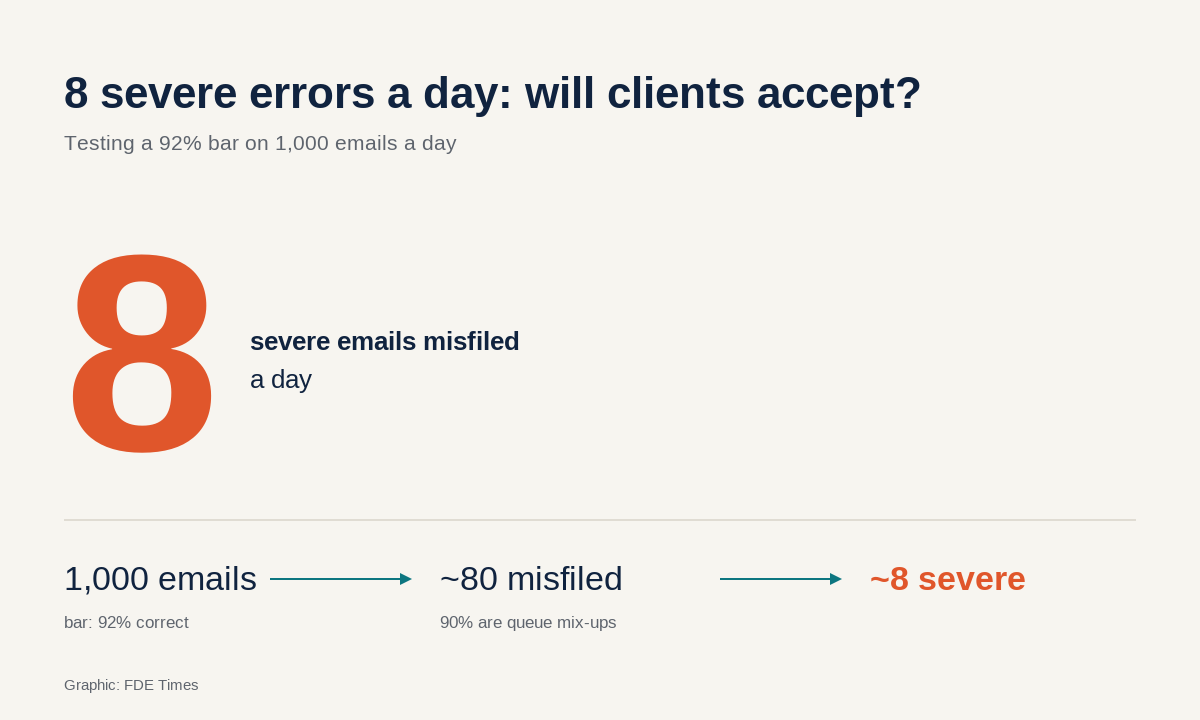
Now run the numbers on the first row. At 1,000 emails a day, 92% means about 80 emails filed wrongly. If 90% of those are merely the wrong queue, that leaves about 8 serious errors a day.
The question to put on the table is: “Eight serious emails a day will be misfiled. Can your team live with that, or do we need a human review step?”
That question turns a vague worry into a business choice that can be discussed. It also matches how Husain sees pass rates: as a product decision about acceptable failures, which means the product owner on the client side has to be in the room when it is made.
What about the “none missed” row? An absolute threshold makes sense only on a narrow, fixed test set large enough that the result does not hinge on luck, such as the 150 emails in the illustrative table. If the system cannot meet it, the remedy is to add human review. Quietly lowering the threshold is not an option.
Five steps for the next project
Step one: rewrite every vague requirement as a sentence with a number. OpenAI’s guide also begins its eval design process with the question of what the success criteria are.
Step two: ask for real data and read about 100 traces with someone from the client who does the work. Record the failure modes in their language and leave out the ML jargon.
Step three: rank each failure mode by severity, then set criteria across several dimensions: accuracy, severity, latency and safety.
Step four: check that the thresholds are achievable. Anthropic stresses that metrics should not exceed what current frontier models can do, and should be grounded in benchmarks or prior experiments. Run the prototype on the test set before promising anything, so that you negotiate with a baseline in hand instead of a hunch.
Step five: get the criteria signed, then automate the evals. OpenAI recommends setting up continuous evaluation so evals run after every change, and calibrating automated grading against human judgment.
Common traps
The first trap is copying thresholds from one project to the next. Anthropic notes that citation accuracy may be critical for a medical application but far less important for a casual chatbot. A 92% threshold that suits email classification may not suit summarizing medical records.
The second is relying on a single headline number. A good accuracy figure can still hide a serious failure mode. You need at least one row on severity and a separate row for the failure the client fears most.
The third is choosing the test set yourself. If you assigned the labels, the client has grounds to distrust the result at sign-off. Have someone on the client side confirm the labels, at least for the test sets covering serious failures.
The last is treating the criteria as paperwork, signed once and filed away. Prompts change, models change and input data changes. The criteria are worth something only if the evals rerun after each of those changes.
When a job description mentions “define success metrics with customers” or “build evals”, this is the skill it means. On a CV, say exactly which thresholds you agreed, on how many samples, and what the client decided based on those numbers.
An exercise for this week: pick an AI feature you are working on and write four rows of criteria like the table above, each with a threshold, a sample size and a measurement method. Then try to answer the question “how many serious errors a day are acceptable?” If you cannot, that is the question to ask the client at the next meeting.
Was this article useful?
Thanks for the feedback!