Hugging Face's Smol Course: the first three units are worth it for FDEs
A course built around the small SmolLM3 model, at 3-4 hours a week, that teaches the question every customer will ask: does the fine-tuned model actually do their job well?

In brief
- Smol Course is a hands-on Hugging Face course built around SmolLM3. Each chapter takes about a week, at 3-4 hours.
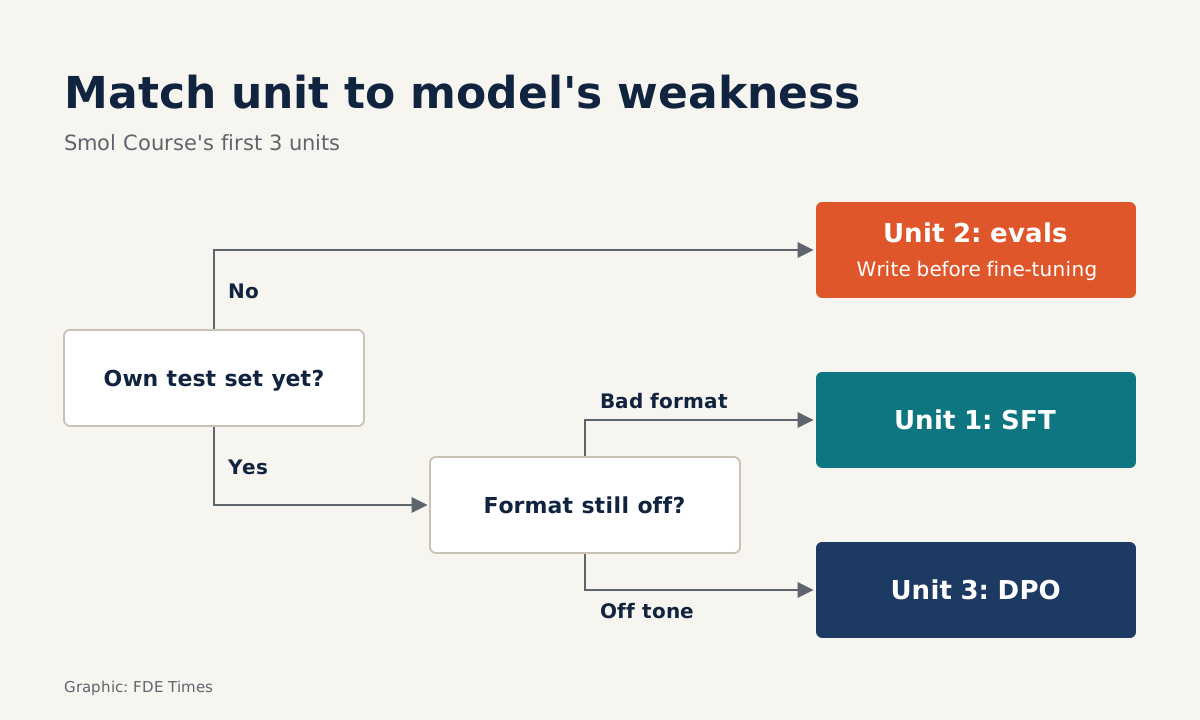
- For FDEs, the three most valuable units are SFT (Unit 1), evaluation (Unit 2) and DPO (Unit 3), taken in that order.
- Finishing Unit 1 earns a fundamentals certificate. The certificate of completion requires every unit plus a final project, which doubles as a portfolio piece.
A small model, a personal computer and 3-4 hours a week. According to Hugging Face, that is enough to start learning how to teach a language model to do exactly what a customer needs.
The course is Smol Course. The README of the huggingface/smol-course repo describes it as a practical course on aligning language models for the learner’s specific use case.
For an FDE, “specific use case” is the day job. Customers rarely need a model that knows everything. They need one that answers in their format, in their tone and with their business rules, and then they need proof that it really does.
Smol Course teaches both halves on a small model, which is enough to practise on before you have to do it for real on a large system.
Who is it for, and how demanding is it?
The course is built around SmolLM3, Hugging Face’s small language model. The Hugging Face Learn page says the audience is software developers and engineers who want to get up to speed quickly on fine-tuning LLMs. Each chapter is designed to be finished in a week, with about 3-4 hours of work, so an engineer in a full-time job can still fit it in.
On hardware, the two official sources differ slightly. The README says everything runs on most personal machines. The Learn page asks only for a computer with internet access and adds that a GPU is recommended.
The claim that it “runs on most personal machines” is the README’s own description and has not been independently verified. The sensible approach is to try it on the machine you already have and look for a GPU only if it is too slow.
The current version is “smol course v2”, with seven units: instruction tuning, evaluation, preference alignment, vision language models, reinforcement learning, synthetic data and an “awards” session. The 2025 schedule ran until December 2025, so you will now be working at your own pace.
SFT is the first thing to try
Unit 1 teaches supervised fine-tuning (SFT). The course calls it the core technique for getting a pre-trained model to follow instructions. One of the unit’s goals is to fine-tune SmolLM3 for a range of tasks.
Picture a logistics customer that wants a model to read complaint emails and return JSON with three fields: order ID, incident type and urgency. However long the prompt, the model still occasionally drifts from the format.
SFT on a few hundred email-and-JSON pairs labelled by the customer’s own staff is the most direct way to teach the model that behaviour. Unit 1 lets you practise exactly this on a cheap model before you have to do it for real.
Only evaluation on the customer’s data will convince them
Unit 2 covers evaluation: benchmarks and custom domain evaluation. Public benchmarks tell you a model is decent in general. The customer cares only whether it does their job well.
Go back to the complaint emails. Before fine-tuning, you might set aside, say, 50 emails the model has never seen, and count how many times the base model returns valid JSON with the correct incident type. After fine-tuning, you run the same 50 emails again, and the before-and-after numbers will persuade better than any slide.
Unit 1 still comes first, because without a fine-tuned model there is nothing to evaluate, but the habit from Unit 2 is what lasts longest. Building a dedicated test set for each problem is an FDE skill that carries over to every project, whatever the model.
Correct, but the customer still isn’t happy? Time for DPO
Unit 3 teaches preference alignment: steering a model towards the answers people prefer, using algorithms such as DPO. The situation is common after SFT: the model gets the format right, but the customer’s specialists still find the answers wordy or off in tone.
Imagine asking the customer’s specialists to pick the better of two model answers, pair by pair. “This one beats that one” data is usually easier to collect than asking them to write model answers from scratch.
Knowing when to use SFT and when to use preference alignment lets you propose the right work to the customer from the start.
What order to take it in, and how to put it on a CV
For FDEs, take Unit 1, then Unit 2, then Unit 3. Leave the units on vision language models, reinforcement learning and synthetic data until a real project needs them. There are two certificate levels: the fundamentals certificate requires only Unit 1, while the certificate of completion requires finishing every unit and submitting a final project.
The final project is where the value lies. Pick a narrow task that resembles real customer work, and present it on your CV in this order: the problem, the evaluation set you built, the results before and after SFT, then the further gains from DPO. Let the evidence that the model got better take centre stage, and give the certificate name a single line.
A small model on a personal computer will not replace the system you deploy for a customer. But it gives you somewhere to make cheap mistakes before you make expensive ones on a customer’s real data.
Was this article useful?
Thanks for the feedback!